The Seductiveness of the Lie, Part 2

In August 2019, my family visited Auckland, New Zealand. We took a direct flight from Chicago to Auckland. It was a long flight, a distance of about 7,123 nautical miles, but modern aircraft are amazingly comfortable.

Auckland

One thing about long distance flights is that, in order to navigate and reach your destination safely, the pilots and navigators of the aircraft must take into account the curvature of the Earth.

Just rolling out a flat-Earth map and charting a course won’t do. What looks like the shortest distance between two points is, in reality, not. To illustrate, using navigation that treats the Earth as a sphere (known as Great Circle Routes), the distance from Buenos Aires to Beijing is 10,433 nautical miles. If one were to take the route that appears as a straight line on a flat map, the distance is 10,730 nautical miles, or almost 300 nautical miles longer. [These data taken from here.]

There are serious consequences to being off by 300 nautical miles. Fuel could run out, the plane could crash into mountains or the ocean.

In other words, if the pilot of our aircraft to Auckland believed and planned the route as if the Earth was flat, we likely would have crashed into the Pacific Ocean instead of arriving safely.

This is just one example of the real-world consequences, to yourself and others, of understanding what is true and verifiable fact. Sure, if you are someone spouting nonsense on the street corner about the Earth being flat, then there’s no real harm in that. If you pilot an international airliner, that’s another matter.

But for various reasons, lies have become accepted as modern currency, permeating politics and religion–where we expect to have a certain amount of everyday lying going on–but also spreading to the press, business, and health care.

And the weird thing is that many people are okay with this. They like the lies, perhaps because they are more attractive, more comforting, and feel more “right” than the actual, albeit inconvenient, truth.

And again, that’s fine when one is only putting oneself at risk. But to put others–dozens of others, scores of others–at risk is unethical and, I would argue, immoral.

Especially if the one producing the lies is doing it for their own personal financial or political gain or egotistical self-interest. Then the lies become fraud. No one likes a fraudster.

The Seductiveness of the Lie, Part 1

In 1978, I remember seeing an issue of Time magazine in my dad’s study. On the cover was the lead story for the week: over 900 members of the Peoples Temple in Jonestown, Guyana, killed themselves by drinking poison at the command of their organization’s leader, Rev. Jim Jones.

They killed themselves because of a lie, or more accurately, a culture of lies. The lies involved allegations that people were out to get them and “capitalist pigs” were going to destroy what they had built. That anyone outside the Peoples Temple community could not be trusted.

Photo courtesy of The Jonestown Institute, http://jonestown.sdsu.edu.

None of this was true. What was true was that the conditions at Jonestown were deteriorating and concerns were being raised about human rights violations, gaining the attention of politicians and the press.

It has been reported that Jones was going off the rails, engaging in drug use and increasingly extreme forms of control over the members of the Peoples Temple. By 1978 he had such a firm grasp on his followers that they were willing to commit murder for him and lay down their lives in response to his lies.

***

In 1954 the leader of a fringe sect in Illinois announced that the world would end on December 21. Word had been received by Dorothy Martin (a.k.a. Marian Keech; later known as Sister Thedra) that was allegedly from Jesus who was now living on an undiscovered planet called Clarion. The message was that a flood would inundate significant portions of the Earth beginning December 21, covering most of the United States, Russia, and other nations. Spacemen from the planet Clarion would arrive just before the flood to rescue the faithful, take them into flying saucers, and bring the safety on Clarion.

People found this believable, and the faithful prepared for the end of the world, many giving away all they had since they would no longer need it. They gathered to greet their rescuers on December 21. The day came, the day went, and needless to say, the spacemen did not appear, nor did the flood happen.

Confusion reigned. The prophesy was reconfigured. Followers gathered to sing Christmas carols in order to renew their resolve. Within days, Martin was threatened with criminal charges.

Martin never admitted fraud, repented, or otherwise took responsibility for the damage she did in the lives of her followers. She moved around a lot after the spacemen from Clarion failed to appear, changed her name, and eventually passed away in Sedona, Ariz.

***

Adolph Hitler–a man who needs no introduction–almost single-handedly managed to convince a nation that they were destined for greatness, if only they could eliminate the Jews and anyone else who stood in their way.

The origins of Nazi Germany have been studied extensively. I will just say that the one of the key elements of its success from 1933 to 1945 (and the groundwork that was laid in the preceding decade) was feeding people a lie, or set of lies, so attractive that they informed on their neighbors, committed genocide, and did nothing to stand up to fascism and domestic terrorists out of fear for their own lives and livelihoods.

***

People will believe lies. People will go so far as to destroy their own lives and the lives of others for a lie.

This unfortunately is a sad fact of human nature. Often our need to belong to something–a religion, a movement, a political organization–is so compelling that it short circuits the other things we ought to be doing in our lives. Things demanded of us by religion and civil society, such as showing compassion, thinking for ourselves, working together, rising above our differences, being kind.

Fat is the Head that Wears the Crown

I was noodling around on Wikipedia recently and began reading a page about the difference between a “head of state” and a “head of government,” and I had a moment of insight.

According to this Wikipedia entry, a head of state (or chief of state) is the public persona who officially embodies a state. This is not to be confused with the head of government.

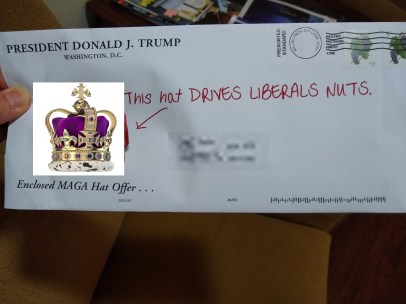
It occurred to me that Donald Trump, in running for president of the United States, wanted to be the head of state. He wanted all of the adulation and ornamentation that accrues to heads of state–monarchs, essentially. He wanted to be the persona of America (or his version of America) and emulate strongmen “leaders” and arbitrary sovereigns. He wanted the thrill of the large crowds cheering for him.

But he definitely did not want to be bothered with mundane things such as laws and regulations.

Trump’s insistence on on posing with a Bible in front of church for photographers on June 1, 2020–and forcibly removing racial justice protestors in the process–is a prime example of what a head of state would do, but likely not a head of government.

Just as importantly, his MAGA-hatted, Trump-flag-waving followers wanted a head of state too. This was demonstrated by the fervent devotion exhibited at all of his campaign rallies and most notably by the mob of rioters on January 6 who, in the name of keeping him as the “leader” of the United States, attacked and vandalized out of zealous loyalty to one man the very seat of our democratic republic.

I recognize that prior to America’s experiment in democracy, the identity of a nation was tied to “king and country.” This is what motivated people–Europeans mostly–to create colonies and subjugate other people.

But the creation of the United States and our written constitution was intended to do away with that, or at least the worst parts of it.

Interestingly, while in America we have a head of state who also is the head of government, there are several different ways of handling this, according to Wikipedia. These range form some power shearing to cases where the head of state has almost nothing to do with running the apparatus that implements the laws under which citizens live their lives.

Trump’s presidency–and the forces that put him into office–emphasize that our system perhaps is due for a makeover. The American setup is not the only way to do this, and it is a useful exercise to consider how we could modify our Constitution to make things a bit more reflective of the modern realities of our multicultural nation. To be blunt, if people want to elect a head of state, and that head of state has no interest in governing, then there’s a way to do that which is safe and quite possibly effective.

But we’d have to amend the Constitution and the odds of that aren’t great as long as we live under this pervasive political opinion that “They” are trying to get “Us” and that we are unable to function as a “We” as in “We the People.”

I for one would welcome some changes to how our country is run. All I have to do is pause and reflect on the fact that nearly 250 years ago, we fought a war and people gave their lives precisely so that we would NOT have a king in America. I think that was a noble cause, and these current generations would do well to uphold it.

Founding father and original patriot John Adams once said:

Power always thinks it has a great soul and vast views beyond the comprehension of the weak; and that it is doing God’s service when it is violating all His laws.

Speaking Up

I am an introvert.

There a number of ways in which introverts and extroverts differ, some of which are fairly obvious day to day and others that are more subtle. One of the ones that shows up rather frequently is that introverts think about what they are going to say, and extroverts talk so that they know what they think. Each can be annoying to the other but being self aware about which camp you are in helps when navigating social situations.

So, for myself, my tendency is to not speak until I have something to say. This carries over to social media (something that I’ve discussed previously here).

But in the new year, I’m resolving to make a change: to speak up more often when it is necessary.

And necessary it is in 2021. Because we have learned that there are real-world consequences to giving free reign on social media to extroverts, those who lack impulse control or self-awareness, and people for whom belief is more important than thinking critically.

I know a lot of extroverts (who doesn’t? They are a dominant force in culture). Many of them are lovely people, warm and friendly, kind and loving.

But the danger comes when many act before they think–which as I said before is part of their nature. And on social media it is SO easy to act before thinking. You click the like button or shoot off a nasty reply before you even process what you’ve seen or read. (The person who coined the phrase that it’s better to ask forgiveness than to ask permission was an extrovert.)

This is how things “go viral” (a term I hate, by the way). But it is also how things become a shit storm. People pile on, one thing leads to another, and before you can say “Facebook” you have a flame war on your hands.

Voices of reason–badly needed right now–are drowned out, buried, lost in the flood. Calm dialog is shouted down. Mob mentality prevails.

So I don’t truly believe that my effort will make any difference, at least not right away. But I do need to defy my nature and speak up when warranted. And not be upset by the inevitable nasty responses. Or apologetic without reason.

If civility is actually what we want in this country (doubtful, but it’s a worthy goal), then somebody has to get the ball rolling, Might as well be me, and maybe you too.

Don’t Like the News? Kill the Messenger

I’m not a journalist but I have worked with and around journalists for over two decades, something I have talked about before here and here.

Which is why I found it disheartening to read the story of the demise of LAWeekly as I knew it. While it is true that newspapers and other journalism outlets have struggled over the past decade or so in the face of economic hardship brought on by the internet (and to some extent, themselves), to learn that an established news outlet has been deliberately targeted for destruction is chilling.

Years ago, I read the LAWeekly and its sister publication the East Bay Express rather frequently when I was a college student in California. These “alternative” weeklies could always be relied on to provide thoughtful stories about local issues not covered in much depth by the bigger news organizations. (Washington, D.C.’s alternative weekly, the Washington City Paper, is still chugging away, but it’s sister paper, the Baltimore City Paper, folded in 2017.)

The story I read about how the LAWeekly has been gutted may contain some hyperbole–journalists are not perfect, and often they have an overblown sense of self and of the importance of their work, in my view.

But I have no doubt that the institution of journalism with its modern emphasis on fairness and accuracy is essential to the effectiveness of democracy and the protection of civil rights. To disparage legitimate journalism as so-called fake news–as President Trump does almost daily–creates a situation where fewer and fewer people trust facts, such as they are.

(It’s important to remember that the freedom of the press was important enough to the Founding Fathers that it is guaranteed by the First Amendment to the Constitution–alongside the freedom to practice the religion of one’s choice and ahead of the right to bear arms.)

According to this version of events from the editorial staff at The LAnd Magazine, the LAWeekly was bought by a “cabal of Republican donors and Trump supporters from Orange County” who are “devoted to defeating progressive ideas by indoctrinating young conservatives and infiltrating what they considered to be liberal institutions.” If true, this is another example of the hypocrisy of conservatives these days.

Conservatives themselves claim with alarming frequency that liberals are somehow “indoctrinating” or “brainwashing” people (if you want examples, leave a comment–I don’t want to unnecessarily drive traffic to people promoting falsehoods). The argument is illogical, however.

The conventional concept of brainwashing requires that someone is led by the intentional actions of others to believe something they would not have and could not have believed if left to their own thought processes. If a journalistic organization publishes verifiable fact, without attempting to manipulate its audience, and someone reads it and draws a conclusion, I can’t see how that, in any way, is brainwashing. (Note that conservative “news” manipulates its audience intentionally every day by distorting the facts and not questioning unsupported claims.)

Conservatives give lip service to individual liberty. However, conservatives are all too eager to oppose that exercise of personal liberty when individuals make up their own minds about their own lives and the lives of those around them in a way that does not conform to an established conservative point of view.

Conservatism, almost be definition, is threatened by new ideas and the reconsideration of how we as a society view the world. It is thus not in favor of personal liberty at all, but rather the adherence to a strict set of codes of (mostly old fashioned) behavior. If a news outlet such as LAWeekly questions those conservative “values,” it is seen as a threat to the conservative ideal.

A threat that, unfortunately, is sometimes targeted for elimination. So who is the larger threat?

Maybe this is an isolated incident and perhaps I’m over-generalizing (overreacting?). And maybe the ideal of having news that’s free of bias is a pipe dream. But the possibility that reasonable people cannot agree on some basic structures of society, such that we now have flavored news that meets our preferred tastes, is frightening.

“Participatory democracy depends on a broadly shared view of reality, and therefore on trusted institutions of journalism and mass media.” – Kevin Platt, University of Pennsylvania