The Trouble With Being American

I have no cultural identity other than “American.” I do not consider myself to be Irish-American or African-American or Hispanic-American or any other cultural identity that I can fall back on. So you can understand my displeasure at the current state of America.

The United States is my country. I was born here and have lived here all of my life. Going back to the early 1700’s, my ancestors have been born here, lived here, and are buried here.

This is the only criteria for American citizenship–be born on American soil (see the U.S. Constitution, 14th Amendment). There are no other criteria, tests, or qualifications.
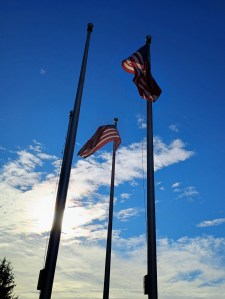
Some people try to make the claim that “real” Americans are those who typically exhibit outward displays of patriotism, have a simplistic view of our nation’s origins, and hold narrow views of what an American should look like. But there is nothing to support that claim. It is just personal opinion (that can be safely ignored).

Singing the National Anthem more loudly does not make you more American. Waving the flag more vigorously does not make you more American. Having more ancestors here does not make you more American. Serving in the military does not make you more American. Being Christian does not make you more American. These things simply don’t.

Unfortunately, these same people also claim to know what America really is (as opposed to what?) and refuse to acknowledge that there is, or even might be, a more expansive, messy, diverse, and complicated understanding of our country.

And the sad thing for me is, that version of the “real” America–the one currently being heavily promoted by Donald Trump and his MAGA co-conspirators–is not my America. It is not the America that I see, or ever want to see in my lifetime. Instead, it is some strange conflagration of illusions, misinformation, wishful thinking, and self-righteousness with large doses of self-delusion, racism, and xenophobia mixed in. (MAGA Americans like to say that those critical of their political positions must hate America. In my view, the America in the “Make America Great Again” is a fictional, made-up place that they somehow think we can return to, making such criticism absurd.)

So where does that leave me?

I am an American in an America that I don’t recognize. When the stars and stripes is displayed, how am I supposed to feel? How can I say I’m proud to be an American when the America that is currently on display is a cruel, mentally unstable place that goes against my integrity and inner sense of what an American is supposed to be?

Sadly, I feel that the America I grew up in, that I learned about in school and on the street, and that I believed in, is rapidly disappearing. Once it is gone, and replaced with something unrecognizable, what then?

Public Transportation, for the People

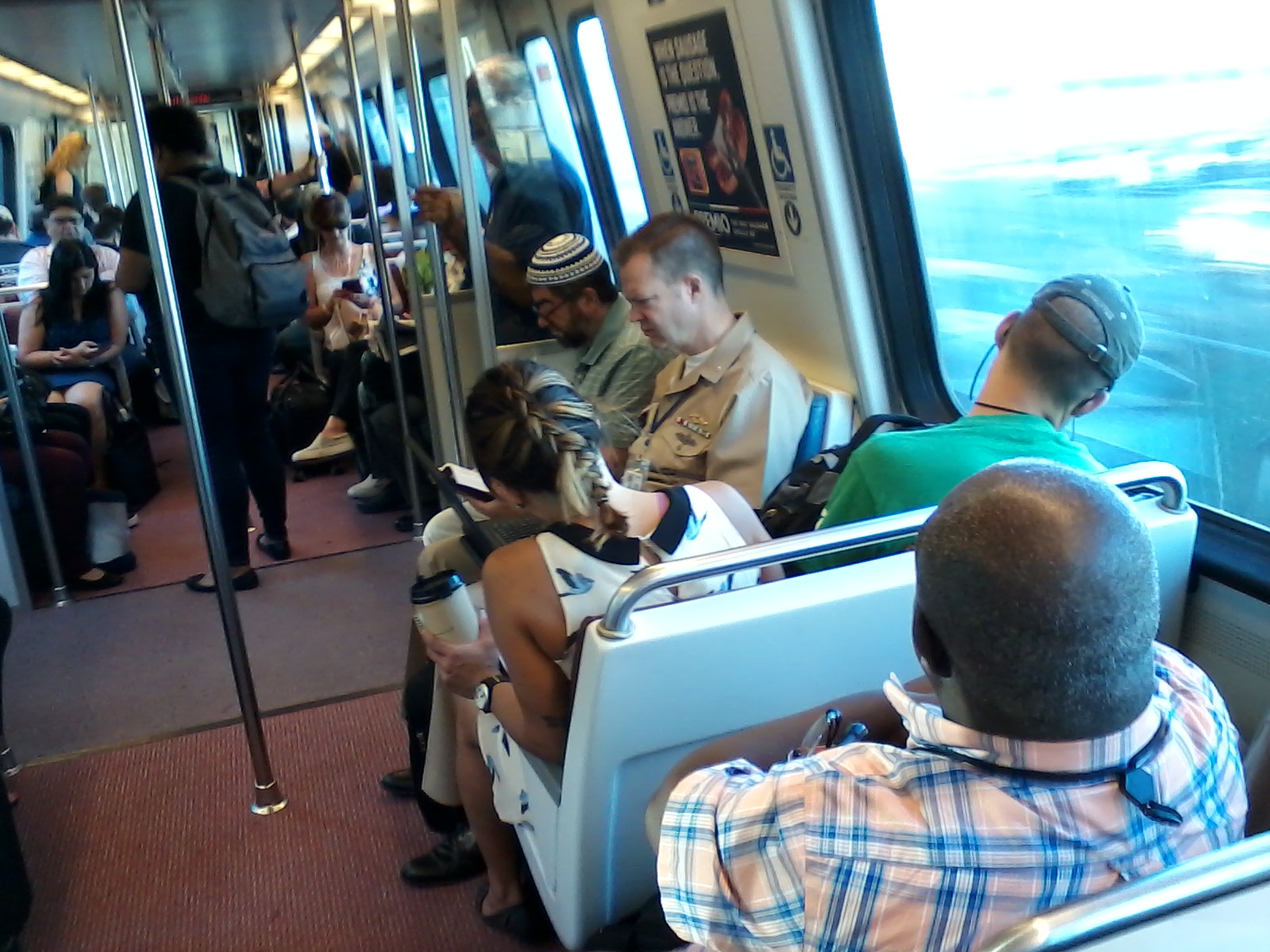
My seat on the Metro train has an empty Bacardi bottle and a lime wedge.

The guy in the seat behind me is dancing along with the music in his headphones like nobody is watching.

The woman in the seat in front of me is talking on her phone. The contact on her phone says My Boo.

Sometimes, the person sitting across from me is reading a book in Chinese, and the person sitting next to me is reading a book in Russian.

Sometimes, street dancers will board the train and perform to loud music as the train moves between two stations, asking for money before they exit to try again on the next train. This is technically not legal but it sure is entertaining.

Life on public transportation is rarely dull.

On the Washington, D.C. Metro, one will see a whole palette of humanity, from drunkards to lawyers to tourists and families. There is Black and White, Asian and Latinx. There is young and old, healthy and infirm, and plenty of Queer people. Sometimes it’s so crowded you can barely move. Other times I’m one of only a few people.

It’s always good to be aware of one’s surroundings, but it’s equally good to notice who’s on board with you. Sometimes I’m surprised when my first impression of someone is proven to be wrong, when they turn out to be kinder or more gentle than they appear.

Sometimes tensions do flare and voices are raised. It’s not always a simple matter to squeeze so much variety into an enclosed train car or bus. But I have yet to see, after decades on the trains, any true violence.

Not that there’s no violence in the Metro system because sometimes there is, late at night or in less populated stations. But it seems usually more to do with personal animosity and unrelated to the “public” part of public transportation.

Riding public transportation requires an unwritten social contract: I leave you alone to get where you need to go and you leave me alone to get where I need to go. Without it, the effectiveness of public transportation breaks down.

People sometimes violate this social contract by doing such things as begging for money, getting into arguments or shoving matches, or trying to talk to someone who does not want to be talked to, especially if it’s about politics or religion.

But they remain in the minority. Most people I ride with don’t try to turn the bus or train into a market or an exclusive place where some people are allowed to ride and others are chased away. Which is good because I imagine there is a tipping point where there would be fewer and fewer riders because they don’t feel comfortable or safe. As long as most people get onboard because the bus or train gets them where they need to go, public transportation will continue to serve its purpose.

I realize that public transportation has a reputation, and I think it is mostly undeserved. It seems to be based on media portrayals of the New York City subway system, which in movies is always a crime-ridden place filled with bums, garbage and graffiti. I have not ridden the NYC subway, but I have ridden public transportation in Boston, Philadelphia, San Francisco, London, Munich, Paris, Auckland, and of course Washington, D.C. My experience has been that, when public transportation is properly run and cared for, it is something that ordinary people find appealing and useful. It is not something that caters only to the dregs of society.

There are people who fear public transportation even under the best conditions. As a result, they travel in their own private vehicles, isolating themselves from the public as much as possible. But that solves nothing and only contributes to many problems.

In the old fairy tale of Beauty and the Beast, the Beast lives in isolation and scares everyone away because of his arrogance, hatred, and selfishness. It is only when he allows himself to be in the presence of others that the curse is lifted.

Change Comes from Within

A few years ago, a documentary aired on TV called 1968: The Year That Changed America. It was about how the events, politics, and social movements of 1968, in the words of the producers, “forever changed the modern American landscape.”

Except that, it now would seem that nothing ever really changed at all. America may no longer be legally segregated, but we are as much divided along racial, ethnic, and religious lines as we ever were. The federal government is in chaos and unable to effectively address the real needs of the American people. People are protesting in the streets nationwide. We have a president who is egotistical, unqualified, and more interested in scoring political points than actually governing the country. We have a media industry that is both part of the solution and contributing to the problem. We have an economy that works well for a few people and excludes many. We have people self-destructing through excessive drug use. We have a Congress that appears to be unable to do anything meaningful.

It would appear that we as a country have learned nothing, and it makes me wonder how that happened. It is as if we collectively have an underdeveloped ability to learn, to regulate our own behavior, and to make changes for the better. Perhaps we suffer from multiple personality disorder, that there isn’t just one America but many, many different ones.

Or perhaps we are in recovery from trauma, that the events of 1968 didn’t set us on the road to improvement but rather created the dividing line between before and after. Most people who suffer a traumatic event view it as a pivotal point in their lives, that they are not the same person after that they were before.

Maybe America continues to struggle with coming to terms with this new sense of self, and we’re not there yet. But are we trying? Sometimes I wonder. Many are, but are there enough of us to create true change? Is change gonna come? Or will we just anesthetize ourselves and turn a blind eye to the real work that needs doing?

I would like to think we have it in us to do the work. When we’re at our best, we do. But, as with anything, we have to want to change. And it is our loss of we don’t.

What is new about American police brutality towards black people? Why did it take the death of George Floyd for the people of Bristol to recognize that they had a monument to a slave owner in their city’s midst? The real question is not what should people do but will people go back to sleep or not? Will we have learned? – Dr. Gabor Mate


A genuine change must first come from within the individual, only then can he or she attempt to make a significant contribution to humanity. – Dalai Lama