During my junior year at Whittier College, I was the managing editor of our student newspaper. We put out an issue every week throughout the school year, which involved the combined efforts of a diverse mix of students who reported, wrote, and edited the stories, took the photographs, and handled the layout. I have fond memories of that time.
In each issue there were a few column inches of space set aside for an editorial. The editor-in-chief and I traded off each week writing the column. Most of them were last-minute compositions, often little more that whatever was on our mind that day. Some were pretty good. Others were not.
This being the 1988-1989 school year, the AIDS epidemic was on everybody’s mind to some degree. One week I wrote an editorial column that essentially repeated the conspiracy theory that the World Health Organization (WHO) was responsible for creating the human immunodeficiency virus (HIV). I spent no time researching this topic and thus was simply repeating a rumor without bothering to consider the implications.
After that issue was published, I got a stern talking-to by our faculty advisor Gary Libman, a professional journalist at the Los Angeles Times and Whittier alum. He calmly stressed the importance of journalistic integrity and the need to critically assess and publish the facts, even in an editorial. He reminded me that as editors of a publication we have a responsibility to our readers that includes avoiding giving voice to rumor, hearsay, and misinformation. He was clearly unhappy that my column made it into print. Although he did not force me to issue a retraction or an apology, he probably wished he had been able to intervene before our publication date.
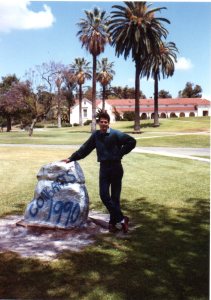
Me at Whittier College in 1990
This event from almost 40 years ago clearly made an impression on me. And I didn’t have to be told twice. I regretted my mistake, took Gary’s lessons to heart, and used this teachable moment as a chance to learn.
Because that is why I went to college–to learn. It sounds strange to have to say that, but it seems that more and more I am hearing about people who go to college not to learn but for some other reason. These include:
- to get a job (a fine goal but not mutually exclusive of learning, one would hope)
- to make a lot of money (education provides riches that money can’t buy)
- to get The Degree (which feels more like the checking of a box than actual learning)
- to be told things that align with your existing worldview (challenging assumptions is exactly what college exists for, so this makes no sense to me)
- to play football (college is an educational institution first and foremost, in my view)
- to get phenomenally drunk as often as possible (a classic college activity but not conducive to learning)
- to get laid (again, classic but you can do that without having to pay tuition).
I’m going to be clear and say that I think these reasons are all bullshit, and here’s why.
College is a place that provides one of those rare opportunities in life: it places the individual student into a learning environment that is probably the richest they will ever encounter before or since. And by “learning environment” I mean both inside the classroom, on campus during non-class hours, and in the surrounding community. During my years in college, I was far removed from my sheltered suburban life, having to interact every day with people who were different from me and see through their eyes how they viewed the world.
College also is a place where faculty puts time and effort toward growing real, human intelligence, not artificial intelligence.
Furthermore, college is usually attended at an age when young adults are the most open to these learning opportunities. We are very much like sponges at that age, soaking up these new experiences and using them (hopefully) to help us shed the prejudices of our upbringing.
But the student must be willing to learn. Evidently, there are people who manage to get through four years of college without learning a thing. This is pointless. It is a waste of money and a waste of both the students’ and the professors’ time.
Sadly, the confluence of a variety of factors including market forces, academia that does not easily acknowledge or embrace change, and a growing distrust of our basic societal institutions such as schools, churches, and government has brought us to the brink of disaster as a nation.
This impending disaster wears two faces. One is the face of those young people who view college as just something to put on your resume, as a thing you do leading from here to there. These people are going to college only because they feel they have to, or their parents insist they do, or they think they want the ‘college experience’ (see drunk and getting laid above). Some of these maybe will emerge on the other side having been changed by the experience, and we’re lucky if they do.
The other face is of those who see college as an outright “scam” to be avoided. These are people who should be going to college–any college–but are not. And thus we have a growing number of citizens who have access to some of the best higher education in the world but instead are turning away.
To be clear, I agree that the academic demands and the traditional structures of college means that it is not suitable for everybody. However, the things college teaches–critical thinking, awareness that there is more than one way of seeing things, learning that life is more than just grubbing for money–are very suitable for every person who wants to live in our multicultural, modern society. If they don’t get those things from college, I hope they get them from somewhere.

