The Middle-Aged Man and the Aging Parents

I am just shy of 60 years old and both of my parents are still alive. I’m pretty sure this is unusual and puts me in the minority.

Most of the people who are my friends or acquaintances have at least one parent who has passed on. The fact that I have both still above ground puts me and my brother and sister in a small club.

According to research conducted last year, 45% of people who are 59 have at least one parent still alive. That drops to 10% when turning 60. Other research says that upon reaching age 50, the percentage of people who have both parents still alive is around 40%.

To be frank, to have both parents still alive at this stage of life is a blessing and a curse. It is a blessing of course for the obvious reasons; I am able to talk with them, either in person or on the phone, and thus am able to share in their lives for a little bit longer. It is a widely held belief that people like me are fortunate to have both parents still around.
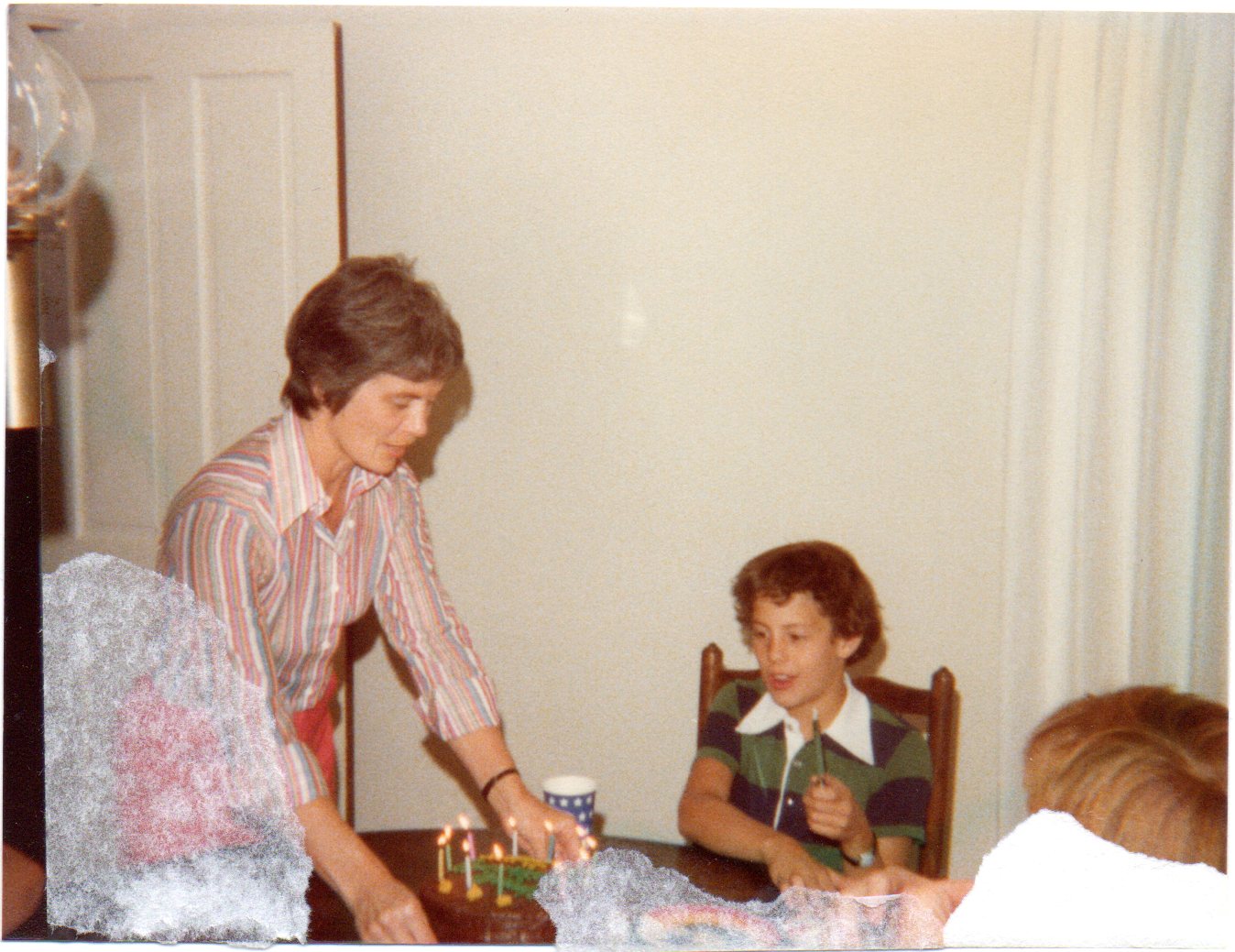
My mother presenting me with a birthday cake, August 1978

But there’s the other part. I would have thought that by the time I was 60 I would be out from under the scrutiny of my parents, free to live my life on my own terms. I have a wife and children to consider; I don’t enjoy having parents to consider as well. They are both set in reasonably comfortable living situations in continuing care and retirement communities (separately because they are divorced). But with every year I and my siblings are taking on more and more responsibility for their financial and health needs, things they can no longer sufficiently do for themselves or that the CCRC is unable or unwilling to do.

I’m not suggesting they depart to suit my needs. However, each passing year adds to the strain. I know it won’t go on forever but there’s a part of myself that I hold in reserve that is directly related to this situation. When will I visit them next? And which one do I visit next, since they don’t live in the same CCRC, or the same city for that matter? What if I have to travel to one of them on short notice because of a medical or other crisis? Is each visit going to be my last visit? Do I need to be still concerned about their expectations for me? Is there something between us that remains to be said?

None of these would be an issue in an alternative situation.

Much as been made of the sandwich generation, often defined as people with at least one parent still alive and at least one adult child receiving financial support. To the casual observer it seems like a minor issue but I’m here to tell you, it is not.

Among other things, parents present something of a conundrum. They beget you in a moment of intimacy that lasts a few minutes at best. Then you are their child for eternity–for better or for worse. It is often said that we don’t choose the families we are born into. Instead we have to make the best of the situation we find ourselves in, and that situation can create financial or emotional pressure that at times can be unpleasant.

In some cultures, much is expected of children with regard to their parents. This includes honoring all of their wishes and financially supporting them through death and burial. If there are people–and I know that they are out there–who have long-standing disagreements with their parents and yet still must honor their wishes and financially support them, I imagine that can create a serious strain.

I am not in that position, thankfully. Even so, I often wonder what it will be like when the day comes. Will I weep? Will I feel relief? I don’t know, and cannot know, until it happens. Because I am just shy of 60 years old and have never known a day in my life without my parents.

The Professional Network

By his own admission, my father had a great career.

He spent three decades, through the 70s, 80s and 90s, as president of a major commercial printing operation in San Francisco. Customers included many of the city’s important businesses as well as several of the new Silicon Valley companies such as Hewlett Packard and Apple.

He successfully steered the company in the face of rapid change throughout the industry brought on by computer typesetting and graphics.

My dad’s business card.

He retired at just the right time, before commercial printing in San Francisco became essentially a thing of the past.

Now in his 90s, he has maintained relationships with people he met throughout his career, and he remains almost universally well-liked.

I had hoped my own career would come close to emulating his. Unfortunately, I have fallen very short of the mark.

There are a number of reasons for that, which I have discussed before. One that I will discuss here is the cultivation and maintenance of business relationships.

My dad was from an era when those relationships were everything. There was no social media or internet. Relationships were maintained through time spent in person or on the phone.

We didn’t go on vacation with the families of his colleagues. But we did have dinner at their houses, and they came to dinner at ours. He had lunch almost every work day with a colleague. (In contrast, I usually eat alone.)

My dad also had connections with many people not in the printing business. He kept in touch with former classmates, with other business leaders, and was active in the local chapter of the Rotary Club. All of it was important to him.

He once told me that, if one of his friends or colleagues said to him “My son needs a job” he would find that person’s son a job at his company. And he expected the same consideration in return.

Whether that was common for the time or just something my dad did, I don’t know, but that sure as hell isn’t what’s happening today. I admit that I have not cultivated relationships the way my father did, but I know people and I have former classmates. And this has been my experience:

Over a decade ago I began to think about a career move. I had some ideas and I started talking to people. I went to lunch with a experienced lawyer and asked for help with a career change. The most he did was look over my resume and say “Washington is an information town. I’m sure you will find something.”

I sent my resume to a member of my church, asking for help with getting a job in her organization. All she did was suggest that my resume should be formatted properly.

I sent an email to the then-managing editor of the Atlantic, James Bennet, asking for help landing a position with the magazine. This was at my dad’s suggestion, since he somehow knew Bennet through his network of connections. Bennet emailed back to say that he forwarded my resume to his HR department. I heard nothing further after that. (At least he responded. Some don’t have the courtesy to do even that.)

When I got laid off in 2009, my search for a career change took on a new urgency.

A friend put me in touch with a friend of theirs at the EPA. I scheduled an appointment to meet and ask for help landing a job there. He looked at my resume, but all he would offer was to say “We are always looking for smart people here. ” I never heard from him again.

I tried contacting someone locally who went to the same law school as I did. I didn’t know him personally, but I recalled my dad’s words about all it should take is to say that I went to the same school to open doors. I sent this guy emails and regular mail. I never heard back, not even to acknowledge receipt of my mail. Literally no response.

The sister of an acquaintance worked at a firm that placed temps in law firms. I met her for an interview. I never heard from her again.

And so it has gone, time after time.

I’m not entirely sure where I veered off course. Maybe I should not have asked for help, been more bold, told people what I can do for them, all the things that career coaches say to do.

But help was what I needed, and I wasn’t too proud to ask.

Which raises questions about the culture of work in America today. Much has been said (too much in fact) about how “no one wants to work.” And yet when someone is literally begging for assistance getting a job, backs are turned.

Maybe I was seen as a bad risk. I will never know for sure. No one is talking to me.

*****

Epilogue: Once I told a friend that I felt as if I had been blacklisted. He said “How can you be sure that you’re not?”