Religions of the World and A World of Religions

There was a period of time when the term “Turk” was synonymous with “Muslim,” even though Islam originated from Mecca, Arabia.

Most Turks are Muslim, but any Turk will tell you that they are not Arab.

Kurds are Muslim but are neither Turkish nor Arab.
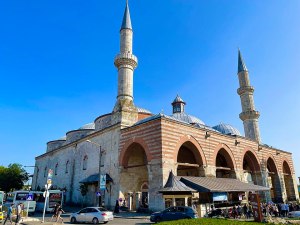
Old Mosque, Edirne, Turkiye. Photo courtesy of Wikimedia

Moroccans are predominantly Muslim and speak Arabic but do not identify as Arab.

The Lebanese are usually classified as Arab, but there are Lebanese Muslims and Lebanese Christians.

The nation with the highest population of Muslims is Indonesia, where they are neither Arab nor speak Arabic.

The people of Pakistan are predominantly Muslim and their official language is Urdu. Urdu is essentially Hindi, but is written in Arabic script, whereas Hindi is written in Indic script. People who speak Hindi are predominantly of the Hindu religion.

The people of the Balkan countries of Croatia, Serbia, and Bosnia are Slavs and all speak a language that is mutually understood among them all. The only thing that separates them is that Serbians are Orthodox Christians, Bosnians are mostly Muslim, and Croatians are Catholic.

Most Latinos identify as Catholic, but for many their religious practice incorporates elements from pre-Hispanic, indigenous faiths that do not align with what is in the Bible and are not sanctioned by the Vatican.

I could go on, but I think the point is made. Religion is, paradoxically, something that both unifies and divides people. For many, one’s religion is both a form of practice and something internalized as a facet of one’s identity, much like ethnicity and language. Many will say that their religion is the true religion and all others are wrong, each pointing at the other.

In addition, it’s tempting to assume that the people who adhere to a particular religion all act the same way and believe the same thing, the concept of a cultural monolith. The reality is that religion, like culture, is diverse and messy. A statement that begins, for example, with “all Muslims are…” will likely miss the mark.

With this in mind, if religion is a search for truth as some would suggest that it is, it seems worth examining why there are so many different religions, different versions of the same religion, and different interpretations of religious doctrine and ritual.

Some say that religion causes more problems than it solves. I say that it is the misapplication and misinterpretation of religion that causes the problems. It is the conflation of cultural preferences with religious truths. It is making religion your cultural or political identity in the place of following the actual tenets of the faith that leads to problems. It is the imposition of “the one” religion upon others who may disagree with that assessment that creates conflict.

If we acknowledge that some people feel they need religion to get by — irrespective of who is “right” — wouldn’t it simplify things if we could whittle it down a bit, such that we have those who follow a religion on one side and the non-religious on the other? Couldn’t we then at least identify that something is being done because of religion, instead of dressing it up as nationality, ethnicity, or political leanings? It would be far more transparent, while also not muddling the religion they claim to represent.

In the meantime, there are hundreds of religions, with hundreds of permutations within each religion, and the only logical way for all of this to coexist is religious tolerance. Get rid of dressing up political rallies as religious events. Dispense with declaring that some form of cultural practice is ordained by a god. End the practice of committing violence against those who don’t believe as you do.

And get back to a place where religion actually provides harmony and value, a place of faith, hope, and love.

****

“Today, religious tolerance and cooperation among Americans cannot simply be a pragmatic or utilitarian undertaking, a mere accommodation to the fact of diversity. No, the source of your commitment to religious freedom is itself a deep religious conviction. Religious tolerance is based on the conviction that God wishes to be adored by people who are free: a conviction which requires us to respect and honor the inner sanctuary of conscience in which each person meets God.” – Pope (now Saint) John Paul II (1995)
Truth (But Not Truth Social)

In the spirit of Independence Day, I hold these truths to be self evident.

(In no particular order.)

Everyone’s well being rests on three pillars: a gainful way to make a living; access to health care; and a community of support.

There are good things decent people do when no one is looking.

If this brings me joy, and it’s not hurting you, why does it matter to you?

The world makes more sense if you realize that most people have a reason for being the way they are.

We are more alike than different. We just need to have a shared understanding of what it is we are all talking about.

Love the prodigal, and be patient. See the person fully worthy of moral concern, extending love beyond the prejudices of your upbringing.

We are all on a journey toward acceptance, and some get there sooner than others.

Historically there are people who have a point of view that has been marginalized or silenced.

Science does not replace religion. But science does replace cultural traditions that masquerade as religion.

There are too many arguments that suffer from logical fallacies, based on emotion and ideology, the setting up and knocking down of strawman arguments, and the selective cherry picking and misuse of facts.

We must not support stating beliefs as “truths” that cannot be challenged.

I am divesting from militarism, from war, and investing in community, healing, and true liberation.

Liberalism creates freedom by lifting barriers and creating opportunity.

Tyranny is the arbitrary, unjust, and unrestrained exercise of power, usually executive power by few or one individual.

The State cannot demand that a pregnant person sacrifice their life, their fertility, or their health in service of “unborn life” particularly where a pregnancy will not or is unlikely to result in the birth of a living child with sustained life.

The biggest impediments to business are social inequality, civil unrest, corruption, and environmental degradation.

When high government officials have businesses, you have a conflict of interest. They are not looking at the country’s interest with these projects. They look at their own interest first.

In our times we see an increasing trend for people in the public eye to display ghastly levels of narcissism. These foul-mouthed, low-intelligence, often wealthy sociopaths, devoted to self-aggrandizement and the debasement of anything truly admirable, demand not only our unreserved celebration of their psychosis, but compliance with their ever-changing immoral opinions.

Prejudice, bigotry, and fear are setting the agenda.

The lesser man will win because he is playing to people’s ignorance. He offers empty dreams, but he is giving every voter a bag of rice, and they all want to believe him.

Criminals lie.

Beware of anyone who declares they’re the only one who can solve the crisis and seizes power indefinitely.

Being convinced of your own greatness is one of the surest signs of being crazy.

The Many-Hued, Messy Faith That is Christianity

I was raised in an evangelical Christian church. I no longer identify as an evangelical. More on why that is some other time.

The thing is, when I was younger, I used to get annoyed by how TV and movies seemed to always depict Christians as Catholics.

Growing up, my church taught that Catholics were not good Christians. They spent too much time on ritual and ornamentation. There was too much memorization of formulaic prayers and not enough memorization of Bible verses. They took their orders from the Pope rather than directly from God (as interpreted by your local pastor, of course). Their faith was too impersonal.

So as a young evangelical Christian, I never identified with the Catholics portrayed onscreen. They may as well have been Muslims, as far as I was concerned.

These days, I don’t really care that “Christian” is equated with “Catholic.” I think it is just easier for the storytelling, so that the audience can readily identify the character as “Christian” and not Jewish or Muslim or Hindu or Buddhist. Of course that assumes that the audience is not seeing “Catholic” as opposed to Methodist or Lutheran or Presbyterian or Greek Orthodox or Jehovah’s Witness or Quaker or Assemblies of God.

Because Christianity does come in many, many flavors. Over the centuries, Christians have diversified into an almost countless number of denominations, sects, cults, and systems of belief. There is no more one type of Christian than there is one style of ice cream.

This is true in spite of the fact that on a regular basis, someone attempts to speak for all Christians. The Pope is a good example. The office of the Pope is intended to be the recognized head of The One Church, Universal and Catholic. What about everyone else? Don’t know; don’t care.

Another example is the increasingly insistent whine of culturally conservative people who identify as some form of Christian. They say various untrue things like “Christians are being silenced” or “Christian voters are being demonized” or “Christians don’t believe in vaccines.” They incorrectly say that to be a “real” Christian you must vote for certain candidates and be in favor of certain cultural, racial, and economic policies (Fun Fact: Jesus said none of these things.) These spokesmen, these self-anointed prophets, tell you what to think, how to read your Bible, which interpretations are approved and which are not.

But that’s just not how Christianity, as laid out by Jesus himself, is. It is varied, diverse, open to many, caring and loving.

There is a saying that’s been around a while in faith circles:

In Essentials: Unity
In Non-essentials: Liberty
In all things: Charity

We could use a bit more of that right about now.