My Facebook Experiment

A few years ago, I joined Facebook. Reluctantly.

The members of the band I was in at the time thought that social media was a good way to publicize our gigs. Everyone else in the band was already on Facebook, and I thought it would give the wrong impression if the bassist were the only one who was not. Up until that point, I didn’t see the value of it. Facebook

So I joined. But I had one condition.

I felt that if I had to be on Facebook–if it wasn’t my idea–then I would do it on my terms. And my terms were these: with a few exceptions, I would not initiate friending anyone; I would wait for them to friend me.

I thought it would look phony if, after having dismissed social media, I suddenly joined and started friending everyone I could think of. Also, and more importantly, I wanted to gauge the level of other’s interest in being connected to me. One way to do that was to wait and see.

And you know what? Very few people have friended me. The usual suspects have–I could have predicted with 95 percent confidence the small number of individuals who would friend me–but a surprising number have not. For example, there are some people with whom my wife is barely acquainted–but who I have known for years–who have friended her, but not me.

I have to wonder what that means. Does that say something about me, or about them?

I would like to blame Facebook’s automated “find your friends” feature, which mines your address book and friends everyone whom you may have, at some point in your life, listed an email address for.

But, more likely, it is that I have some fundamental misunderstanding of the rules of social media, because they are essentially the same rules that govern social interaction in general. It has something to do with how attractive you are, how talkative you are, and how comfortable you are with the medium. Things like intelligence and humor do not come across well on Facebook.

And if that feels like high school, it’s because…well…it is like high school. In a recent article in New York magazine, writer Jennifer Senior points out that research indicates that all our social skills–the ability to pick up on cues or fail to do so–we learn as adolescents. Quoting work by Gabriella Conti, she says ” ‘Adolescent popularity,…it’s about interpersonal relations. High school is when you learn how to master social relationships—and to understand how, basically, to play the game. ” Or don’t.”

Underlying all of this is being able to effectively interact with people and make yourself interesting to others. This is a skill that is, for the most part, independent of media, although Facebook does amplify the extent to which one has mastered it, thus requiring the refinement of one’s social toolkit to avoid being annoying.

I’ve heard people say how connected they feel on Facebook, but these are people who were already connected in the real world. For me, Facebook has not upped my feeling of connection. Rather, it is one more avenue of communication that I suck at. Most days, instead of updating my status with some inane personal detail, I find myself thinking, “Why bother?” and “Who cares?”

The bottom line is that social media is little different from any other social situation. Those who understand the rules are rewarded, and those for whom the rules remain mysterious are marginalized or even penalized. I know of a number of people who’ve tried Facebook but have since deactivated their accounts. “It just didn’t work for me,” one guy told me.

I continue to use Facebook on occasion. Often I go more than a week without even logging in. Sometimes I wonder why I use it at all.

The Enigma of Hair

For nearly 15 years, I hated my hair.

I know what you’re thinking–it’s a long time to be in conflict over something about which one can do little. A few years back, I reached a sort of truce with my hair and began to accept it for what it was. But it is an uneasy truce, one that threatens to erupt into conflict again at any moment.

So you can imagine my surprise when a woman I’d never met before stopped me recently to tell me I have “gorgeous hair.” I was flattered. Furthermore, it made me reassess my feelings about my hair.

Me at 4 years old.

Me at 4 years old.

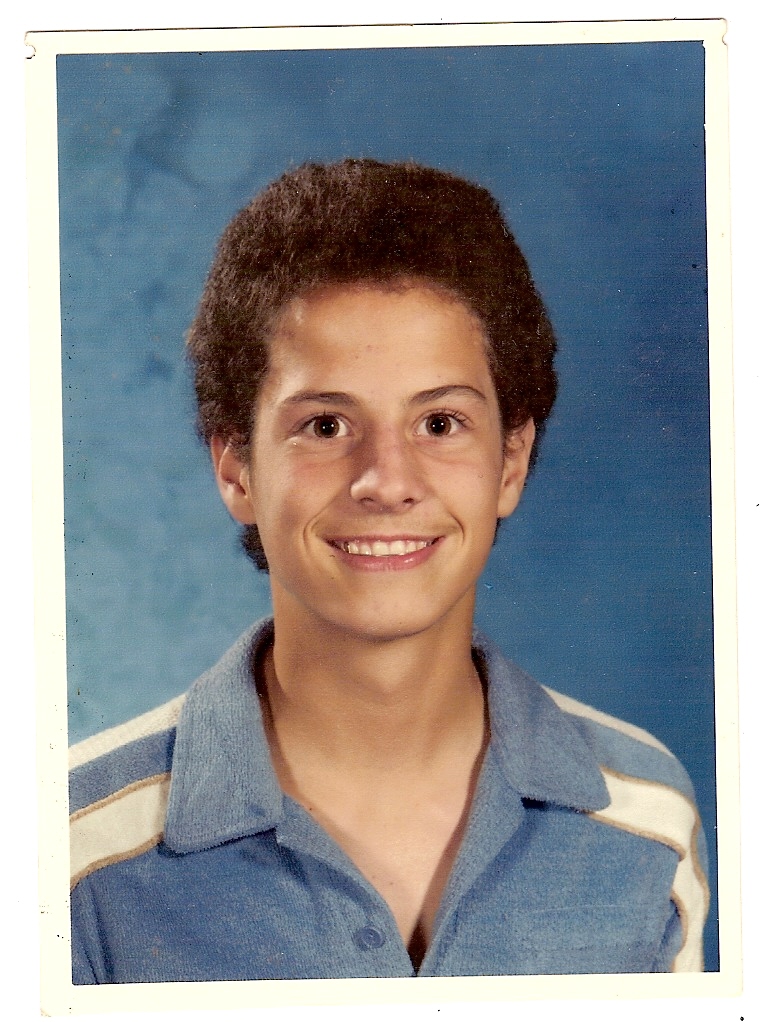
When I was born, I had straight, blond hair. Somewhere around 8 or 9 years old, however, it began to darken and curl. Having lived with one kind of hair up to that point, I was unprepared for this change.

Curly hair does not run in my family. Both of my parents have essentially straight hair. Of my two sisters, one had straight-as-straight-can-be hair, and the other has what I would call wavy hair. My younger brother has wavy hair too. Mine is undeniably curly.

My mother tried to blame the change on me, that I was not taking care of my hair properly and so causing it to curl. In hindsight, I see how ridiculous this is, but at the time, I listened to my mother. So I washed it excessively, combed it excessively, and tried different hair cuts, all in an attempt to bring back the flaxen hair I had. It was no use.

Me at 11 years old (with orthodontics).

Me at 11 years old (with orthodontics).

I was at a loss for how to care for my new hair, and in fact was doing more damage than if I’d just accepted it and let it be. This being the late 70’s, what I wanted was hair like David Cassidy–long, rich, flowing hair. I tried to grow mine longer, but it went cockeyed, poofed, and frizzed. I looked more like Gabe Kaplan, and I wasn’t amused.

Hair is a strange thing, if you think about it. Every other mammal on the planet is either completely covered in hair or is completely naked. People, on the other hand, have this strange patch on the tops of our heads. It doesn’t seem to serve any functional purpose, so we create meaning for it. Native American men grow their hair long as a symbol of their strength and cultural identity. Sikh men grow long hair as a symbol of piety. Buddhist monks shave theirs off, also to show piety.

Me at 15 years old, with frizz in full swing.

Me at 15 years old, with frizz in full swing.

It’s hard for an individual to be accepting of what one’s been given when culturally we don’t seem to know what to do with our hair.

To this day, I normally don’t think of my hair as an asset.  So to have a complete stranger tell me my hair is gorgeous came as a bit of a shock.

“Really?” I said.

“It’s like Richard Gere hair,” she said, smiling.

Wow. Who knew?

All of Life is a Performance

All of life is a performance.

When you get up in the morning, you enter the stage and you don’t exit the stage until you go to bed at night. All day long, you are in front of the audience, both your admirers and critics. And just to keep things interesting, it is always improvisation. There is no director, no stage manager, no script. We each must seek our motivations and speak in character.mic3

As with all performance, you will have some “on” days and you will have some days when you are really off, days when you’ll want to hide backstage and not re-emerge until the next show. You will sustain injury and heartbreak. You will experience an entire change of cast. But the show must go on.

If you act out of character, or refuse to appear, you may be boo’d or deserted by your fans. Critics will wonder aloud what happened to your mojo.

When the performance is over, when the show finally closes, your obituary is your review. The friends and the critics will finally weigh in on what they thought of you. Sadly, you will not get to read these reviews. In fact, while the performance is running, you may never know for sure what anybody thinks. But you must perform anyway.

Because all of life is a performance.

[With a tip of the hat to Erving Goffman. I’ve not read The Presentation of Self in Everyday Life, and can only say that this piece was born of my own experience. But I did read Asylums in college and was deeply impressed.]

The Virtue of a Pigeon

I pass the same pigeon on my way to work each day. Her plumage is white with brown patches the color of wheat toast. When I approach her, she does not startle and bolt, or dodder around goofily like most pigeons.  She just calmly keeps doing what she is doing, pecking and scratching for whatever bounty city grass might provide.

Photo: Alexander James Stock Photography

Photo: Alexander James Stock Photography

But all pigeons are the same, you say.  They look the same and they act the same.  They even seem to think the same, with a collective consciousness that, like The Borg on Star Trek, give them no identity, no individuality.  But this one is different.

She has a beau, I think.  He’s a typical black-grey-and-white pigeon who is always nearby.  He’s the one who looks ready to burst into crazy-eyed flight when I walk past, but not her.  She’s the sensible one.

As a species, pigeons (Columba livia) suffer from a bad reputation.  Originally imported to this country for food, they’ve now become naturalized citizens, inhabiting the gritty spaces of urban America. A biology professor of mine once called them the rats of the bird world.  In some cities, peregrine falcons hunt them as a means of population control. People are happy to let this happen because falcons, after all, are much cooler than pigeons.  When I lived in Burlington, Vermont, in the early 1990s, the city government decided to poison the town’s pigeons but underestimated the dose.  For several days, dazed and dying pigeons wandered the streets like intoxicated homeless people.

Such malice arises from a contempt bred by familiarity. But if you can see beyond it, you’ll find that pigeons have their virtues too. For instance, they are amazingly skilled flyers.  Watch them slicing through narrow city spaces, under bridges and around cars, and you’ll know what I mean.  Also, they have the ability, thanks to their fantastic breast muscles, to become airborne from a standstill.  Imagine suspending your entire weight in thin air with a single downbeat of wings. It sounds impossible, yet pigeons do it every day.

That is not to say they are particularly smart.  In Burlington, a pair of pigeons would nest on the stone window sill outside the office where I worked.  The nest was spare, so their egg would essentially sit on the stone.  If the egg happened to roll off, they would just lay again in the same place.  Another time, in Oakland, California, my soon-to-be-wife and I were entering the courthouse to purchase a marriage license when we heard a dull thunk from above.  A pigeon flying full-throttle had collided with the large windows above the entrance, dropping dead at our feet.  We chose not to take it as an omen concerning our marriage.

Perhaps if pigeons were smart, they would become dissatisfied with their station in life and we would have a great pigeon revolt on our hands.  Cities the world over would have to mobilize to quash the rebellion.  Overnight, squab would become a featured entrée on restaurant menus.

But my pigeon seems happy.  She looks healthy, and perhaps that is happiness to a pigeon.  She has companionship aplenty in this town.  In addition to her suitor, pigeons by the scores socialize at virtually every public space with a statue where birds can congregate.

My pigeon most likely was born in this town and will die in this town.  She will raise a few babies and scratch out a living.  She will do what she can to stay cool in the summer and warm in the winter, but her life will pass quickly by, not remarked by anyone.

Anyone except me, that is.  I’ve noticed her, and perhaps she has noticed me.  Each day, we nod greetings to each other and then go our separate ways.

Note: It has been several years since I first wrote this. My pigeon is most likely long gone.

Clues

Imagine that you were transported to a world where everything around you seemed improbable. Where what you saw and what you heard seemed distant and alien. Where both your sorrow and your happiness felt bizarre and unexpected, and unexplainable. You would look around yourself, at all the things you were doing and that were happening to you, and you would wonder if they were actually occurring, or whether it was all just a product of your imagination, a beautiful or horrible dream.sidewalk

So you would search for clues, some kind of confirmation that this was really happening. You would search for words on a page, the touch of a stranger, the knowing look in another’s eye that would say to you “Yes! I feel it too—I am experiencing what you are experiencing. You are not alone in this strange and bizarre world.”

And you would never rest—no matter how weary you became, or how many obstacles you faced—until you found the evidence that what you were seeing and hearing and feeling were real.

Because you would know that if you ever came to believe it wasn’t real—that none of it ever really happened—then you would invalidate your experience. You would invalidate your very existence. You would cease to be an individual and would forever doubt the reasons why you ever lived at all.

Do not deny the improbable.  It may be all you have.