Finding My Way Along the Career Path

“Why don’t you go to any professional development seminars?” my boss asked me once. She wasn’t just my supervisor; she was the division head. Since our division was relatively small, I had frequent interaction with her. Rarely did she ask such a pointed question.

I mumbled some reply and moved on to another subject. But it was a valid question. I had done little in the way of career development training and it left me with a vague feeling of dissatisfaction. And now I know why.

I didn’t know what career I was in.

Back in 1994, I joined a journalism organization with the intention of becoming an environmental journalist. Think Bill McKibben. I started as a researcher but figured that, before too long, I would be able to move up to more prominent writing positions. Years went by, however, and I ended up not doing much journalism. I am partly to blame for that because I was, I now realize, ambivalent about journalism in general.

In college, I worked on my student newspaper but never took a journalism class. After graduation, I tried to write for newspapers, but never applied for a staff position. Writing held an allure for me, but pursuing journalism for its own sake–all that interviewing and beat reporting–did not spark my interest.
23

After college, I saw two paths to where I wanted to go. One was that of the environmentalist who was also a writer. The other was the journalist who specialized in the environment. I preferred the former but left myself open to the latter if the right opportunity presented itself.

I once asked an editor whether he was looking for the environmentalist writer or the specialized journalist. “Journalist,” was his answer. I was dismayed because I did not believe that journalism was the only path to being an effective writer.

In the area of nature and the environment, some of the nonfiction writers who I admire the most–Annie Dillard, David Gessner, John McPhee–do not consider themselves journalists at all.* And in spite of that–or because of that–I feel they have contributed the most to the conversation. Not needing to fit into the constraints imposed by modern-day journalism, they are free to push the boundaries.

Journalists appear to believe that they have exclusive access to the facts, and that writers who are not journalists are sloppy or unable to grasp the story. Journalists act as members of a club–the Fourth Estate and all that–and consider writers to be wannabes lingering around the fringe. (Writer Joan Didion refers to “the contempt for outsiders” in her article about journalists and the political types they report on.) Needless to say, I disagree.

To many people, the terms “journalist” and “writer” are interchangeable, which is not surprising since the majority of the current generation of writers came up through the ranks of journalists. But it’s worth asking whether that was just a historical coincidence. Today, when news is published on what one writer calls “the vaguely Soviet-seeming syndication-fed news pages,” journalism and real writing seem to be drifting further and further apart.

Frankly, journalism as a career path for a young writer is dying. The website CareerCast, in its annual Jobs Rated report, lists newspaper reporter as the number one worst job in America in 2013. “The opportunity to climb the [career] ladder disappeared,” says one reporter who was interviewed. Furthermore, according to one recent poll, only 28 percent of the public think of journalists as contributing a lot to society’s well being. This does not make for an enticing career choice.

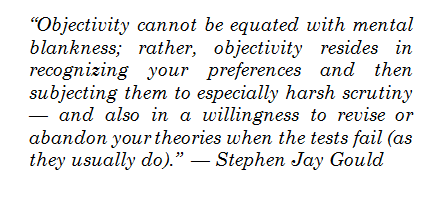
The writing I’m interested in is less about a recitation of the facts than the finding of greater truths. To do that, writing must have a strong voice and an informed point of view. Journalistic objectivity doesn’t allow for either of those.

Gould

I’m no longer afraid to make known my lack of journalistic ambition. Journalism is not my career, and being around journalists day after day has not provided the professional development that one would expect from over 15 years on the job. I’m not entirely sure where I’m headed, but I’m sure of one path to avoid.

*McPhee, in a piece in the July 2, 2012, issue of The New Yorker, refers to himself as a “writer of long fact” and that he teaches “factual writing.” Another writer who I deeply admire, William Langewiesche, studied anthropology in college and “does not want to be viewed as a straight news reporter” according to one interview.

 [Do you think you might be in the wrong career? Take The Glenn O’Neill Test and see.]

Exercise and It’s Discontents

I crossed the finish line. My time wasn’t great, but I completed the 12 kilometer San Francisco Bay to Breakers race. In 1986, I was young, slim, and reasonably fit. From what people said, it sounded like fun, so I did it.

And how did I feel? Honestly, I felt neither exhausted nor euphoric. I felt nothing, really, except the pain in my knees the following day. It was a task I set out to do, and I completed it. I had no doubt that I would. And I had no expectation that I’d get the “runner’s high.”

Twio X | Parkour Leipzig
I’m still waiting for the day when exercise releases endorphins into my brain, giving me that euphoric feeling after a strenuous physical workout. When is it supposed to start happening?  Please tell me, because I really want to know. I’ve been waiting 4 decades for it.

Frankly, exercise leaves me with only one, simple feeling: tired. That seems normal, doesn’t it?  I’ve put out effort, I’ve burned all my calories. What else should I be expecting?

Euphoria, apparently.

That’s not to say I don’t have my exercise routines, because I do. I make a point of walking for 20 to 30 minutes each day, outdoors. And I lift weights on a regular basis.  If I’m being really good, I ride my bike once in a while. But these all have side benefits independent of any expected euphoria. Walking and biking get me outdoors. The weights allow me to avoid being embarrassingly unmanly when I have to lift something.

They are not, however, driven by any passion or expectation of euphoria. My exercise is a necessary evil, a means to an end, not an end itself. It is like sex in a passionless marriage, or the routine of a dull job. I do it because I’m supposed to, and I pretend to like it.

I could really use a dose of that alleged euphoria I hear so much about, though. It might make a difference.

Was It Something I Said?

We broke up by email.

“Dear band friends,” it said. “I emailed Mike yesterday to let him know that I was planning on leaving the band and that I thought we should disband. We talked it over today and we are in agreement — while we may individually (and collectively) continue to play music in various configurations, the band is no more.  –Brad”

bassman

Me – the bass player – going for it at one of our better gigs.

I was okay with it at first. There had been some signs that foretold our demise. Our drummer had quit and we were struggling to find our sound without her. We needed to either a) locate a new drummer or b) figure out a new configuration to play our songs with what we had. So, it wasn’t much of a surprise that it just wasn’t going to work out.

But then, about six months later, I found out that, with a new band name, Mike was playing again with our singer. A few months after that, Brad had joined them and they played an outdoor gig nearby.

That meant that, besides the drummer who quit, the band was back together. Except without me.

I won’t say that it didn’t sting. Because it did. And it still does.

At the outset, the break up seemed unremarkable. I’d been with the band for four years, and Mike and Brad had been playing together for about six. We’d performed a respectable number of paying gigs and recorded a CD. But these kinds of things have a life cycle, and time was beginning to take its toll. The drummer quitting was the final straw, and while we tried to limp along for a couple of months, it wasn’t working and we knew it.

At least, that’s what I thought. But now Brad, Mike, and the singer are playing together again, so there clearly is no tension or grudge held there. The drummer quit. Of all of us, I’m the only member who

  • was not consulted on the break up,
  • did not leave voluntarily, and
  • was not asked to rejoin.

I think they’re trying to tell me something.

But what? I gave all I had to give to the band. My bass playing was only getting better. I provided valuable suggestions on riffs and arrangements that were readily adopted. I supplied back-up vocals and percussion. I showed up to all the gigs. What did I do that merits being exiled? Was it something I said?

Sure, if I wanted to be blunt, I could ask. But I’ve only had a few conversations with Brad over the past year, and none with Mike. It’s not like I’ve had the opportunity to easily bring up the topic. And I don’t think it would go over well if I showed up unannounced, demanding an explanation. That would just make me look crazy.

Besides, actions speak louder than words. The message is loud and clear.

The new band will be performing in the next couple weeks. They have a different guy playing bass. They didn’t even extend me the courtesy of a personal note.

It’s Time For a Revision: An Addendum

In any given situation, behavior can be at odds with one’s feelings about the situation. In such cases, people become discontent and seek ways to make their behavior and feelings consistent with each other. The condition–known in psychology as “cognitive dissonance”–is solved by either changing one’s behavior or changing one’s attitude towards it. Frequently, the chosen response is to adjust one’s attitude rather than trying to change one’s circumstances.

People have cognitive dissonance in connection with a great many things because, sadly, things are not always as we wish them to be.  We rationalize and make excuses, always hoping that if we keep re-framing, we can set things right. But many times, the situation is what is wrong, so that is what must change.
the Door

Recently, I came to realize that I’ve had cognitive dissonance  in regard to my career, and decided that it was time to do something about it.

Yet I have continued to wonder why it has taken me this long to seek out alternatives, and I think that maybe I’ve found an answer. A classic psychological study demonstrated that the more invested one feels in a situation, the less likely one is to abandon it and the more likely one is to try to change one’s attitude to fit. Such efforts to relieve the cognitive dissonance are not always successful. “It’s worthwhile, and a bit alarming, to ask how many…projects we fail to abandon – bad jobs, bad marriages, bad wars – because we think we’ve invested too much to turn back,” notes Oliver Burkeman, who writes about social psychology for The Guardian.

I’ve spent more than 15 years pursuing a career that I thought would bring the satisfaction of making a difference in the world. It hasn’t, and no amount of attitude adjustment is going to make it so. I had thought I’d invested too much to turn back, but my lay-off forced me to confront the absurdity of sticking with it. I see that clearly now.

I can close the door on this stage of my life. I’m ready to open a new one.

Helping Hands

Near my home, there is an intersection of two busy roads where people beg for money. I drive through at least weekly. It is a rotating cast of characters. You have the disabled veteran, or the older guy who has “lost it all,” or the woman with the multiple kids she must feed. I can’t tell if they’re drawn there because it’s a particularly lucrative spot, or if panhandling has now reached the suburbs and intersections are the new street corner.

Only occasionally do I give some money. But I am always moved. I just don’t know how best to respond.

Sometimes what’s needed is a helping hand. Sometimes what’s needed is a hand to hold.

Often, it’s hard to tell, at any given moment, which is needed more.
Helping hands

Last July, a friend of mine lost her partner to cancer. They’d been together only a few years, and both were married before. Essentially, she had stopped communicating during the last month of his life, and in the months following. I struggled to discern whether she needed help, and if so, what kind? What was the right help to offer?

Recently, a couple I know who are the parents of one of my son’s friends were struck by a car while crossing the street. When I first heard, my reaction was to be a part of their support network. But as each day led to the next, and the struggles of my own life claimed my attention, their need became less pressing. They have mostly recovered now, and I didn’t even stop by their house. Was that the best thing to do?

Twelve years ago, my life derailed when my wife suffered a ruptured aneurysm while carrying our second child. I’ve written about this before, so I won’t repeat the details. With hindsight, though, I can see that during her recovery, I was facing  grief, traumatic stress, the normal demands of raising small children and earning a living, and serving as my wife’s primary care-giver, all mixed together. My needs changed constantly, even several times a day. I could never, while immersed in it, say with any certainty whether I needed a helping hand or a hand to hold. Honestly, at times it was probably both simultaneously, while at other times neither. Often, when people asked if there was anything they could do, I couldn’t say because I just didn’t know.
sadness

What is the “right” response? How can anyone tell what another person needs, and when they need it?

In the book How Can I Help? Stories and Reflections on Service, authors Ram Dass and Paul Gorman say that while it natural to want to help, compassion is not without complication.

“We needn’t go deep beneath the surface before we encounter our ambivalence,” they write. “We note the interplay of generosity and resistance, self-sacrifice and self-protectiveness…. There are clearly many ways in which we hesitate to reach out or we get confused when we try.”

In spite of the complete mystery of it, sometimes people do do the right thing. That December, when it all began to unravel for me, my wife’s former employer brought us a Christmas tree. I could not have said at the time that I needed it, but I deeply believe now that it was exactly the right thing for us.
Holding Hands

Contrary to what many may think, the helping transaction requires something from each party—both the helper and the helped are giving and getting. I was very bitter and angry when I was in need of help. I probably asked for less than I needed, and was less gracious than I could have been.

In contrast, I see a cheerful gratitude in the couple recovering from the car accident. They feel lucky to be alive, which says so much about their approach to the event.

What had I to offer them? Maybe very little. Should I have done something? Probably.

Action is required, and compassion, and luck. “On this path we will stumble, fall, and often look and feel a little foolish,” say Dass and Gorman. But in the end, we’ve done what we could, and we “trust the rest to God, to Nature, to the Universe.”