The Few, the Young, the Underemployed

Recently, I wrote about how people of certain age and generation have found themselves locked out of the opportunities presented by our current economy. And I wasn’t talking about the very old or the very young.

Many (myself included) have remarked about how tough things are for young people just now finding their way in the job market. And while that continues to the true, these recent graduates have something in common with people a generation or so older who were caught off-guard by a massive economic shift.

Specifically those who graduated from college between 1989 and 1992. Let me explain.

Picture with me career advancement as a made-up metric called “level of opportunity” (hey, it’s no weirder than the term “utility” used by economists). Granted, there is no way to project across a population how successful each individual will be, due to the unique circumstances of each person. What this metric measures, then, is what the chances are (the probability) that someone at that age will be able to achieve career goals and a satisfying return on their education.

Normally, the expectation is this:

oppur_graph1

Generally, under normal circumstances, one’s level of opportunity rises with age and experience (ignoring other factors such as financial means, gender, and race). As you get older and accumulate more experience in a career, you are regarded as more valuable. You have a greater ability to receive higher pay and to make a positive influence on your field of expertise. The curve drops off around retirement age.

This stands in contrast to what people of my age group have been dealing with:
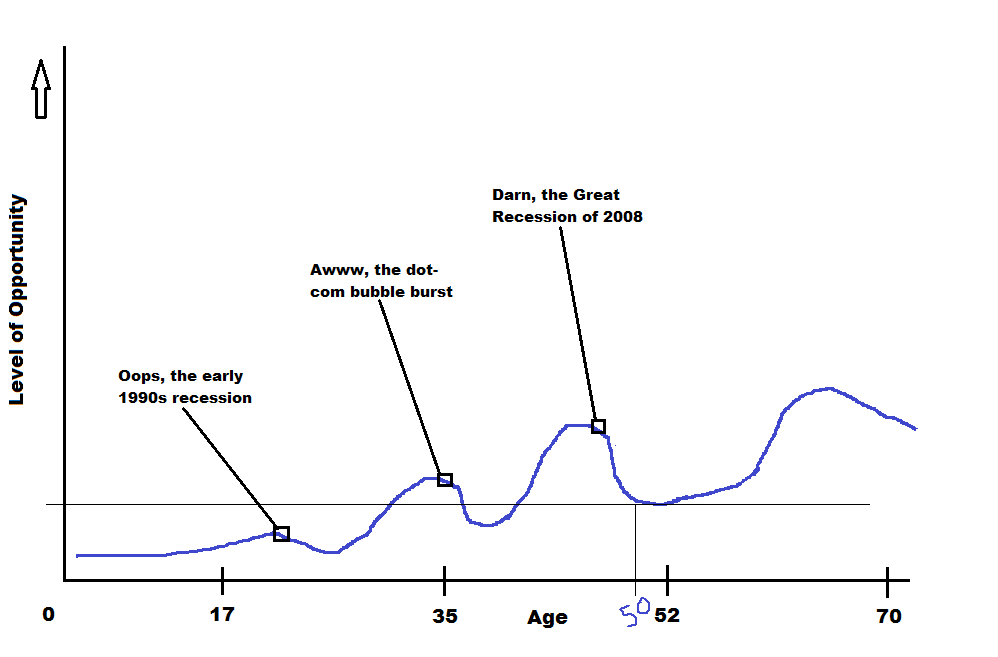
oppur_graph2

As you can see, instead of rising over the years, our professional lives have been slammed with repeated setbacks that have left us far below where we expected to be.

I thought that by now I’d be in a position to make a difference in this world instead of continuing to be underemployed, plodding toward retirement. As I approach the 50-year-old milestone, I am only as far along as someone in their early thirties.

I actually know several younger people who have surpassed me, doing what they enjoy in a way they want to do it, including:

  • a senior principal at the National Rural Electric Cooperative Association,
  • the senior manager of communications at the Share Our Strength non-profit,
  • the executive director of the Association of Clean Water Administrators,
  • the chief executive officer of an international luxury jewelry company, and
  • an assistant television editor for such programs as “Jennifer Falls,” “Whitney,” and “Mulaney.”

In addition, I know many others who’ve started their own businesses.

This proves two things. First, being too young is not the problem. For years, I told myself that if I just was patient a bit longer, my worth would be proven, my years of service recognized, and opportunities would open up. Now I’m convinced that ain’t gonna happen.

And second, my generation–or my slice of it–is especially blighted. Due to the fickle nature of economic and demographic trends, we, for the most part, have missed out on the benefits that should have accrued to us. We’ve been overlooked, swept aside by the tides of history and there’s no going back.

The upshot is this: for those of us who are low on the opportunity totem pole, the impacts to our lives are very real and quantifiable. We don’t get asked to join meetings or conferences, which in turn means we have a very small network of colleagues. Our contributions are undervalued, which leads to a corresponding devaluation in our career field, both inside and outside of our organizations. This can lead to lower than average salary and fewer chances to move up. We don’t get asked for advice or input despite the fact that our ideas are as good as, or maybe better than, those of better-known colleagues. We aren’t recruited for new job openings.

Which only reveals one thing that we already know: life ain’t fair.

Now that I’ve vented a little, maybe it’s time to get something done.


Stay tuned: in the next few days, I will be inviting folks to take a survey about how your work/life attitudes may be affected by your generation. I hope you will participate.

Non-Joggers of the World Take Heart

Ah-ha. I knew it!

Jogging for fitness isn’t so good for you after all.runner

To recap: the dominant public narrative at the moment is that if some running is good, more is better. As I have discussed before, this had led to an explosion of half-marathons, marathons, and ultra-marathons. And to what end?

Nothing, apparently. A new study from researchers in Denmark has found that while some exercise is good, more is actually worse. According to the Los Angeles Times, “high-intensity, high-mileage joggers die at the same rate as channel-surfing couch potatoes.”

I’m willing to bet that obsessive jogging and/or running has more to do with competitiveness and perceived self-worth than any actual fitness benefits.

Personally, I take my cues from the Chinese. What do they do for exercise? They get outside and walk every day. No fancy running shoes. No strenuous uphill runs. Just walking. It works for me.

Just Have to Say

Yesterday, I finished reading an article in the Washington Post that has really stuck with me, and not in a good way.**

The article, written by Cynthia McCabe, is about man who e-mailed a dozen or so writers–all strangers to him–of his intention to commit suicide. The reasons he gave were that he, as a writer, had “said everything I wanted to say and consider my work finished.” He goes on: “I believe I have an immense amount to give, not only from my mind but from my heart, and there are just no takers.”

It was a suicide note from a writer who had failed to find an audience.

Sadly, I found that McCabe’s reaction, and that of some of the other writers, showed an appalling lack of compassion.

Writers, in my experience and from anecdotal evidence, are all too happy to sacrifice their own as they claw their  way to the top. McCabe has the privilege of being allowed to write and publish about this failed writer. Instead of saying how she may have felt similar feelings at one time or another, she voiced her disdain and that of the other writers for this failed writer and his tactics to bring his work to the world.

The suicidal writer, a man named Dennis Williams (or his pen name, Katry Rain), is described by his ex-wife, who perhaps knew him best, as a philosopher, a thinker, a writer of both prose and music, and a popular teacher.

But in McCabe’s article, he is called narcissistic and selfish. One writer who received Williams’ e-mail said she felt emotionally mugged. A Washington Post reporter basically said that Williams should have called someone who cared, implying that he didn’t.

McCabe herself calls Williams’ writing clunky and not particularly noteworthy. If whether your prose is impressive or not is the benchmark against which we should measure success as a writer, then “Fifty Shades of Grey” and countless other commercially successful but otherwise unremarkable works would be consigned to the dustbin of history.

Williams is in no position to defend himself. McCabe’s article, written from the point of view of an author who has tasted some success, feels like bullying.

This is exactly why he took his life.


**NOTE: For an update on this topic, see here.

Twenty-five Years of Nothing

celeb90

On the eve of my 25-year college reunion, something struck me in a recent article in the Washington Post, something that made me take notice:

The first decade of the 21st century produced two recessions and two “jobless recoveries,” and when it was over, the vast majority of Americans found themselves no better off than they were a quarter-century ago.

This is the career landscape into which I and my classmates graduated. Hopes of finding meaningful work have all but evaporated over time. We are now just trying to get by.

I’m not struggling, by any means. I and my wife have healthy incomes. But we have two children nearing college age. We live in a modest house with a modest mortgage. We have two modest cars. We go into debt to take a modest vacation once in a while. I’ve been laid off once, so far.

In contrast, by the time he was my age, my father was the president and part owner of a company in San Francisco that employed hundreds of workers. There is no way I will ever reach that mark now.grads

Nor will anyone of my generation. As I have said elsewhere, people who graduated from college between 1989 and 1992 have, for the most part, vanished from the public sphere. It does not mean that we are not smart enough, or talented enough, or ambitious enough. Rather, it has everything to do with the economy.

And, for those of us who are doing reasonably well monetarily, we are paying in other ways: lack of career advancement. We will shuffle through our mid-level jobs, never rising to our potential. There are consequences to that.

We are part of America too, so our story is America’s story. The Post article wraps up with this:

[America] has waited decades for middle-class jobs to come back, through a loop cycle of political bickering, to no avail.

I can vouch for that.

The Ghosts of Loneliness

The month after the September 11th terrorist attacks, my wife and I decided to visit the harvest festival at Cox Farms in Virginia. She’d heard about it from our neighbors so we took a Saturday to see what it was all about.

It was a windy fall day with clear skies, and the festival area was already busy when we arrived. From the parking lot, we walked through the entry gates into an open, gently sloping area bordered by corn fields. Pumpkins, straw bales and gathered cornstalks decorated everything.

Our two-year-old daughter, bundled in layers, ran to the first activity area. It was a small stage with percussion instruments for the kids to play. Some music was coming through a sound system and my daughter picked two drum sticks and banged along on a log. My wife and I sat on some hay bales and watched the somewhat chaotic “music.”

My wife and daughter at Cox Farms in 2001.

My wife and daughter at Cox Farms in 2001.

I carried our younger child, not quite one year, in the carrier backpack. He was bundled too and hunkered down against the wind. He peered out at the activity around him but seemed content to stay in his nest.

Our daughter next wanted to try the long slide. Built into the side of a slope, I thought it would be daunting to a small child but she was game. At the bottom we waited and as she slid to a stop in the soft straw, she looked as if it were a bit much.

“Would you like to go again?” I asked.

“No,” she said. So we moved on to the next thing.

My wife and I had come to Cox Farms that day looking for something. It had been a rough year for us. Our son had been born through an emergency caesarian section when my wife had suffered a ruptured aneurysm while pregnant. The subsequent brain surgery, while saving her life, caused trauma that required months of rehab and supervised care. And all while we tried to raise two small children.

The aneurysm was an event that divided our lives into “before” and “after,” a clear marker that separated what we wished for our future from what was now actually achievable. The brain trauma also created a separation between “us” and “them”—those who understood what brain injury was all about and those who could not.

These twin difficulties worked in tandem to create a feeling of isolation for us. And the September 11th attacks only added to our desire to find connection with others and with a normal flow of life.

But we didn’t find it that day, nor for several years to come. The loss and the resulting loneliness were with us constantly, a formless presence that acted out when least appropriate, seeping into our daily routines and interactions. It seemed to live in our bones.

And now, these many years later, feeling that we’ve almost regained our footing, that visit to Cox Farms on a blustery October day seems like a story from another life, an alternative past. I’m saddened to think that our children may have sensed our lack of direction, that it may have shaped their views of the world. But it couldn’t be helped, not then and not now.

We were there for maybe an hour when my wife and I decided that we were ready to go. We walked back to the car and ate lunch in the back of our station wagon, hiding from the wind.