Books That Will Go Unwritten

I think I could write a book.

It probably wouldn’t get accepted by a publisher, and even if it did probably no one would read it.

But that doesn’t change the fact that I am fairly certain that I could write a book. As in, I have the knowledge and the skills and the discipline to complete the project.

But I have not actually written a book and it seems unlikely that I ever will. There are several reasons for that.

One is my career and my ability to make a living. Early on, my career was satisfying enough that it was all I really needed. I didn’t engage much in hobbies or side projects. But after I was laid off in 2009, my professional work lost its appeal and it was then that I began to think about putting my energy elsewhere (like into this blog for instance).

A related issue is my inability to find a way to write the kind of book I want to write while not going broke or starving to death. To do justice to the ideas that I have would require significant investments of time and money. I just don’t see how I could keep my job and write a decent book. Nor do I see myself financing the effort from my savings and expecting to have the cost reimbursed from the publishers and from book sales.

Many published writers in the past few decades have not had to make that kind of choice. A discussion of women photojournalists–while talking about photographers and not writers–nonetheless sheds some light on the business of publishing: “The business has been taken over by a younger generation, many of which have alternate sources of funding, such as trust funds…. [E]ditors have sought out these self-funding talents. They had little choice. The new photographers didn’t mind, they needed the validation the publications offered and in the case of trust-funders, they didn’t need the money.”

For me it would mean quitting my current job and taking a leap of faith on a project with a very small chance of success. I’m not that much of a risk-taker.

Another is that I’m only recently figuring out, late in life, what kinds of topics I  am so interested in that I’d be willing to devote the time and energy into making it a full length book. For many years I was very focused on only a few ideas that frankly had done already by other writers, and I wasn’t  expanding into anything new. I could probably do it now but few writers find success late in life and the odds are against me.

There are actually three people who I know or have known through the normal course of life who have written and published books. One is Charles Bock, with whom I went to college. Another is Ellen Prentiss Campbell, a former neighbor and someone with whom I spent a few years in a writers’ group, reading some of her early work. The third is Andrea Jarrell, another neighbor and friend. They’ve been able to get their writing out there. I’d love to find time to pick their brains about it.

Back when Great Literature and Great Journalism were being written, the market for such things was almost assured. People had few options for leisure activity but to watch TV, see a movie, listen to radio, or read a book or magazine. The publishing houses thrived on high quality material and were always needing more of it. Bookstores were commonplace.

Today the tables have turned. Lots of people write or claim to want to write, while we have fewer and fewer places where this writing will be seen. As noted above, old models of success no longer apply. And if you have a decent bookstore within 10 square miles of you consider yourself lucky.

Which has me wondering: how many books are out there living as an idea inside someone’s head that will never see the light of day because the basic pathways of writing for publication have collapsed?

Sad to think, but it could be hundreds of thousands.

Success That Writers Crave

A few years ago, I posted a couple times in reaction to an article in the Washington Post. Not to beat a dead horse, but I have a bit more to say.

The article was written by Cynthia McCabe, who was e-mailed by a man, a complete stranger, announcing his intention to commit suicide. The reasons this man gave were that he, as a writer, had “said everything I wanted to say and consider my work finished.”

In my posts, I take issue with McCabe’s inability to relate to the man’s situation. Specifically, I found it strangely insensitive that a fellow writer could not sympathize with that man’s desire to have his writing read, and in that way find some measure of community that understood him.

Instead, McCabe’s article calls the man narcissistic and selfish, perpetrating an emotional mugging.

Narcissistic, just for wanting some success in his writing career. Success that all writers crave at some level, right?

In case further proof were needed, the latest magazine and course catalog from my local writers’ center includes a piece by a writer named Anu Altankhuyag, who has this to say:

I knew I wanted to continue writing as more than a hobby. I wanted to one day be able to walk through a bookstore and see my name on the shelf. Every writer does.

Including, one would assume, Cynthia McCabe. But seeing that desire in a fellow writer was too much to ask.

Euphamisms

When the failure of a product or service is discussed, people will say how “the market wasn’t there.”

When a company tries to launch something new and doesn’t succeed, they’ll say that it “didn’t do well with consumers.”

When a writer is unsuccessful, they’ll say he “failed to find an audience.”

These are all just variations of the same thing. They are euphemisms that grown-ups use for age-old playground judgements:

“You suck!”

“Loser!”

Creating fancy phrases derived from social correctness or business school lingo doesn’t make it hurt any less.

In fact, all of these smell of head-shaking and pity. “Poor soul,” they seem to say as the ice cubes clink in their glasses of scotch, “he just couldn’t rise to the occasion, didn’t have the right stuff.”

“Shame, really.”

“Indeed.”

To Be Read, and To Be Understood

Recently, I noticed a flurry of views on a post I wrote in January. The post was my reaction to an article in the Washington Post Magazine, an article about a writer, Cynthia McCabe, who was e-mailed by a man, a complete stranger, announcing his intention to commit suicide. The reasons this man gave were that he, as a writer, had “said everything I wanted to say and consider my work finished.”

It was an article to which I had a visceral reaction, and I don’t mean a positive one.

I won’t summarize my reaction–you can read it for yourself–except to say that I felt McCabe, as the writer of the article, was missing the bigger picture. I also figured that she had said what she needed to on the subject and that the story would be laid to rest.

Not so.

I was curious about what was behind the uptick in views of my post, so I decided to find out. The recent increase in views, evidently, was provoked by the story reappearing on the radio program Snap Judgement. Don’t get me wrong, I like the program and have listened to it on several occasions. But I question the resurrection of the story in a new format, the motives behind it, and the approach taken by the producer of the piece, Julia DeWitt.

Julia DeWitt, exercising questionable judgement.

Julia DeWitt, exercising questionable judgement.

The story, in my opinion, should have been that a person named Dennis Williams (aka Katry Rain) had dedicated a lifetime’s worth of energy and effort into a body of work that has been essentially ignored, and that this emptiness led him to end his life.

I’m not alone in this. One commenter on the NPR website had this to say about the handling of the story:

I found this story very troubling. Not because the writer committed suicide, but because the producer, Julia DeWitt, seemed to so completely fail to respect or understand his decision…. It doesn’t sound like Ms. DeWitt read a single thing he wrote beyond the letter. How is what he died for not the story here?

And a commenter on my January post said this:

My uneasiness with reading The Washington Post article…was [from] the writers’ callous tone (listing her course of options rather than expressing genuine sympathies, or her semi meta-judgmental of the publishing world, yet failing to recognize her part in it).

It appears that McCabe has not given any further thought on the matter.

In the radio show, however, Dara Horn–the one who called the incident an “emotional mugging”–says this:

You know, I’ve been very fortunate to have had a fair amount of success as a writer. And so perhaps it’s not fair for me to say this because perhaps I would feel differently if I weren’t as successful as I’ve been, but it would never occur to me that my writing was the most important thing that I had contributed to this world.

Interestingly, many writers–successful ones–have felt exactly what Williams felt, that their writing was vitally important to their lives. F. Scott Fitzgerald wrote “On the other hand, for a shy man it was nice to be somebody except oneself again: to be ‘the Author’….”

John Updike observed that the embodiment of the New Yorker, Eustace Tilley, “was like a god to me, the guardian of excellence; he weighed my mailed-in words and paid a grand or so for tales he liked. A thousand dollars then meant we could eat for months. A poem might buy a pair of shoes. My life, my life with children, was a sluice that channeled gravelly water to my pan; by tilting it, and swirling lightly, I at the end of day might find a fleck of gold.”

Here’s the thing: why did DeWitt feel the need to re-warm this story for the radio? Was it because it really needed to be told again, that radio would provide something that print could not? I doubt it.

Yes, Dennis Williams has received a boost of attention from these events. But DeWitt seems to have no interest in Williams, and she admits that the people interviewed for the story don’t either. I rather think it was because it was a nifty story to tell, and DeWitt would get some feathers in her cap for doing it.

Williams was not looking for fame per se. He just wanted to be read, and also to be understood. DeWitt and McCabe and Horn clearly don’t understand.

[updated Jan. 31, 2017]

Writing is a Crap Shoot

I want to let you in on something that I’ve learned the hard way: writing is a crap-shoot.

Case in point: Elizabeth Gilbert is the best-selling author of Eat, Pray, Love. I have not read anything she’s written, but I’m sure she’s a fine writer. Fine enough to impress the editors at Esquire magazine, where one of her unsolicited manuscripts was pulled from the slush pile and published–a dream that most writers can only hope to achieve. That one event catapulted her into a career as a writer.

editor

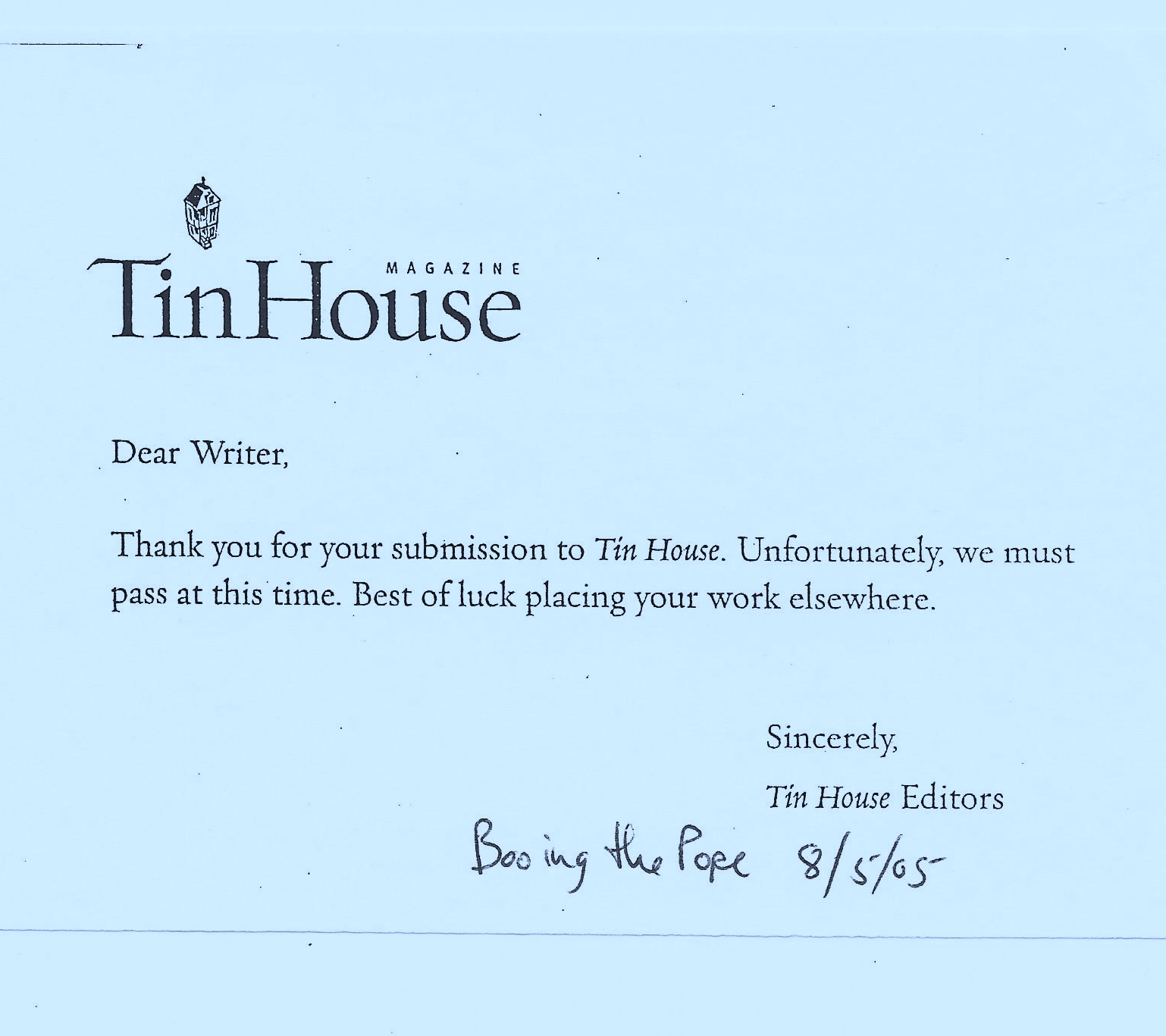
Actual rejection slip from an editor (I have many).

It does not mean that she is a remarkably better writer than all the tens of thousands who silently toil with no success. Let’s all admit that she got lucky.

And about editors–they are human too. They have feelings, they have biases, and they make mistakes. They can be arrogant, misguided, and sometimes they cheat, steal, and lie. But they are the guardians of the gate, and they will exercise their power to either make someone’s career or make sure that a writer is never heard from again.

Recently, I submitted a short essay to the Washington Post Magazine. For a few years, they have been running a regular feature where the essayist describes a small, seemingly unimportant object that has significant meaning for them. After six months (editors are soooo busy), I finally received a response from an editor. He declined my essay, giving the reason that, while it was a “powerful” story about my grandfather, “there’s not a particular narrative about the object in question–which enters late in the piece.” (I subsequently self-published the essay here.)

Quietly, I accepted his explanation, believing that my essay just didn’t meet the magazine’s standards. I don’t know what constraints exist in the magazine’s editorial processes, and figured that if I studied other published essays, I’d understand what he meant.

Yet, in a recent issue, an essay was published that included everything that this editor said was wrong with mine.

When editors contradict themselves so blatantly, it’s hard for me to take any of them seriously.

If anyone tells you that there is a writing community–a network of support where writers find strength–then they are lying. Writers and editors eat their own, and secretly (or not so secretly) rejoice in the failure of other writers.

A few years ago, I realized that I wanted needed writing to be a significant part of my life. The need is there, the drive and desire. Maybe it is just that I don’t have the talent. Or maybe that I’ve started too late, that I have too many other competing interests in my life, that I don’t have the time and the space necessary for proper reflection.

I continue to roll the dice, hoping that I may get that magic combination that will take me to the next level. But it’s possible that I will never find out.