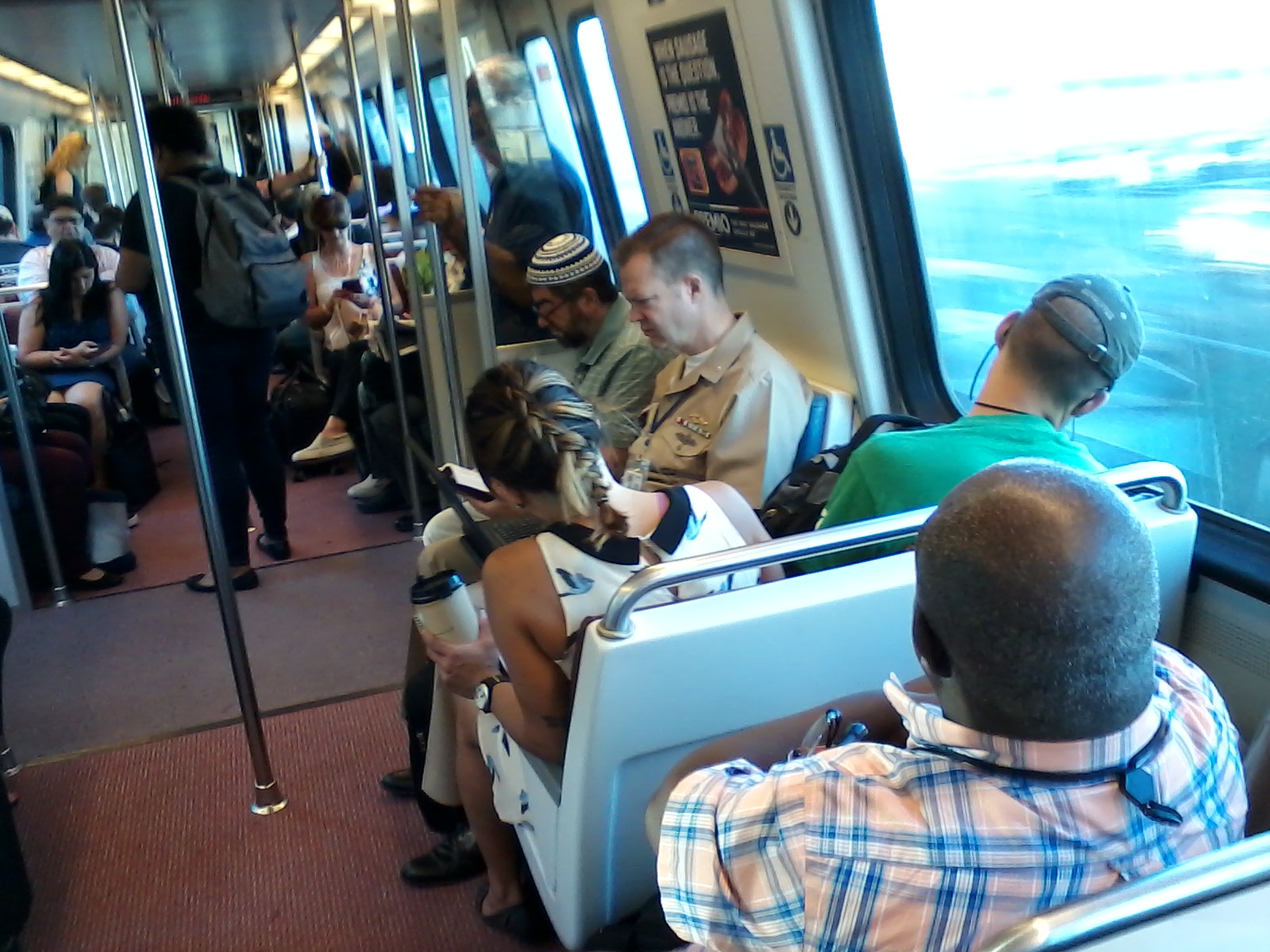
My seat on the Metro train has an empty Bacardi bottle and a lime wedge.
The guy in the seat behind me is dancing along with the music in his headphones like nobody is watching.
The woman in the seat in front of me is talking on her phone. The contact on her phone says My Boo.
Sometimes, the person sitting across from me is reading a book in Chinese, and the person sitting next to me is reading a book in Russian.
Sometimes, street dancers will board the train and perform to loud music as the train moves between two stations, asking for money before they exit to try again on the next train. This is technically not legal but it sure is entertaining.
Life on public transportation is rarely dull.
On the Washington, D.C. Metro, one will see a whole palette of humanity, from drunkards to lawyers to tourists and families. There is Black and White, Asian and Latinx. There is young and old, healthy and infirm, and plenty of Queer people. Sometimes it’s so crowded you can barely move. Other times I’m one of only a few people.
It’s always good to be aware of one’s surroundings, but it’s equally good to notice who’s on board with you. Sometimes I’m surprised when my first impression of someone is proven to be wrong, when they turn out to be kinder or more gentle than they appear.
Sometimes tensions do flare and voices are raised. It’s not always a simple matter to squeeze so much variety into an enclosed train car or bus. But I have yet to see, after decades on the trains, any true violence.
Not that there’s no violence in the Metro system because sometimes there is, late at night or in less populated stations. But it seems usually more to do with personal animosity and unrelated to the “public” part of public transportation.
Riding public transportation requires an unwritten social contract: I leave you alone to get where you need to go and you leave me alone to get where I need to go. Without it, the effectiveness of public transportation breaks down.
People sometimes violate this social contract by doing such things as begging for money, getting into arguments or shoving matches, or trying to talk to someone who does not want to be talked to, especially if it’s about politics or religion.
But they remain in the minority. Most people I ride with don’t try to turn the bus or train into a market or an exclusive place where some people are allowed to ride and others are chased away. Which is good because I imagine there is a tipping point where there would be fewer and fewer riders because they don’t feel comfortable or safe. As long as most people get onboard because the bus or train gets them where they need to go, public transportation will continue to serve its purpose.
I realize that public transportation has a reputation, and I think it is mostly undeserved. It seems to be based on media portrayals of the New York City subway system, which in movies is always a crime-ridden place filled with bums, garbage and graffiti. I have not ridden the NYC subway, but I have ridden public transportation in Boston, Philadelphia, San Francisco, London, Munich, Paris, Auckland, and of course Washington, D.C. My experience has been that, when public transportation is properly run and cared for, it is something that ordinary people find appealing and useful. It is not something that caters only to the dregs of society.
There are people who fear public transportation even under the best conditions. As a result, they travel in their own private vehicles, isolating themselves from the public as much as possible. But that solves nothing and only contributes to many problems.
In the old fairy tale of Beauty and the Beast, the Beast lives in isolation and scares everyone away because of his arrogance, hatred, and selfishness. It is only when he allows himself to be in the presence of others that the curse is lifted.
 The Seeker