The Trouble With Being American

I have no cultural identity other than “American.” I do not consider myself to be Irish-American or African-American or Hispanic-American or any other cultural identity that I can fall back on. So you can understand my displeasure at the current state of America.

The United States is my country. I was born here and have lived here all of my life. Going back to the early 1700’s, my ancestors have been born here, lived here, and are buried here.
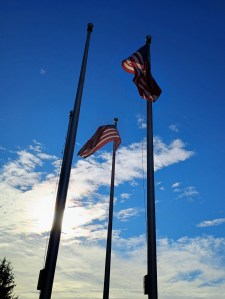
This is the only criteria for American citizenship–be born on American soil (see the U.S. Constitution, 14th Amendment). There are no other criteria, tests, or qualifications.

Some people try to make the claim that “real” Americans are those who typically exhibit outward displays of patriotism, have a simplistic view of our nation’s origins, and hold narrow views of what an American should look like. But there is nothing to support that claim. It is just personal opinion (that can be safely ignored).

Singing the National Anthem more loudly does not make you more American. Waving the flag more vigorously does not make you more American. Having more ancestors here does not make you more American. Serving in the military does not make you more American. Being Christian does not make you more American. These things simply don’t.

Unfortunately, these same people also claim to know what America really is (as opposed to what?) and refuse to acknowledge that there is, or even might be, a more expansive, messy, diverse, and complicated understanding of our country.

And the sad thing for me is, that version of the “real” America–the one currently being heavily promoted by Donald Trump and his MAGA co-conspirators–is not my America. It is not the America that I see, or ever want to see in my lifetime. Instead, it is some strange conflagration of illusions, misinformation, wishful thinking, and self-righteousness with large doses of self-delusion, racism, and xenophobia mixed in. (MAGA Americans like to say that those critical of their political positions must hate America. In my view, the America in the “Make America Great Again” is a fictional, made-up place that they somehow think we can return to, making such criticism absurd.)

So where does that leave me?

I am an American in an America that I don’t recognize. When the stars and stripes is displayed, how am I supposed to feel? How can I say I’m proud to be an American when the America that is currently on display is a cruel, mentally unstable place that goes against my integrity and inner sense of what an American is supposed to be?

Sadly, I feel that the America I grew up in, that I learned about in school and on the street, and that I believed in, is rapidly disappearing. Once it is gone, and replaced with something unrecognizable, what then?

Trying to Erase Palestine

This is a picture of a railroad bridge in my hometown.

A few months ago, someone spray painted FREE PALESTINE on this bridge, in green and red paint. Not long after, someone — the city? the railroad? — had someone go up on the catwalk with a bucket of brown paint and a roller, and paint over PALESTINE. Those blocks of lighter brown paint are where the letters used to be. (To see this picture at full resolution, click here.)

They did not paint over FREE — you can still see it at the left side of the photo. Also, if they were interested in keeping graffiti to a minimum they would have painted over the graffiti that has been put there since they painted over PALESTINE, but they have not.

They only painted over the word PALESTINE, as if to say that there is something inherently wrong about Palestine.

This makes me wonder why.

Palestine, or more clearly Palestinians, are a people without a state. In this respect they are akin to other stateless people in the world, such as the Kurds and the Roma. While there is a team of athletes at the 2024 summer Olympic Games in Paris representing Palestine, Palestine is not a member state of the United Nations.

Yet they are an ethnicity who share a cultural identity. Millions of people in the Middle East and various countries around the world self-identify as Palestinian. Even people with Jordanian or Israeli citizenship identify ethnically as Palestinian.

Importantly, they are doctors and teachers and businesspeople. They are mothers and fathers. They are people hoping to end over 75 years of statelessness, occupation, and exile.

Perhaps those who painted over PALESTINE on the bridge truly are under the impression that there is something inherently wrong with Palestine. But it would be an ignorant mistake to think that being Palestinian equals being a terrorist and that all support of Palestinian human rights is anti-Israel.

This would be like saying that in the 1930s and 1940s, being German equals being a Nazi. (There were in fact Germans who opposed the policies of the Nazi party.)

This would be like saying being Muslim equals being a terrorist. (There are millions of Muslims worldwide who are peaceful, law-abiding people.)

This would be like saying being Black equals being enslaved. (This, of course, is unequivocally not true.)

Imagine a reverse situation: the spray painter instead painted FREE AMERICA, and then someone was offended by the word AMERICA and painted over only that word. What does that say? Does it say that the word is itself offensive? Does it say that those who identify as American do not have a right to say so? Does it mean just by asserting an American identity you are somehow threatening others?

I would like to think that in this modern era, humanity has moved beyond the idea that one nationality or ethnicity is naturally (or divinely) better than another. I would like to think that we don’t try to dehumanize people who we think are different from us. The United Nations was formed in 1945 under the idea that (with the somewhat questionable exception of the Security Council Permanent Members) all nations on Planet Earth have an equal seat at the table, have an equal stake in the outcome of international decisions, and are capable of cooperation rather than animosity.

Sadly, reality is much more complicated and less optimistic. Nationalism — the idea that nations of the world cannot work together and in fact are and ought to be kept separate — is on the rise in many parts of the world, including the United States.

And with nationalism comes the desire to define who is “us” and who is “them,” and who gets to stay, and who gets erased.

But it should not be for a town in Maryland, United States to decide whether Palestinians exist.