The Trouble With Being American

I have no cultural identity other than “American.” I do not consider myself to be Irish-American or African-American or Hispanic-American or any other cultural identity that I can fall back on. So you can understand my displeasure at the current state of America.

The United States is my country. I was born here and have lived here all of my life. Going back to the early 1700’s, my ancestors have been born here, lived here, and are buried here.

This is the only criteria for American citizenship–be born on American soil (see the U.S. Constitution, 14th Amendment). There are no other criteria, tests, or qualifications.

Some people try to make the claim that “real” Americans are those who typically exhibit outward displays of patriotism, have a simplistic view of our nation’s origins, and hold narrow views of what an American should look like. But there is nothing to support that claim. It is just personal opinion (that can be safely ignored).

Singing the National Anthem more loudly does not make you more American. Waving the flag more vigorously does not make you more American. Having more ancestors here does not make you more American. Serving in the military does not make you more American. Being Christian does not make you more American. These things simply don’t.

Unfortunately, these same people also claim to know what America really is (as opposed to what?) and refuse to acknowledge that there is, or even might be, a more expansive, messy, diverse, and complicated understanding of our country.

And the sad thing for me is, that version of the “real” America–the one currently being heavily promoted by Donald Trump and his MAGA co-conspirators–is not my America. It is not the America that I see, or ever want to see in my lifetime. Instead, it is some strange conflagration of illusions, misinformation, wishful thinking, and self-righteousness with large doses of self-delusion, racism, and xenophobia mixed in. (MAGA Americans like to say that those critical of their political positions must hate America. In my view, the America in the “Make America Great Again” is a fictional, made-up place that they somehow think we can return to, making such criticism absurd.)

So where does that leave me?

I am an American in an America that I don’t recognize. When the stars and stripes is displayed, how am I supposed to feel? How can I say I’m proud to be an American when the America that is currently on display is a cruel, mentally unstable place that goes against my integrity and inner sense of what an American is supposed to be?

Sadly, I feel that the America I grew up in, that I learned about in school and on the street, and that I believed in, is rapidly disappearing. Once it is gone, and replaced with something unrecognizable, what then?

Remedial Lessons on Being a Decent Human

My main takeaway from the results of the US election on Nov. 5, 2024, is that a majority of Americans have failed to identify what it takes to be a decent human being.

Seriously. Whoever thinks it is okay to elect a convicted criminal and chronic liar who violated his oath of office during his first term as president; who finds people and institutions to cruelly condemn and insult for his own political gain; and who apparently feels that being sincere or apologetic is a sign of weakness, really need to reexamine their moral fiber.

I am not sure anyone has accepted the challenge of reeducating our fellow brothers and sisters on just what it means to be decent to other people. So until someone comes along to do just that, I am offering here some very basic guidelines on how to treat others. None of this is new; all of this should be known and cherished, but isn’t.

Welcome to remedial class, kiddos.

“In everything, do to others what you would have them do to you.” — Jesus Christ (0-33), Matthew 7:12 (NIV)

Everyone should know this, often called the Golden Rule. How little it is put into practice, including by many self-proclaimed Christians. In recent years, Americans (including self-proclaimed Christians) have been okay with separating children from their parents for no other reason than having come across the border into the US; prohibiting health care for people who badly need it; and turning a blind eye on systemic civil and human rights abuses. And the rationale is that the people involved are “them” and not “us.”

“If someone strikes you on the right cheek, turn to him the other also. And if someone wants to sue you and take your tunic, let him have your cloak as well. If someone forces you to go one mile, go with him two miles.” — Jesus Christ, Matthew 5:39 (NIV)

The basic message here is don’t be vindictive even in a bad situation. Instead, show yourself to be the better person. Sadly, Americans (including self-proclaimed Christians) appear to revere egotistical narcissists like Donald Trump, who bullies and insults anyone who gets in his way, spreads lies (breaking the Ninth Commandment with alarming frequency) to make himself look better, and is generally a sore loser.

“On one occasion an expert in the law stood to test Jesus. ‘Teacher,’ he asked, ‘what must I do to inherit eternal life?’ ‘What is written in the law?’ he replied. ‘How do you read it?’ He answered: ‘Love the Lord your God with all your heart and with all your soul and with all your strength and with all your mind; and love your neighbor as yourself.’ ‘You have answered correctly,’ Jesus replied. ‘Do this and you will live.’ ” — Jesus Christ, Luke 10:25 (NIV)

Look at that! Jesus again, for three in a row! While this is a nice and simple formula for being a decent person (and, regarding the ‘love your neighbor’ part a repeat of Leviticus 19:18, so the commandment has been around a very long time), what’s really great is that here it is followed by the parable of the Good Samaritan. As any Christian will know, Jesus told the story to explain what it means to be a neighbor. Specifically, Jesus pointed out that it is not important that your neighbor meet certain minimum qualifications, such as having the same skin color, or the same ethnicity, or the same religion, or the same language, or to be of “your people” however you perceive that. Nor is it about whether helping your neighbor will leave you with a little less food or money. What is important is that you see someone in need, and you extend your help.

“Do not forget to entertain strangers, for by so doing some people have entertained angels without knowing it.” — Saint Paul, Hebrews 13:2 (NIV)

There are several places in the Bible (such as Leviticus 19:33) that deliver the message that it is our moral duty to extend kindness and hospitality to people who are not like us. I like this one because it is succinct, getting to the meat of the point that those who may appear worthless are quite possibly divine. Unfortunately, the world–including the United States–has become gripped with a fixation that all who are not “like us” are to be suspected and rejected (cue the Trump campaign speeches). It is worth noting that people who lived centuries ago lived among strange people from faraway lands, often quite successfully. We think ourselves modern and advanced, yet have failed to learn a basic lesson.

“The worth of a man is measured by his words and evaluated by his actions.” — Ibn Khaldun (1332-1406)

This one is new to me, but obviously it is not new. Ibn Khaldun was a Muslim scholar in Tunisia at a time when Europeans were still living under centuries of darkness. The fact that this comment is over 600 years old should mean that it is familiar to many people. Sadly it is not. Certainly not to people who appear to think Donald Trump and those like him are qualified to be the leaders of a nation. The words and actions of Trump and others quite plainly show otherwise.

“There is a principle which is pure, placed in the human mind, which in different places and ages hath had different names. It is, however, pure and proceeds from God. It is deep and inward, confined to no forms of religion nor excluded from any, where the heart stands in perfect sincerity. In whomsoever this takes root and grows, of what nation soever, they become brethren in the best sense of the expression.” — John Woolman (1720-1772)

The abolitionist John Woolman, an American Quaker, has been called an inspiring writer, a model of Christian charity, a religious genius, and an exemplary figure in the history of social reform. Considering that his life ended over 250 years ago, one might think he was less enlightened than we are today. But it is just the opposite: sadly many people are now less enlightened than he was. It leaves one to wonder how and why people have squandered such richness.

“Injustice anywhere is a threat to justice everywhere. ” — Dr. Martin Luther King Jr. (1929-1968), “Letter from a Birmingham Jail”

This statement is so simple that it might appear to be nonsense. But think about it. First, when injustice is left unchallenged, people become desensitized to it and it becomes an endemic part of the culture. Secondly, one act of injustice that is not corrected can metastasize, leading to more and more acts of injustice, until justice itself is at risk. I assume we want justice, right? We claim to want justice. It’s even part of the Pledge of Allegiance that we recite with regularity: “…with liberty and justice for all.” But perhaps those now are empty words.

“We but mirror the world…. If we could change ourselves, the tendencies in the world would also change.” (Be the change you want to see in the world.) — Gandhi (1869-1948)

I end with this because it is a call to action, one that does not reflect any particular political party, religion, or cultural perspective. I admit that I have mostly tuned out the election postmortem. But the few things I have heard suggest that the outcome is because people are mad, people are upset, people want things to change (without providing specifics). What Gandhi is saying is that it is not enough (or not the right approach) to wait for the world to change around you, or for someone else to change first. Instead, we are called to model better behavior. If we each accept that challenge, then the world will change, naturally. Conversely, if we don’t it will only get worse.

One might be tempted to say that these are easy things to say when one has a comfortable life. And you might be right. But consider that these ideas arose from very diverse circumstances, from people who were acquainted with hardship, but all arriving at a similar message. That suggests that the truths are independent of circumstance and instead are (or should be) universal. In that case, they apply universally.

Universally, as in applying to you and applying to me. What needs to happen is that we as people must acknowledge from an early age that these truths (among others) are part of our human heritage. They supersede the ultimately petty differences that seem important in the moment.

Only then will the strife begin to fall away.

America Throws Hissy Fit, Elects Class Bully President

In a temper tantrum over things not going their way, America chose an aged convicted criminal and bully as their chief executive.

Citing no valid complaints, Americans overwhelmingly opted for a chronic liar who utterly failed in his previous attempt at running the country, to run it again.

“Waaaaah! Border security! Waaaaah!” said a voter named Adolph, who withheld his last name out of fear that people would learn about his belief that White people are the Master Race.

When asked what policies Donald Trump would be effective at implementing, Adolph said “Waaaaah! No socialism! Waaaaah!”

Voters once again rejected a woman for president, citing sexism and misogyny. And racism. But mostly sexism, and some racism thrown in for good measure. But definitely sexism.

And racism. Yes, that too.

An average voter, who identified himself as Vladimir, said a woman cannot be trusted to run America.

When it was pointed out that women have successfully run Great Britain, Germany, Italy, Ireland, Finland, Pakistan, India, the Philippines, Australia, and New Zealand, he said “Sure.”

When asked to clarify, Vlad said “America will never have a woman as president as long as a single man remains breathing.” He then commenced to flex his muscles for this reporter.

Polls show that Vlad, Adolph, and other average natural born Americans lean heavily toward a dystopian style of government, where guns are plentiful and civil rights are few.

Also, a majority of legal, registered voters said they are the downtrodden minority fighting against an overwhelming number of illegal noncitizens.

Plans are underway for the most spectacular inauguration of any president ever in the past or the future. Sources close to the planning, who have requested to remain anonymous due to threats from the dangerous radical left, have confirmed that the ceremonies will include detonation of a nuclear device.

We Don’t Need No Stinkin’ King

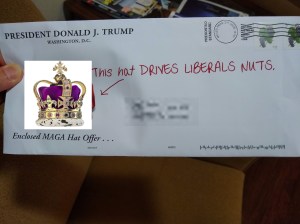
A few years ago I wrote a post that said, essentially, that in getting himself elected president in 2016, Donald Trump wanted to be the head of state. He wanted all of the adulation and ornamentation that accrues to heads of state, such as monarchs. But he did not want to be bothered with mundane things such as passing laws and governing.

I’m learning that there is a lot of agreement on this point.

Recently, the American Civil Liberties Union (ACLU) sent out mailers saying exactly that: No Kings In America. They don’t implicate Trump directly but it’s clear what point they’re trying to make.

I think it is worth noting that our Founding Fathers were very aware and very concerned about this new country devolving into a monarchy. They were breaking from a long tradition of people ruled by hereditary kings and they wanted to guard against the citizens of the United States running for the comfort of the familiar when things got tough.

The Constitution specifies that the chief executive is an elected position and that they are in power for only four years before being subject to reelection by the people. It also says that we have a republican (small R) form of government, i.e. not a monarchy.

More explicitly, Alexander Hamilton in Federalist Paper No. 69 took pains to point out exactly how unlike a king the office of president is intended to be, including the following: “The President of the United States would be an officer elected by the people for FOUR years; the king of Great Britain is a perpetual and HEREDITARY prince.”

America does not need a king. We are a republic founded on democratic principles, and we are admired for it.

Now is not the time to abandon the effort. I believe we can make our system of government work without a king. But we have to want to.

Fat is the Head that Wears the Crown

I was noodling around on Wikipedia recently and began reading a page about the difference between a “head of state” and a “head of government,” and I had a moment of insight.

According to this Wikipedia entry, a head of state (or chief of state) is the public persona who officially embodies a state. This is not to be confused with the head of government.

It occurred to me that Donald Trump, in running for president of the United States, wanted to be the head of state. He wanted all of the adulation and ornamentation that accrues to heads of state–monarchs, essentially. He wanted to be the persona of America (or his version of America) and emulate strongmen “leaders” and arbitrary sovereigns. He wanted the thrill of the large crowds cheering for him.

But he definitely did not want to be bothered with mundane things such as laws and regulations.

Trump’s insistence on on posing with a Bible in front of church for photographers on June 1, 2020–and forcibly removing racial justice protestors in the process–is a prime example of what a head of state would do, but likely not a head of government.

Just as importantly, his MAGA-hatted, Trump-flag-waving followers wanted a head of state too. This was demonstrated by the fervent devotion exhibited at all of his campaign rallies and most notably by the mob of rioters on January 6 who, in the name of keeping him as the “leader” of the United States, attacked and vandalized out of zealous loyalty to one man the very seat of our democratic republic.

I recognize that prior to America’s experiment in democracy, the identity of a nation was tied to “king and country.” This is what motivated people–Europeans mostly–to create colonies and subjugate other people.

But the creation of the United States and our written constitution was intended to do away with that, or at least the worst parts of it.

Interestingly, while in America we have a head of state who also is the head of government, there are several different ways of handling this, according to Wikipedia. These range form some power shearing to cases where the head of state has almost nothing to do with running the apparatus that implements the laws under which citizens live their lives.

Trump’s presidency–and the forces that put him into office–emphasize that our system perhaps is due for a makeover. The American setup is not the only way to do this, and it is a useful exercise to consider how we could modify our Constitution to make things a bit more reflective of the modern realities of our multicultural nation. To be blunt, if people want to elect a head of state, and that head of state has no interest in governing, then there’s a way to do that which is safe and quite possibly effective.

But we’d have to amend the Constitution and the odds of that aren’t great as long as we live under this pervasive political opinion that “They” are trying to get “Us” and that we are unable to function as a “We” as in “We the People.”

I for one would welcome some changes to how our country is run. All I have to do is pause and reflect on the fact that nearly 250 years ago, we fought a war and people gave their lives precisely so that we would NOT have a king in America. I think that was a noble cause, and these current generations would do well to uphold it.

Founding father and original patriot John Adams once said:

Power always thinks it has a great soul and vast views beyond the comprehension of the weak; and that it is doing God’s service when it is violating all His laws.