The Trouble With Being American

I have no cultural identity other than “American.” I do not consider myself to be Irish-American or African-American or Hispanic-American or any other cultural identity that I can fall back on. So you can understand my displeasure at the current state of America.

The United States is my country. I was born here and have lived here all of my life. Going back to the early 1700’s, my ancestors have been born here, lived here, and are buried here.

This is the only criteria for American citizenship–be born on American soil (see the U.S. Constitution, 14th Amendment). There are no other criteria, tests, or qualifications.

Some people try to make the claim that “real” Americans are those who typically exhibit outward displays of patriotism, have a simplistic view of our nation’s origins, and hold narrow views of what an American should look like. But there is nothing to support that claim. It is just personal opinion (that can be safely ignored).

Singing the National Anthem more loudly does not make you more American. Waving the flag more vigorously does not make you more American. Having more ancestors here does not make you more American. Serving in the military does not make you more American. Being Christian does not make you more American. These things simply don’t.

Unfortunately, these same people also claim to know what America really is (as opposed to what?) and refuse to acknowledge that there is, or even might be, a more expansive, messy, diverse, and complicated understanding of our country.

And the sad thing for me is, that version of the “real” America–the one currently being heavily promoted by Donald Trump and his MAGA co-conspirators–is not my America. It is not the America that I see, or ever want to see in my lifetime. Instead, it is some strange conflagration of illusions, misinformation, wishful thinking, and self-righteousness with large doses of self-delusion, racism, and xenophobia mixed in. (MAGA Americans like to say that those critical of their political positions must hate America. In my view, the America in the “Make America Great Again” is a fictional, made-up place that they somehow think we can return to, making such criticism absurd.)

So where does that leave me?

I am an American in an America that I don’t recognize. When the stars and stripes is displayed, how am I supposed to feel? How can I say I’m proud to be an American when the America that is currently on display is a cruel, mentally unstable place that goes against my integrity and inner sense of what an American is supposed to be?

Sadly, I feel that the America I grew up in, that I learned about in school and on the street, and that I believed in, is rapidly disappearing. Once it is gone, and replaced with something unrecognizable, what then?

We Don’t Need No Stinkin’ King

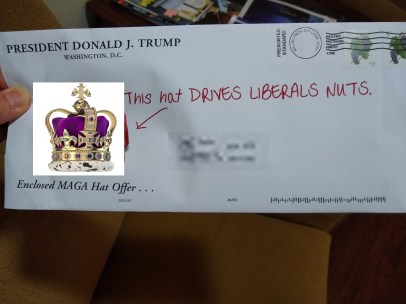
A few years ago I wrote a post that said, essentially, that in getting himself elected president in 2016, Donald Trump wanted to be the head of state. He wanted all of the adulation and ornamentation that accrues to heads of state, such as monarchs. But he did not want to be bothered with mundane things such as passing laws and governing.

I’m learning that there is a lot of agreement on this point.

Recently, the American Civil Liberties Union (ACLU) sent out mailers saying exactly that: No Kings In America. They don’t implicate Trump directly but it’s clear what point they’re trying to make.

I think it is worth noting that our Founding Fathers were very aware and very concerned about this new country devolving into a monarchy. They were breaking from a long tradition of people ruled by hereditary kings and they wanted to guard against the citizens of the United States running for the comfort of the familiar when things got tough.

The Constitution specifies that the chief executive is an elected position and that they are in power for only four years before being subject to reelection by the people. It also says that we have a republican (small R) form of government, i.e. not a monarchy.

More explicitly, Alexander Hamilton in Federalist Paper No. 69 took pains to point out exactly how unlike a king the office of president is intended to be, including the following: “The President of the United States would be an officer elected by the people for FOUR years; the king of Great Britain is a perpetual and HEREDITARY prince.”

America does not need a king. We are a republic founded on democratic principles, and we are admired for it.

Now is not the time to abandon the effort. I believe we can make our system of government work without a king. But we have to want to.

The Seductiveness of the Lie, Part 3

There has been a lot of talk in recent years in the United States about “free speech,” much of it misinformed.

It has gotten so bad that elected officials, and not just the fringe ones, and lawyers–people who ought to understand the law–are promoting a theory of protected speech that is unsubstantiated by the legal framework of this country.

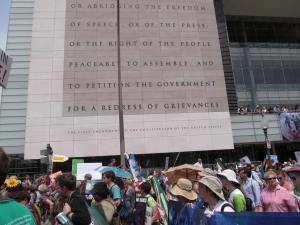
Protest march in Washington, D.C. in 2017 past the text of the First Amendment

The term “free speech” or “freedom of speech” derives, as best I can figure, from the First Amendment to the Constitution of the United States: “Congress shall make no law…abridging the freedom of speech….”

What that means specifically has been interpreted by over 200 years of Supreme Court decisions. The key bottom line for me is two things:

  • Citizens and noncitizens are not free to say literally anything in the US. The government can put restrictions on speech that would lead or does lead to violence, cause mass panic, or is used to intimidate or threaten others.
  • The “abridging the freedom of speech” part of the First Amendment applies only to the government. Not private employers. Not your neighbor. Not media outlets that are not controlled by the government. Again, only the government.

In other words, when some idiot is yakking about how suspending someone from Twitter is taking away their right to free speech, that is outright bullshit. Twitter is a private company, not the government.

No one has a Constitutional right to use Twitter. Or to comment on web pages owned by private companies. Or to say anything they want to at work, when the employer is a private enterprise.

What about bald-faced lies? Yes, in the US you have the freedom to say, and believe, lies. The government is not allowed to stop that (unless it involves some of the above mentioned circumstances). But anyone who is not the government can have policies and procedures in place to put a stop to deliberate falsehoods, hate speech, and advocating violence, if applied with equality and with consideration to protected classes of people.

***

There is another long-standing legal concept of the “reasonable person standard.” This is where judges and juries consider what would be acceptable or unacceptable to a hypothetical reasonable person, when deciding whether to rule for or against someone in court.

This assumes there is agreement and understanding held in common and widely shared of what “reasonable” means. The events of recent years, when people form their opinions based on the intentional falsehoods of celebrities such as Rush Limbaugh, Alex Jones, and Tucker Carlson, makes me wonder if that will continue to be the case.

***

The position the Supreme Court has taken is that the cure for a proliferation of lies is to flood the “marketplace of ideas” with other points of view. The gist is that the more ideas that are circulating, and the more varied those ideas are, truth and a shared concept of reality will ultimately win. (See New York Times Co. v. Sullivan (1964), Central Hudson Gas & Electric Corp. v. Public Service Commission of New York (1980), United States v. Alvarez (2012).)

Unfortunately, many times the lies are more attractive, more comforting, spoken more loudly and with more fervor, than the actual truth. I worry that facts cannot keep up with the constant output of lies.

This to me raises the issue of how long our modern civil society can tolerate this festering subculture of lies. Just being passive is, increasingly, not an option, in my opinion. Rather, those who are still able to identify the truth need to speak, speak loudly, and not assume that one can appeal to people’s reason, compassion, or sense of community.

The risks are real.

Fat is the Head that Wears the Crown

I was noodling around on Wikipedia recently and began reading a page about the difference between a “head of state” and a “head of government,” and I had a moment of insight.

According to this Wikipedia entry, a head of state (or chief of state) is the public persona who officially embodies a state. This is not to be confused with the head of government.

It occurred to me that Donald Trump, in running for president of the United States, wanted to be the head of state. He wanted all of the adulation and ornamentation that accrues to heads of state–monarchs, essentially. He wanted to be the persona of America (or his version of America) and emulate strongmen “leaders” and arbitrary sovereigns. He wanted the thrill of the large crowds cheering for him.

But he definitely did not want to be bothered with mundane things such as laws and regulations.

Trump’s insistence on on posing with a Bible in front of church for photographers on June 1, 2020–and forcibly removing racial justice protestors in the process–is a prime example of what a head of state would do, but likely not a head of government.

Just as importantly, his MAGA-hatted, Trump-flag-waving followers wanted a head of state too. This was demonstrated by the fervent devotion exhibited at all of his campaign rallies and most notably by the mob of rioters on January 6 who, in the name of keeping him as the “leader” of the United States, attacked and vandalized out of zealous loyalty to one man the very seat of our democratic republic.

I recognize that prior to America’s experiment in democracy, the identity of a nation was tied to “king and country.” This is what motivated people–Europeans mostly–to create colonies and subjugate other people.

But the creation of the United States and our written constitution was intended to do away with that, or at least the worst parts of it.

Interestingly, while in America we have a head of state who also is the head of government, there are several different ways of handling this, according to Wikipedia. These range form some power shearing to cases where the head of state has almost nothing to do with running the apparatus that implements the laws under which citizens live their lives.

Trump’s presidency–and the forces that put him into office–emphasize that our system perhaps is due for a makeover. The American setup is not the only way to do this, and it is a useful exercise to consider how we could modify our Constitution to make things a bit more reflective of the modern realities of our multicultural nation. To be blunt, if people want to elect a head of state, and that head of state has no interest in governing, then there’s a way to do that which is safe and quite possibly effective.

But we’d have to amend the Constitution and the odds of that aren’t great as long as we live under this pervasive political opinion that “They” are trying to get “Us” and that we are unable to function as a “We” as in “We the People.”

I for one would welcome some changes to how our country is run. All I have to do is pause and reflect on the fact that nearly 250 years ago, we fought a war and people gave their lives precisely so that we would NOT have a king in America. I think that was a noble cause, and these current generations would do well to uphold it.

Founding father and original patriot John Adams once said:

Power always thinks it has a great soul and vast views beyond the comprehension of the weak; and that it is doing God’s service when it is violating all His laws.