Memo to Joe Breda

“Matthew – I hope you are well. I’m writing for two reasons:”

So began an email from the head of my division at work, my boss’s boss’s boss’s boss. A guy named Joe Breda.*

He continues: “First, while I know you have made a partial leave request with HR I do not have any information about the circumstances of your leave. It is not necessary for me to know any of the details, but if there is anything I can do to assist please let me know.

“Second, I want to make sure you are aware how the company’s RTO (return to office) policy applies to your situation. Obviously, you are not expected to be in the office on days you have been granted leave. However, you should be in the office – up to three days per week – for days that you are not taking leave. If this presents a hardship, I’m advised that you to consider applying for full leave. Please let me know if you have any questions.
JB”

This email arrived on the eve of my wife being discharged after three and a half months in the hospital.

Me at Johns Hopkins Hospital in February 2022.

In January of 2022, my wife suffered a ruptured cranial aneurysm. After emergency surgery to save her life, she remained in the Johns Hopkins Hospital in Baltimore — first in intensive care, then several weeks as a regular inpatient — until late April. She needed months of physical therapy to recover, and she is still disabled today.

This was an incredibly difficult time for me and my family. We all faced hardship, stress, and worry over this entire period of time.

So to receive this heartless, tone deaf email from upper management did nothing to ease the strain.

In fact it made it worse.

Worse because I applied for and received authorization for 12 weeks of protected leave under FMLA. Joe Breda not only seemed to not know this. But also, his insistence that I adhere to the RTO requirements contradicted what I was previously told by HR, namely that those requirements did not apply to anyone currently exercising their FMLA rights.

Worse because the the uncertainty surrounding the day and manner of my wife’s discharge made it necessary for me to be flexible with my schedule, able to travel to the hospital or discharge facility on short notice. Being required to be physically in the office made that very difficult.

Worse because I was running out of leave. So Joe Breda’s glib, uninformed comment that I “may want to consider applying for full leave” is empty and meaningless.

This email from Joe Breda has eaten at me for close to three years. In all the time since this email, Joe never once inquired about my wife’s health or asked how I was doing.

His offer of assistance — especially since he claimed to not know what was going on — was complete self-serving bullshit.

He kicked me when I was down, using the power of his position, and never apologized or even acknowledged my situation.

So I now realize why this eats at me so much.

It was an abuse of power disguised as a “clarification of current policy.”

It was forcing me to concede when I was vulnerable, something that thugs do.

It was bullying.

Joe Breda has left the company and no longer is in a position of authority over me.

So I now want to take the time to say what I have been wanting to say for three years.

Fuck you, Joe Breda.


*Yes, this is his real name. A Google search will bring up some information about him, including the company where we both worked. But I won’t say more than that.

The Professional Network

By his own admission, my father had a great career.

He spent three decades, through the 70s, 80s and 90s, as president of a major commercial printing operation in San Francisco. Customers included many of the city’s important businesses as well as several of the new Silicon Valley companies such as Hewlett Packard and Apple.

He successfully steered the company in the face of rapid change throughout the industry brought on by computer typesetting and graphics.

My dad’s business card.

He retired at just the right time, before commercial printing in San Francisco became essentially a thing of the past.

Now in his 90s, he has maintained relationships with people he met throughout his career, and he remains almost universally well-liked.

I had hoped my own career would come close to emulating his. Unfortunately, I have fallen very short of the mark.

There are a number of reasons for that, which I have discussed before. One that I will discuss here is the cultivation and maintenance of business relationships.

My dad was from an era when those relationships were everything. There was no social media or internet. Relationships were maintained through time spent in person or on the phone.

We didn’t go on vacation with the families of his colleagues. But we did have dinner at their houses, and they came to dinner at ours. He had lunch almost every work day with a colleague. (In contrast, I usually eat alone.)

My dad also had connections with many people not in the printing business. He kept in touch with former classmates, with other business leaders, and was active in the local chapter of the Rotary Club. All of it was important to him.

He once told me that, if one of his friends or colleagues said to him “My son needs a job” he would find that person’s son a job at his company. And he expected the same consideration in return.

Whether that was common for the time or just something my dad did, I don’t know, but that sure as hell isn’t what’s happening today. I admit that I have not cultivated relationships the way my father did, but I know people and I have former classmates. And this has been my experience:

Over a decade ago I began to think about a career move. I had some ideas and I started talking to people. I went to lunch with a experienced lawyer and asked for help with a career change. The most he did was look over my resume and say “Washington is an information town. I’m sure you will find something.”

I sent my resume to a member of my church, asking for help with getting a job in her organization. All she did was suggest that my resume should be formatted properly.

I sent an email to the then-managing editor of the Atlantic, James Bennet, asking for help landing a position with the magazine. This was at my dad’s suggestion, since he somehow knew Bennet through his network of connections. Bennet emailed back to say that he forwarded my resume to his HR department. I heard nothing further after that. (At least he responded. Some don’t have the courtesy to do even that.)

When I got laid off in 2009, my search for a career change took on a new urgency.

A friend put me in touch with a friend of theirs at the EPA. I scheduled an appointment to meet and ask for help landing a job there. He looked at my resume, but all he would offer was to say “We are always looking for smart people here. ” I never heard from him again.

I tried contacting someone locally who went to the same law school as I did. I didn’t know him personally, but I recalled my dad’s words about all it should take is to say that I went to the same school to open doors. I sent this guy emails and regular mail. I never heard back, not even to acknowledge receipt of my mail. Literally no response.

The sister of an acquaintance worked at a firm that placed temps in law firms. I met her for an interview. I never heard from her again.

And so it has gone, time after time.

I’m not entirely sure where I veered off course. Maybe I should not have asked for help, been more bold, told people what I can do for them, all the things that career coaches say to do.

But help was what I needed, and I wasn’t too proud to ask.

Which raises questions about the culture of work in America today. Much has been said (too much in fact) about how “no one wants to work.” And yet when someone is literally begging for assistance getting a job, backs are turned.

Maybe I was seen as a bad risk. I will never know for sure. No one is talking to me.

*****

Epilogue: Once I told a friend that I felt as if I had been blacklisted. He said “How can you be sure that you’re not?”


Three Awards

The corporation I work for has three awards to recognize employees’ accomplishments, none of which I qualify for.

One is for journalists, and I am not a journalist. One is for people who work on specific products that we offer, and I work on none of those products. And one is for managers, and I am not a manager.

Which leaves me in the pool of employees who essentially work unrecognized, day after day, year after year. This would include people such as accountants, help desk representatives, or the people who make sure the toilets still flush.

However, there is one award we all qualify for: the “service award.” This is the “award” people get for sticking with the company for 10 years or more. It basically recognizes people for being unambitious and unable to be employed anywhere else. It rewards people for not being creative enough, or providing enough value, to be noticed. It rewards people for blind loyalty and doing the minimum required to not get fired.

The situation does not inspire me to achieve much. I was laid off once from this company and I fully expect that it could happen again.  I know I’m expendable. This makes the “service award” less impressive than the others. (Full disclosure: even people who’ve won the above mentioned awards have been laid off.)

Which means that all the corporate-speak about teamwork, collaboration, and excellence ring hollow. If employees truly mattered, there would be more ways to recognize, more value placed on everyone’s work product (and not just the work product of the few). There would be a CEO who actually spoke to employees, not at them (we used to have one; he’s dead now).

Corporations are different than they used to be, and I don’t think it can be entirely blamed on the economy. My father ran a commercial operation for over 20 years in San Francisco and he knew the name of every one of his employees. This could still be done today if the CEO wanted it to, instead of wanting more salary and to please the shareholders. Or to achieve greatness. In other words, corporations are the people who compose them, more so than their stock ticker or SEC filing. It would be nice if they behaved that way.

The Few, the Young, the Underemployed

Recently, I wrote about how people of certain age and generation have found themselves locked out of the opportunities presented by our current economy. And I wasn’t talking about the very old or the very young.

Many (myself included) have remarked about how tough things are for young people just now finding their way in the job market. And while that continues to the true, these recent graduates have something in common with people a generation or so older who were caught off-guard by a massive economic shift.

Specifically those who graduated from college between 1989 and 1992. Let me explain.

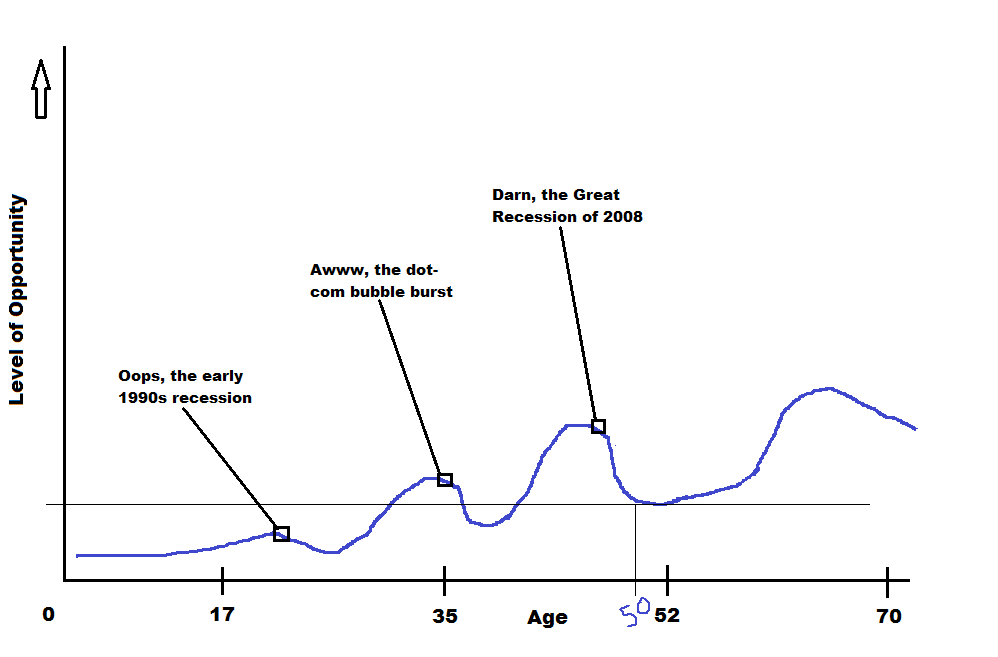
Picture with me career advancement as a made-up metric called “level of opportunity” (hey, it’s no weirder than the term “utility” used by economists). Granted, there is no way to project across a population how successful each individual will be, due to the unique circumstances of each person. What this metric measures, then, is what the chances are (the probability) that someone at that age will be able to achieve career goals and a satisfying return on their education.

Normally, the expectation is this:

oppur_graph1

Generally, under normal circumstances, one’s level of opportunity rises with age and experience (ignoring other factors such as financial means, gender, and race). As you get older and accumulate more experience in a career, you are regarded as more valuable. You have a greater ability to receive higher pay and to make a positive influence on your field of expertise. The curve drops off around retirement age.

This stands in contrast to what people of my age group have been dealing with:

oppur_graph2

As you can see, instead of rising over the years, our professional lives have been slammed with repeated setbacks that have left us far below where we expected to be.

I thought that by now I’d be in a position to make a difference in this world instead of continuing to be underemployed, plodding toward retirement. As I approach the 50-year-old milestone, I am only as far along as someone in their early thirties.

I actually know several younger people who have surpassed me, doing what they enjoy in a way they want to do it, including:

  • a senior principal at the National Rural Electric Cooperative Association,
  • the senior manager of communications at the Share Our Strength non-profit,
  • the executive director of the Association of Clean Water Administrators,
  • the chief executive officer of an international luxury jewelry company, and
  • an assistant television editor for such programs as “Jennifer Falls,” “Whitney,” and “Mulaney.”

In addition, I know many others who’ve started their own businesses.

This proves two things. First, being too young is not the problem. For years, I told myself that if I just was patient a bit longer, my worth would be proven, my years of service recognized, and opportunities would open up. Now I’m convinced that ain’t gonna happen.

And second, my generation–or my slice of it–is especially blighted. Due to the fickle nature of economic and demographic trends, we, for the most part, have missed out on the benefits that should have accrued to us. We’ve been overlooked, swept aside by the tides of history and there’s no going back.

The upshot is this: for those of us who are low on the opportunity totem pole, the impacts to our lives are very real and quantifiable. We don’t get asked to join meetings or conferences, which in turn means we have a very small network of colleagues. Our contributions are undervalued, which leads to a corresponding devaluation in our career field, both inside and outside of our organizations. This can lead to lower than average salary and fewer chances to move up. We don’t get asked for advice or input despite the fact that our ideas are as good as, or maybe better than, those of better-known colleagues. We aren’t recruited for new job openings.

Which only reveals one thing that we already know: life ain’t fair.

Now that I’ve vented a little, maybe it’s time to get something done.


Stay tuned: in the next few days, I will be inviting folks to take a survey about how your work/life attitudes may be affected by your generation. I hope you will participate.

Twenty-five Years of Nothing

celeb90

On the eve of my 25-year college reunion, something struck me in a recent article in the Washington Post, something that made me take notice:

The first decade of the 21st century produced two recessions and two “jobless recoveries,” and when it was over, the vast majority of Americans found themselves no better off than they were a quarter-century ago.

This is the career landscape into which I and my classmates graduated. Hopes of finding meaningful work have all but evaporated over time. We are now just trying to get by.

I’m not struggling, by any means. I and my wife have healthy incomes. But we have two children nearing college age. We live in a modest house with a modest mortgage. We have two modest cars. We go into debt to take a modest vacation once in a while. I’ve been laid off once, so far.

In contrast, by the time he was my age, my father was the president and part owner of a company in San Francisco that employed hundreds of workers. There is no way I will ever reach that mark now.grads

Nor will anyone of my generation. As I have said elsewhere, people who graduated from college between 1989 and 1992 have, for the most part, vanished from the public sphere. It does not mean that we are not smart enough, or talented enough, or ambitious enough. Rather, it has everything to do with the economy.

And, for those of us who are doing reasonably well monetarily, we are paying in other ways: lack of career advancement. We will shuffle through our mid-level jobs, never rising to our potential. There are consequences to that.

We are part of America too, so our story is America’s story. The Post article wraps up with this:

[America] has waited decades for middle-class jobs to come back, through a loop cycle of political bickering, to no avail.

I can vouch for that.