The Middle-Aged Man and the Aging Parents

I am just shy of 60 years old and both of my parents are still alive. I’m pretty sure this is unusual and puts me in the minority.

Most of the people who are my friends or acquaintances have at least one parent who has passed on. The fact that I have both still above ground puts me and my brother and sister in a small club.

According to research conducted last year, 45% of people who are 59 have at least one parent still alive. That drops to 10% when turning 60. Other research says that upon reaching age 50, the percentage of people who have both parents still alive is around 40%.

To be frank, to have both parents still alive at this stage of life is a blessing and a curse. It is a blessing of course for the obvious reasons; I am able to talk with them, either in person or on the phone, and thus am able to share in their lives for a little bit longer. It is a widely held belief that people like me are fortunate to have both parents still around.
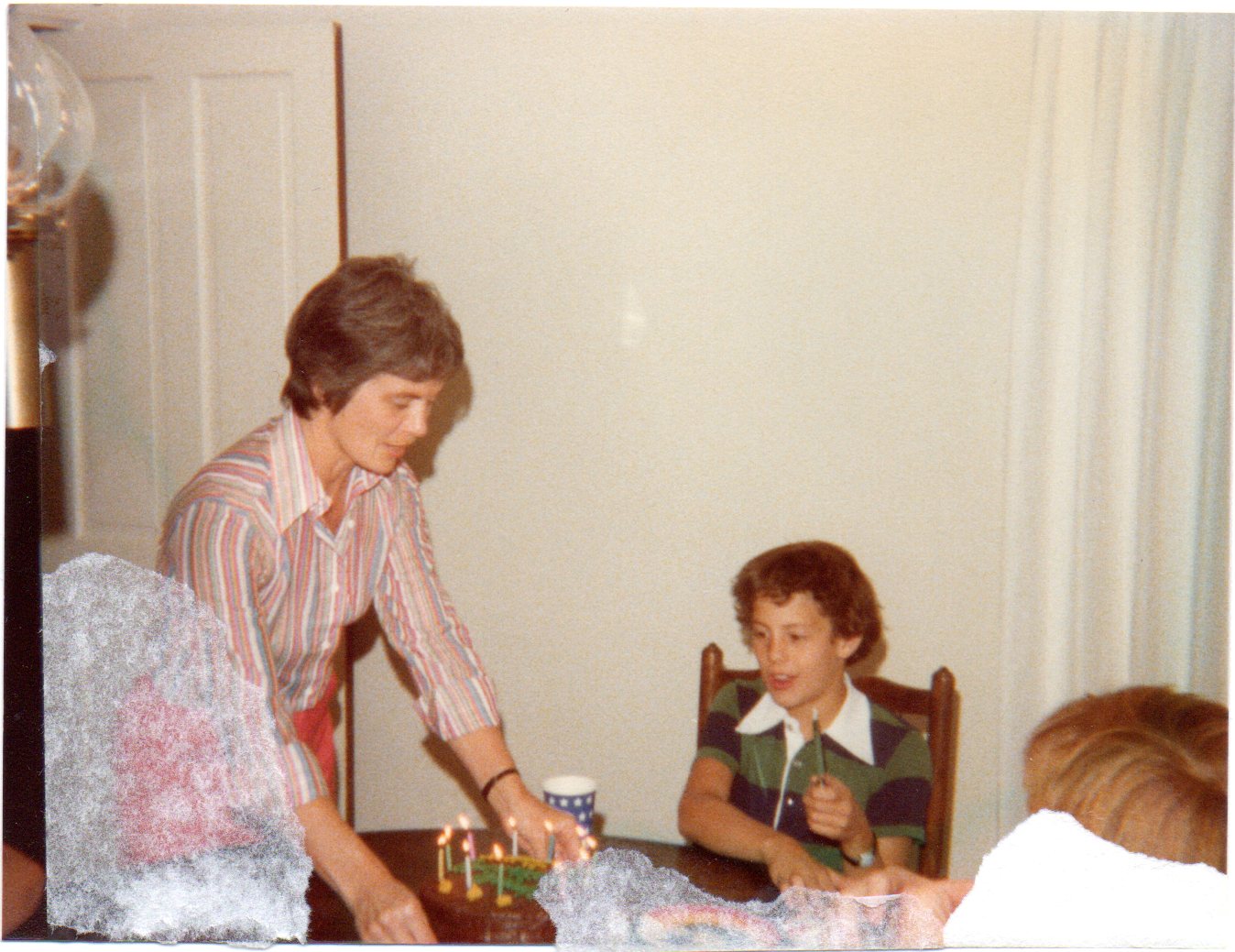
My mother presenting me with a birthday cake, August 1978

But there’s the other part. I would have thought that by the time I was 60 I would be out from under the scrutiny of my parents, free to live my life on my own terms. I have a wife and children to consider; I don’t enjoy having parents to consider as well. They are both set in reasonably comfortable living situations in continuing care and retirement communities (separately because they are divorced). But with every year I and my siblings are taking on more and more responsibility for their financial and health needs, things they can no longer sufficiently do for themselves or that the CCRC is unable or unwilling to do.

I’m not suggesting they depart to suit my needs. However, each passing year adds to the strain. I know it won’t go on forever but there’s a part of myself that I hold in reserve that is directly related to this situation. When will I visit them next? And which one do I visit next, since they don’t live in the same CCRC, or the same city for that matter? What if I have to travel to one of them on short notice because of a medical or other crisis? Is each visit going to be my last visit? Do I need to be still concerned about their expectations for me? Is there something between us that remains to be said?

None of these would be an issue in an alternative situation.

Much as been made of the sandwich generation, often defined as people with at least one parent still alive and at least one adult child receiving financial support. To the casual observer it seems like a minor issue but I’m here to tell you, it is not.

Among other things, parents present something of a conundrum. They beget you in a moment of intimacy that lasts a few minutes at best. Then you are their child for eternity–for better or for worse. It is often said that we don’t choose the families we are born into. Instead we have to make the best of the situation we find ourselves in, and that situation can create financial or emotional pressure that at times can be unpleasant.

In some cultures, much is expected of children with regard to their parents. This includes honoring all of their wishes and financially supporting them through death and burial. If there are people–and I know that they are out there–who have long-standing disagreements with their parents and yet still must honor their wishes and financially support them, I imagine that can create a serious strain.

I am not in that position, thankfully. Even so, I often wonder what it will be like when the day comes. Will I weep? Will I feel relief? I don’t know, and cannot know, until it happens. Because I am just shy of 60 years old and have never known a day in my life without my parents.

The Enigma of Departure

Most of the time, when you part company with someone, you fully expect to see them again the next time.

It’s just part of how human interaction works. The expectation of continuity allows so many of our institutions, from family to employment to government, to function.

And yet sometimes, there is a high probability that you could be saying your last goodbye. Managing that is not easy.

My mother is 88 years old this year. She had a stroke over four years ago that has left her disabled and dependent. She lives in a retirement home of her own choosing in California. Each time I visit, saying goodbye requires that I both believe I will see her again and know that I may not.

My father turned 90 years old in January. Obviously, he is in his twilight years. I haven’t seen him in person in four years, for a variety of reasons including, of course, the global pandemic. But we talk frequently on the phone. Each time I say goodbye, I hope we will speak again in a few days but also wonder if I have said all that I feel I need to say to him.

My sons are both adults and mostly independent. They come and go as it suits them. All it would take is some careless driving or an undiagnosed health condition to make that casual wave as they go out the door be the last time we see each other.

My wife was in a hospital in Baltimore, struggling to recover from a serious health emergency during the first half of this year. I was visiting her almost every day. But each time I left for the day, I carried with me the possibility that she might not make it until the next day. If I knew for sure that she was dying, I would not go home. But the doctors and nurses assured me that she’d be there when I returned. I had to trust them. And I know myself enough to know that if I try to get by with my reserve of energy at zero, I won’t survive either. That helps nobody.

So the goodbyes are loaded with silent meaning and unspoken hopes and fears. There is no other way it can be. I cast all my bets on there being a tomorrow with my wife, my children, my father, my mother. And then spin the wheel.

Giorgio de Chirico painting artwork

The Better Path

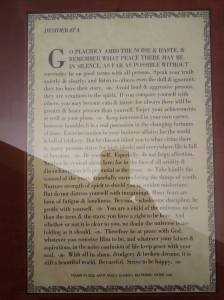
There is a fairly famous poem called “Desiderata.” You may have seen it before. The first lines are “Go placidly amid the noise & haste, and remember what peace there may be in silence. As far as possible without surrender be on good terms with all persons.”

Desiderata

I found a large framed copy of this poem recently as I was packing up my mother’s apartment. A little over a year ago, my mother had a stroke that requires her to live full time in a nursing home from now on. I remember this framed copy hanging in the house I grew up in, so it meant enough to Mom to have kept it for a long time.

My mother is a person of many contradictions. She can be both generous and cold. She is often critical and just as often accepting. She is relentlessly critical of some people but is capable of acceptance and forgiveness.  She voted for Trump but also has spent an unknown amount of money to support children in developing countries and also children with developmental disabilities in this country. She has done many things in her life but complains that she’s not accomplished anything.

The poem exhorts us to be the best version of ourselves and not worry overmuch about what might have been. “You are a child of the universe,” it says, “no less than the trees & the stars; you have a right to be here. And whether or not it is clear to you, no doubt the universe is unfolding as it should.”

And maybe that’s why mom has this framed copy, as something to reflect on when it all seems too difficult, as a way of reminding her to stop once in a while, take a deep breath, and try again. Perhaps we all have things that we put in place to remind of to strive for better and not succumb to the darker impulses. It might be a poem, a book, or a song. It could be rosary beads or a religious artifact. It could be a special picture or movie.

The thing is, even though the poem was parked in my mom’s closet and not hanging on a wall, the fact that she still kept it tells me that she is, at 84 years old, still in the process, as are all of us I suppose.

I’ve said before that knowing one’s parents is complicated, especially for those of us who have our parents in our lives for over five decades, and for those of us who have parents who have been difficult to understand.

So it can’t be said often enough that stopping once in a while, taking a deep breath, and trying again can lead us to the better path.