Perhaps Travel is Not the Key to Broader Horizons

Growing up in California in the 70s and 80s, one of the refrains that I occasionally heard was that travel outside your home will expand your horizons. But does it?

We all have our cultural idiosyncrasies that are a result of where we grew up and who we grew up with. The challenge, then, is what do we do with that. As a young person, I was very much a product of California, a state so vast and independent–almost as if it were its own country–that one could live a full and varied life and never once leave the state. (Some people live a crabbed and limited life and never once leave the state, but that’s a topic for another time.)

Anyway, I have family in New York and traveled a bit in high school, so I was not as parochial as some. But I had a lot to learn, and still do.

Which brings me back to my original point: does travel open doors to greater understanding, as some travel writers suggest? (A recent article proclaims “To travel is to learn.”)

My gut reaction is yes, it does. It seems to me that once you see that there are different ways to achieve the same or similar results, you begin to understand that there is not (with some exceptions) one right way to do things.

And if there isn’t one right way to do things, that means that there are multiple ways of being that are just fine. With an open mind, one will see, at the very least, that one’s preferred (or accustomed) way of doing things may not be the best way.

Growing up, I was acquainted with a elderly couple, Frank and Helen Hitchin. The Hitchins were devout Christians and had spent time doing missionary work in other countries to evangelize the message of Jesus. Frank had spent time in the Belgian Congo and later, both went to Tunisia. There may be other countries that I am not aware of.

In my memory, the Hitchins were stodgy and dull, despite all of their worldly travels. This may be explained by the fact that they were old and I was young. But my grandparents were also old and did not seem nearly as stodgy and dull as the Hitchins.

Photo: Amitav Ghosh

I have a copy of a letter from the Hitchins that I recently obtained. My mother and I were sorting through some of her papers and we came across this letter, written to my parents in 1979 when the Hitchins were doing missionary work in Tunisia.

Most of the letter shows very little in the way of compassion for the Tunisians. Rather, it it strikes me as condescending and tone deaf. It belittles the Muslims for being impractical and bound by tradition. It asks us to be thankful that we are not camel herders and complains that there is no good sharp cheddar cheese to be had. It says with a regretful tone that all the newspapers in Tunis are in either French or Arabic, and the Hitchins cannot therefore read them.

It on the one hand says, disdainfully, that the Muslims can be “fiercely loyal” to their faith and on the other hand says that serving the Christian God is a “privilege” that is welcome despite hardship. It also seems reluctant to call Islam a religion.

And finally there’s this: “Frank just commented that sometimes he feels like [the apostle] Paul — in our rented apartment, a ‘prisoner’ of the Gospel….”

This makes me ask: why were they even there? Did Tunisia leave any impression on them, other than that they were glad to be Americans? How could their missionary work have been effective if they didn’t speak the language, and showed little interest in the Tunisian people’s lives?

So perhaps cross-cultural understanding is not automatic. As much as I’d like to think that stepping outside one’s American existence to learn something new will expand one’s horizons, maybe that’s an illusion.

Or at least debatable. Some argue that the saying that travel opens one’s mind is a false adage. “Travel does not automatically make you a better person,” says Travis Levius, a travel journalist and hospitality consultant. This appears to be true of Mr. and Mrs. Hitchens. I’m not saying that they weren’t good people, whatever that means in the long run. But their travel in the name of Jesus did not, evidently, make them more compassionate towards people of cultures that were different from their own.

True compassion transcends differences in culture, age, language, or religion. And compassion, I would argue, was one of the main teaching points of Jesus. But more on that some other time.

Epilogue: Mr. Hitchin claimed that he would not die before the Second Coming of Jesus. He died in 1996. Make of that what you will.

[Updated 3/17/22 with some corrected information on Frank Hitchin.]
Things That Did Not Cause the Collapse of Society: A List

This week, a county school board in my area took a bold step in the direction of diversity, equity, inclusion, and frankly, justice. You may have heard the news.

Those opposed to this action have offered a variety of disconnected reasons that this was the wrong thing to do. They range from claims that the action will ruin our children (it won’t) or usurp parental rights (no more than other public education actions) to claims that the action will somehow interfere with their religious freedom (to discriminate). (Here’s just one example of hyperbolic reaction.)

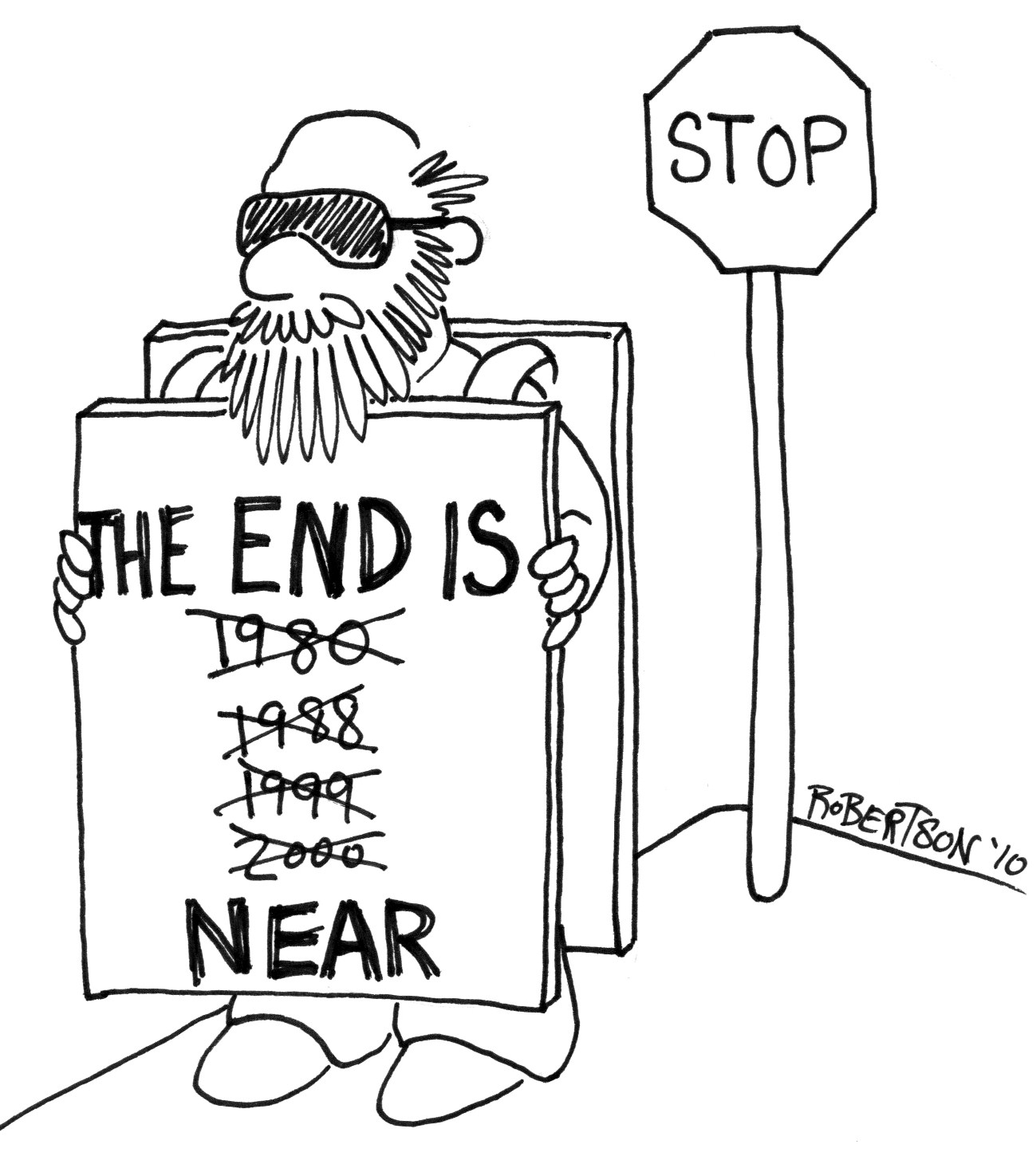
I would bet money that privately, people also are thinking that it is another step in the downfall of society, another inch closer to the end of the world.

People opposed to positive social change–let’s call them conservatives–have argued for literally hundreds of years that steps taken to improve a pluralistic society and advance social justice will lead to the collapse of civilization. Which we know now is absurd. But conservatives still use that argument today anyway.

So I thought I would make a list off the top of my head of some of the things that over the years did not in fact cause social collapse (approximately in reverse chronological order):

  • the legalization of same-sex marriage
  • equal funding for women’s education
  • affirmative action
  • allowing women to enroll in historically men’s schools
  • access to contraceptives
  • the legalization of interracial marriages
  • the integration of public schools
  • the integration of the Army and Navy
  • women working outside the home
  • giving women the right to vote
  • giving Blacks the right to vote
  • ending race-based enslavement of other people
  • removing the Church as an arm of the State
  • not doffing one’s hat or bowing to one’s “betters”
  • the scientific method

What does lead to a breakdown in social cohesion? Here a few things:

  • police brutality and a militarized State (ongoing)
  • lies and misinformation (ongoing)
  • environmental degradation (ongoing)
  • income inequality and entrenched poverty (ongoing)
  • unequal access to educational or economic opportunity (probably ongoing)

As usual, I am thinking of America as I write this. I realize that many other countries are at different stages of their journey toward a modern society and I wish them the best.

America can and ought to be better than we often are. I’m constantly amazed and saddened by how many Americans want to turn back the clock and erase so much of the hard-won progress that has been made over the centuries. At the same time, I understand that those people whose identity is threatened the most are the ones who will scream the loudest.

Which raises the question of who would create their identity around maintaining injustice and inequality? Think about it.

I, for one, think that regression to some imagined former “greatness” at the expense of general social improvement would be mistake.

P.S. It is good to remember that one’s personal opinions about how things “ought to be,” no matter how strongly held or deeply felt, are not “truths” that cannot be challenged. They are only opinions and can be heeded or dismissed as circumstances warrant.

Just a Paycheck

A comeback that is 25 years in the making can hardly be considered “snappy” but here it goes.

The first three years after I graduated from college, I spent in food service. And one day, on a day off, I was at a function with my now wife and some of her co-workers. I was sharing a conversation I’d recently had with one of the cooks at the restaurant I was working for at the time. I’d asked if he cooked much at home and he told me that most days he just makes a sandwich and has a beer.

One of my wife’s co-workers, who had some experience in running a restaurant, said something along the lines of “Well, he most not be a real cook, because the real cooks I’ve worked with continue to create in their kitchen at home.”

At the time, I didn’t know what to say. She was older, presumably more experienced, and I was not one to argue.

But in the intervening years, I have learned that, for many people, a job is…

Just.

A.

Paycheck.

It would be wonderful if we all could be gainfully employed in an occupation that we find ourselves uniquely suited for, that gives us companionship with colleagues and the satisfaction every day of a job well done.

But not every job is the perfect job, and not everyone has the privilege in their life of finding something that even resembles perfect. The laws of supply and demand remove many of our choices to somewhere beyond our grasp.

In the meantime, the bills have to be paid and there are mouths to feed. There is trash to be collected and sewers that need to be unclogged. There is vomit that needs to be cleaned up, roadkill that needs to be moved out of the road, asses that need wiping.

As I’ve said before, there are some people of a certain political point of view who say that everyone should be grateful simply to be employed. And I will allow that being employed has merits in an of itself. But the gratefulness is a stretch when the best you can say about your job is that it is just a paycheck.

So yes, there are certainly some “real cooks” out there who are passionate about preparing food. And then there are others (probably many others) for whom the work at the stove and the plating of the food is just a means to an end. When they clock out, they’d rather not think about it until the next shift.

And it would be best not to confuse one for the other.

There’s a fine line between “work[ing] like a soul inspired until the battle of the day is won” and “hanging on in quiet desperation.” Most of us take comfort believing that there are working heroes, who pour their soul into their occupation day in and day out (lots of TV shows about that). But if you peel back the curtain a bit, the reality is far more bland and nuanced, and we should neither think better of ourselves for it nor judge others (or ourselves) more harshly.

There. A not-so-snappy comeback.

Compassionate Inquiry on Wrongness

What do you call someone who privately knows they may be wrong about something but publicly advocates in favor of it, sometimes with intense fervor, because to admit they are wrong would be against their interests?

A weasel? An asshole? A hypocrite? A lost soul?


A lot of political cataclysm comes from people doubling down on things because of an unwillingness to say, “Maybe I was wrong.” Those actions affect their lives but also the lives of all the people they come in contact with and cause a lot of damage for everyone else.

Actor Joel Edgerton, in the Washington Post


For a long time, people kept many of their opinions to themselves, for a variety of reasons. But today, people’s lives are so we’ll documented, and we have more ways of learning fact than ever before in history, that now we have many examples of this kind of clinging to wrongness.

For instance, there are those who cling to the belief that the Earth is flat. There are those who hold deeply conservative religious views and who show no interest newly revealed truths. We have people who believe there is evidence that Donald Trump won the 2020 presidential election.

Is this wise? If not, why does it happen with alarming frequency?

Based on casual observation, it appears that such persons take psychic refuge in what they are believing. Their belief system–political, religious, views of human nature–provides value to them, often in the form of a coherent narrative to their lives. Which is what belief systems have done for tens of thousands of years, so it’s human. But more often than not, such beliefs can conflict with new ways to understand the world. People willing to adapt will learn to adjust. Others, even in the face of evidence, dig in their heels.

At that point, the humane thing to do is quietly but firmly inform them of their wrongness, be strong and ignore their continued attempts to assert their opinions, and be compassionate. Some of these people can be redeemed but many are so caught up in their belief system, sometimes with intense fervor, that they are essentially lost.

Interestingly, Jesus said much about hypocrites while he was teaching 2000 years ago, none of it good. Somewhere along the line, many people stopped listening to that teaching and instead doubled down on their out-of-touch beliefs. But also, Jesus–and the Buddha, and Hindu scriptures–teach compassion for the lost.

Wise teaching indeed.

Quick Note on Conspiracy Theorists and Iron John

I just finished reading a Washington Post article about, in essence, the deep connection between the new-age men’s movement and the idiots who mobbed the U.S. Capitol on January 6.

The gist is that at least some of the thick-brained Trump worshipers got their ideas from their reading of the men’s movement of the 1970’s and 1980’s. One guy in the article says it all started for him with reading Iron John: A Book About Men, by Robert Bly.

In the article, this guy praises the book and how it lead him to conclude, among other things, that “fierce protective men have been noticeably absent, and the women are standing up stronger and more vocal,” apparently a negative thing.

And I just have to say, I read Iron John–I have a copy in fact–and I would never vote for Donald Trump for president even if you paid me to do it. I wouldn’t elect him to the local school board, for that matter. And I certainly wouldn’t commit treason in his name.

So I’m missing something here. I just don’t see how someone could read a book about reaching a deeper understanding of masculinity beyond drinking beer, being violent, and having sex, and then claim that it leads to this QAnon bullshit.

Clearly, these White guys are searching for more meaning in their lives–aren’t we all?–but I would think that the absurdity of whatever falsehoods they think they believe in would sooner or later trigger the rational thinking alarm bells.

And to trace it back to a book where the intent was to fashion a more caring, more self-aware man is just nonsense. Or maybe they read a different Iron John than I read.