Run Baby Run

0930131740
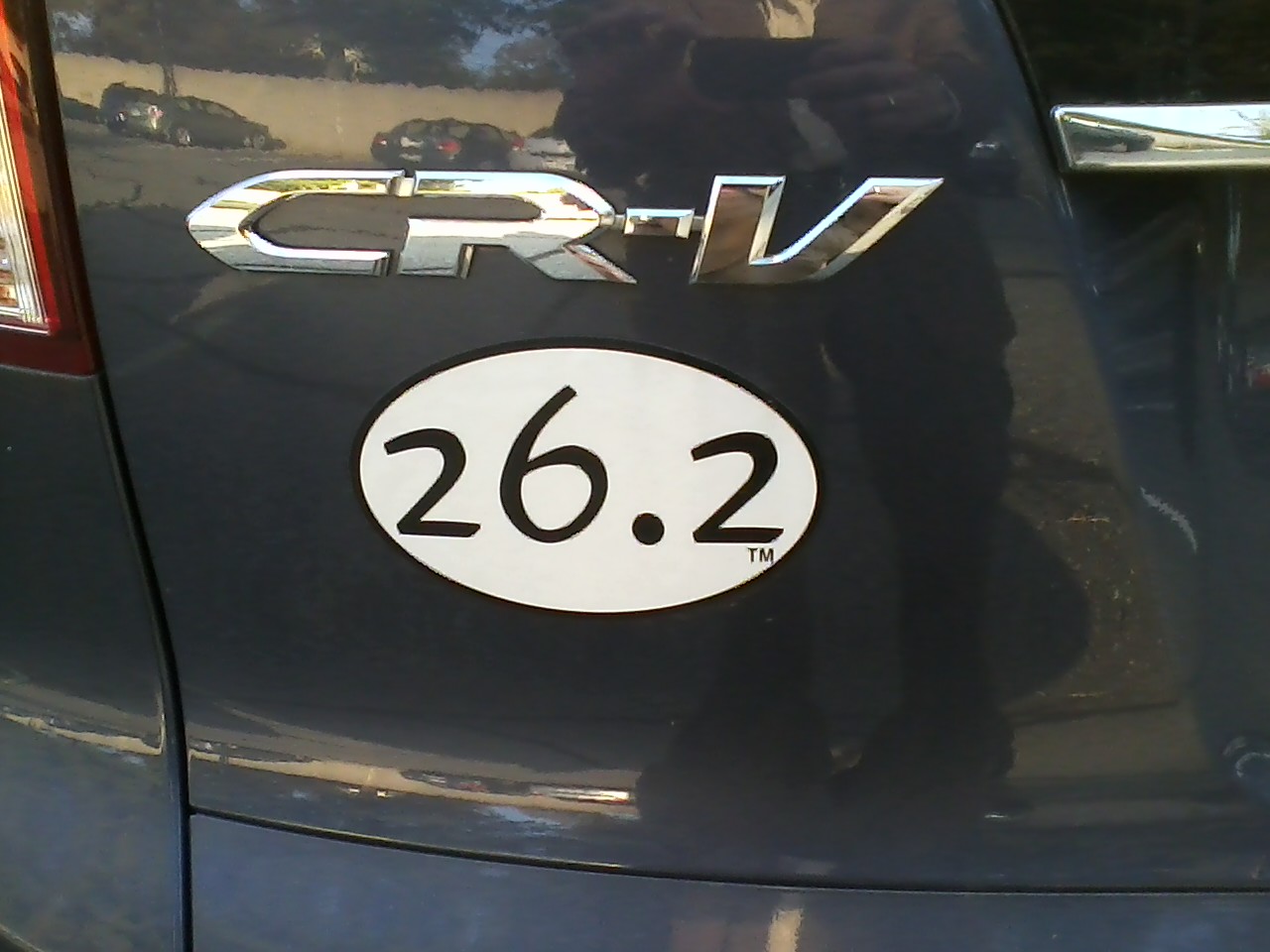
There are decals that I have noticed recently on cars in my area. They seem to be everywhere. For a long time I wondered what they meant because they simply are some numbers. Eventually, I figured it out.

26.2.

The number of miles in a marathon.

It seems that marathons are having their day.

As I have said before, I have a certain amount of ambivalence about exercise. I do what I need to do and no more. Marathons, to me, seem like way more than what’s necessary. So why are they so popular?

And when a “simple” marathon is not enough, how about one of these:

Antarctica Marathon — Run 26.2 miles on the coldest continent on Earth.

Death Valley Ultramarathon — Run (or walk) 135 miles in the hottest, driest place on Earth.

I don’t know whether to admire these people or feel sorry for them.

In another context, this would be considered self-flagellation.  And people generally think of self-flagellation as weird and vaguely fetishistic.

So why would the Antarctica Marathon attract 110 people in 60 days for its inaugural run? And why are there are 94 runners in the article about the Death Valley race?

What’s really going on here?0923130719 - Copy

I don’t buy into what the organizer of the Antarctic race says: “These are people who take the reins and ride life hard. They’re not afraid to take some risk and live life to the fullest.”

Personally, I don’t shy away from living life to the fullest. I’ve written for publication. I’ve played music in a band in front of live audiences. I’ve donated a kidney.

But I think there is something unhealthy about all this so-called physical fitness. I don’t think of these marathon exploits as living life to the fullest. Rather, I think it’s madness.

Maybe that’s just me.

0926130726

The Voice Inside

I have this voice inside of me. It’s only now beginning to speak. It’s only now able to ask for what I need. It is only now finding the words, reaching through the voices that have been with me since childhood.

question marks
When we are babies, our needs are simple and our voice is simple. When we are hungry, we cry. When we are tired, we cry. When we wet ourselves, we cry. As we mature, we gain the ability to say more, ask for more, express more. At the same time, our needs evolve, and so does the voice that grows within.

I am forty-six years old. It has taken these years for this voice to develop. If I had lived to only thirty-five, I would not have felt the emergence of this voice. I would not have reached this developmental milestone, would never have known what this new stage feels like.

Some of have said that we have emotions of which we never speak simply because we don’t have the words to describe them. Perhaps we all are waiting for the voice inside to find a way to express what truly matters to us. It is not the voice of raw childishness (“I want” “pay attention to me”), nor is it the voice of rational adulthood (“you can’t” “you shouldn’t”), but rather a third voice that can only emerge when the time is right.voice

In the Bible, Jesus says “Ask and it will be given to you; seek and you will find; knock and the door will be opened to you.” These are good words to live by, but it seems that Jesus glossed over an important point. How can you ask for something when you don’t know the words to frame the question? Without a voice with the ability to express the need, the searching question lingers inside you, unformed.

I have this voice inside of me. It’s development is something over which I’ve no control. It has simply appeared and is with me now. It’s as if I were to suddenly grow a third arm, the seeds of which have been with me since birth. What should I then do with this new arm? Should I have it cut off because it’s “not normal”? Or should I make the best use of it that I can?

This voice has been silent all these years. I can feel it as it stretches, reaching for the words, finding the way to express what I need and formulating the right questions. If the eyes are the window to the soul, then the voice is the door. And the door is opening.
Open

I will listen as the voice speaks. I will give it the room it needs to grow, hushing the other voices that are louder and have been with me longer. I will hear what it’s saying and trust that it knows of which it speaks. Maybe, just maybe, it will become a friend and companion for this second half of my life.

With all due respect and credit to Tori Amos for the phrase “silent all these years.”

Exercise and It’s Discontents

I crossed the finish line. My time wasn’t great, but I completed the 12 kilometer San Francisco Bay to Breakers race. In 1986, I was young, slim, and reasonably fit. From what people said, it sounded like fun, so I did it.

And how did I feel? Honestly, I felt neither exhausted nor euphoric. I felt nothing, really, except the pain in my knees the following day. It was a task I set out to do, and I completed it. I had no doubt that I would. And I had no expectation that I’d get the “runner’s high.”

Twio X | Parkour Leipzig
I’m still waiting for the day when exercise releases endorphins into my brain, giving me that euphoric feeling after a strenuous physical workout. When is it supposed to start happening?  Please tell me, because I really want to know. I’ve been waiting 4 decades for it.

Frankly, exercise leaves me with only one, simple feeling: tired. That seems normal, doesn’t it?  I’ve put out effort, I’ve burned all my calories. What else should I be expecting?

Euphoria, apparently.

That’s not to say I don’t have my exercise routines, because I do. I make a point of walking for 20 to 30 minutes each day, outdoors. And I lift weights on a regular basis.  If I’m being really good, I ride my bike once in a while. But these all have side benefits independent of any expected euphoria. Walking and biking get me outdoors. The weights allow me to avoid being embarrassingly unmanly when I have to lift something.

They are not, however, driven by any passion or expectation of euphoria. My exercise is a necessary evil, a means to an end, not an end itself. It is like sex in a passionless marriage, or the routine of a dull job. I do it because I’m supposed to, and I pretend to like it.

I could really use a dose of that alleged euphoria I hear so much about, though. It might make a difference.

My Facebook Experiment

A few years ago, I joined Facebook. Reluctantly.

The members of the band I was in at the time thought that social media was a good way to publicize our gigs. Everyone else in the band was already on Facebook, and I thought it would give the wrong impression if the bassist were the only one who was not. Up until that point, I didn’t see the value of it. Facebook

So I joined. But I had one condition.

I felt that if I had to be on Facebook–if it wasn’t my idea–then I would do it on my terms. And my terms were these: with a few exceptions, I would not initiate friending anyone; I would wait for them to friend me.

I thought it would look phony if, after having dismissed social media, I suddenly joined and started friending everyone I could think of. Also, and more importantly, I wanted to gauge the level of other’s interest in being connected to me. One way to do that was to wait and see.

And you know what? Very few people have friended me. The usual suspects have–I could have predicted with 95 percent confidence the small number of individuals who would friend me–but a surprising number have not. For example, there are some people with whom my wife is barely acquainted–but who I have known for years–who have friended her, but not me.

I have to wonder what that means. Does that say something about me, or about them?

I would like to blame Facebook’s automated “find your friends” feature, which mines your address book and friends everyone whom you may have, at some point in your life, listed an email address for.

But, more likely, it is that I have some fundamental misunderstanding of the rules of social media, because they are essentially the same rules that govern social interaction in general. It has something to do with how attractive you are, how talkative you are, and how comfortable you are with the medium. Things like intelligence and humor do not come across well on Facebook.

And if that feels like high school, it’s because…well…it is like high school. In a recent article in New York magazine, writer Jennifer Senior points out that research indicates that all our social skills–the ability to pick up on cues or fail to do so–we learn as adolescents. Quoting work by Gabriella Conti, she says ” ‘Adolescent popularity,…it’s about interpersonal relations. High school is when you learn how to master social relationships—and to understand how, basically, to play the game. ” Or don’t.”

Underlying all of this is being able to effectively interact with people and make yourself interesting to others. This is a skill that is, for the most part, independent of media, although Facebook does amplify the extent to which one has mastered it, thus requiring the refinement of one’s social toolkit to avoid being annoying.

I’ve heard people say how connected they feel on Facebook, but these are people who were already connected in the real world. For me, Facebook has not upped my feeling of connection. Rather, it is one more avenue of communication that I suck at. Most days, instead of updating my status with some inane personal detail, I find myself thinking, “Why bother?” and “Who cares?”

The bottom line is that social media is little different from any other social situation. Those who understand the rules are rewarded, and those for whom the rules remain mysterious are marginalized or even penalized. I know of a number of people who’ve tried Facebook but have since deactivated their accounts. “It just didn’t work for me,” one guy told me.

I continue to use Facebook on occasion. Often I go more than a week without even logging in. Sometimes I wonder why I use it at all.
The Enigma of Hair

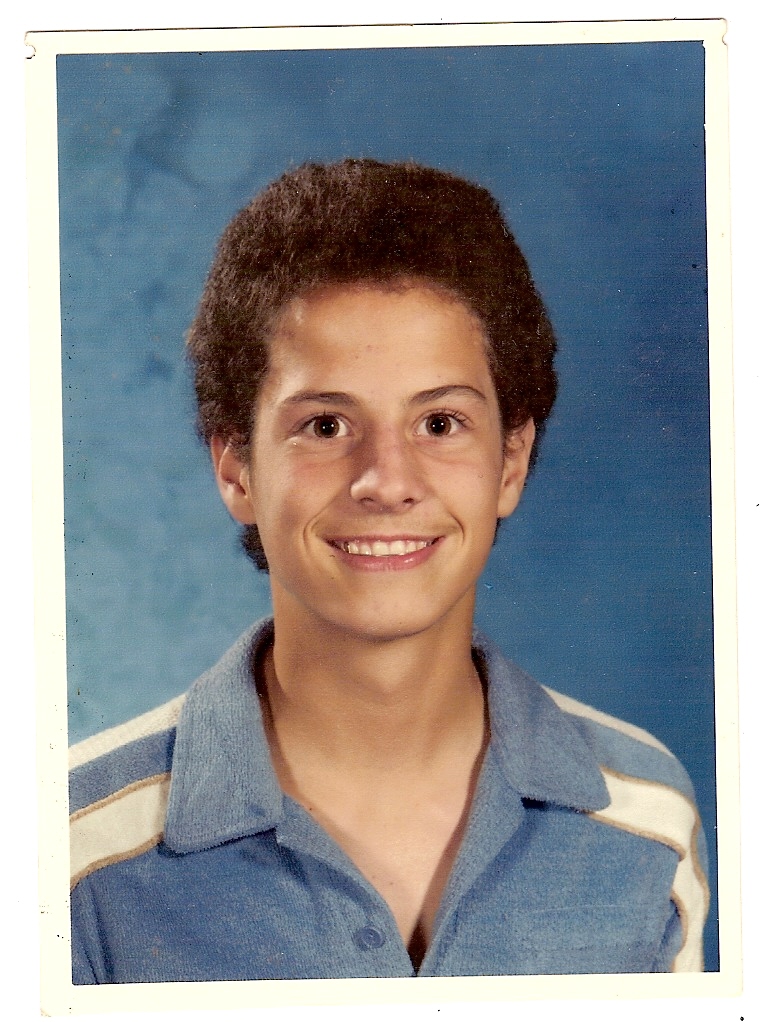
For nearly 15 years, I hated my hair.

I know what you’re thinking–it’s a long time to be in conflict over something about which one can do little. A few years back, I reached a sort of truce with my hair and began to accept it for what it was. But it is an uneasy truce, one that threatens to erupt into conflict again at any moment.

So you can imagine my surprise when a woman I’d never met before stopped me recently to tell me I have “gorgeous hair.” I was flattered. Furthermore, it made me reassess my feelings about my hair.

Me at 4 years old.

Me at 4 years old.

When I was born, I had straight, blond hair. Somewhere around 8 or 9 years old, however, it began to darken and curl. Having lived with one kind of hair up to that point, I was unprepared for this change.

Curly hair does not run in my family. Both of my parents have essentially straight hair. Of my two sisters, one had straight-as-straight-can-be hair, and the other has what I would call wavy hair. My younger brother has wavy hair too. Mine is undeniably curly.

My mother tried to blame the change on me, that I was not taking care of my hair properly and so causing it to curl. In hindsight, I see how ridiculous this is, but at the time, I listened to my mother. So I washed it excessively, combed it excessively, and tried different hair cuts, all in an attempt to bring back the flaxen hair I had. It was no use.

Me at 11 years old (with orthodontics).

Me at 11 years old (with orthodontics).

I was at a loss for how to care for my new hair, and in fact was doing more damage than if I’d just accepted it and let it be. This being the late 70’s, what I wanted was hair like David Cassidy–long, rich, flowing hair. I tried to grow mine longer, but it went cockeyed, poofed, and frizzed. I looked more like Gabe Kaplan, and I wasn’t amused.

Hair is a strange thing, if you think about it. Every other mammal on the planet is either completely covered in hair or is completely naked. People, on the other hand, have this strange patch on the tops of our heads. It doesn’t seem to serve any functional purpose, so we create meaning for it. Native American men grow their hair long as a symbol of their strength and cultural identity. Sikh men grow long hair as a symbol of piety. Buddhist monks shave theirs off, also to show piety.

Me at 15 years old, with frizz in full swing.

Me at 15 years old, with frizz in full swing.

It’s hard for an individual to be accepting of what one’s been given when culturally we don’t seem to know what to do with our hair.

To this day, I normally don’t think of my hair as an asset.  So to have a complete stranger tell me my hair is gorgeous came as a bit of a shock.

“Really?” I said.

“It’s like Richard Gere hair,” she said, smiling.

Wow. Who knew?