Fighting the Battle, Losing the War

The international bestselling Italian author Umberto Eco once addressed this question: why is it that Superman, the most powerful being on the planet, spent his time combating petty criminals?

His answer was that Superman exists not to change the structures of a society based on representative democracy and capitalism. Rather, he serves as a morality tale for the masses who must live their daily lives within those fixed structures. He is an example to be emulated but not a champion for changing the way our world is organized.

Thus, Superman uses his phenomenal superhero powers in what is essentially hand to hand combat in the trenches, rather than trying to stop the war.

In the same vein, it seems to me that a majority of employment law and labor management has been built from and centered around what could be characterized as petty disputes between employee and immediate supervisor. In other words, complaints and conflicts and lawsuits over workplace issues deal most of the time with the friction that occurs between a manager and the people being managed.

But isn’t the real villain bigger than that? Isn’t it the work that people are being asked to do, and the company employment policies, and the income disparity between managers and workers? Isn’t it capitalism itself?

In my career, I have been both a middle manager and a non-management employee. I’ve seen things from both sides and I can say that both sides are constrained by the systems within which they must operate. Sometimes the strain between an employee and their manager is just a manifestation of a manager having to implement poorly considered policies, or an employee acting out due to problems at home.

I can envision a way where the petty interpersonal frictions would be eased with the application of broad systemic reforms. Things like better access to mental health care. Or single payor health care that is independent of one’s employment. Or less systemic racism. Or universal basic income.

If successful, I would expect that the number of little bickering disputes would decline, along with a decline in the number of lost work hours, lost productivity, and people holding bitterness and grudges against each other. Instead of litigants duking it out in a court of law day after day, year after year, time and effort could be put toward making the world a better place for everyone.

For all our feelings of having made progress and living in an age of advanced development, we are still very much a reactionary species, where we fight the next skirmish and never seem to spend too much time wondering why the conflicts never end.

Kids These Days

We have a problem. There is a generation of young people, now entering the workforce, who have become disillusioned with the largely unrealized lofty ambitions of Big Tech.

Yes, these young people have been raised with this technology and accept it as part of daily life. But for them it holds neither magic nor promise.

Increasingly, many of these young people want to free themselves from Big Tech and it’s demands of loyalty. They want a life lived more on their own terms, working with physical materials and time honored processes. They want to grow food, weld metal, make things with their hands.

But Big Tech is a hungry monster. It insists that young people enter STEM careers. It demands that they use established platforms and no others. It tries to make sure they don’t think for themselves, that they just become more bricks in the wall.

It’s a problem.

There will be a backlash. Those who are willful enough will resist the demand to enter a STEM career. They will become artists, musicians, farmers. Big Tech will complain about how there are not enough trained workers, that America will lose its business edge.

Whether society chooses to make these free thinking young people feel bad about their choices, or instead embraces their aspirations — that is up to us.

The Trending of Trends

For a few years now, Google has had an idiotic feature by which a user can see “trending searches.”

In case you have not been paying attention, “trending searches” are search terms or strings that are very popular with the masses. I don’t know how Google determines this (frame of time, country of origin, etc.) but I do know that Google records every search everyone ever makes in the search engine. So these trending searches somehow compile this for display, from all the billions of searches being executed every day.

Presumably, Google assumes that users will see these and think to themselves “Hey, everybody is searching for information on third round draw carabao cup, so maybe I should too.”

This is the twenty-first century equivalent of herd behavior, people madly rushing about (virtually, of course) trying to get to the next great thing, and beat others to it in the process. It is mindless behavior, mob mentality.

And it is of course an extension of Google’s autocomplete feature, where it suggests searches based on what you begin to type in the search box. These are searches that, according to Google, “have been typed previously by Google users or appear on the web.”

Evidently, Amazon now also thinks this is a great idea and is using it. Amazon, of course, logs every search everyone ever makes on their platform too.

I don’t know how successful this feature is, but with Google it cannot be turned off. (Apparently, you used to be able to turn it off but I don’t see that option now.)

Believe me, I would if I could.

Because I will never click on a trending search. Why? Because I just don’t care. I don’t care about what searches other people using, and I don’t care about that for which they are searching. Why should I? They are not me, and I am not them.

I am myself, and I’m reasonably self-aware. Other people’s trending searches will have miniscule relevance to my life. I would think the same is true for most other people.

And yet here we are.

Poison Gas, Driverless Cars, and You

The Nobel Prize-winning chemist who discovered the method for creating synthetic ammonia for fertilizer went on to invent the chlorine gas used to devastating effect by the Germans in World War I. He did it because he loved his native country and believed in their ability to win the war.

In the 1930s, a medical scientist was hired by the leading manufacturers of asbestos products to conduct a study of the health risks. He downplayed the negative effects of asbestos exposure on workers at factories and job sites, believing that American industrial progress and fidelity to authority was more important than the human lives being put at risk.

The scientists who worked on the Manhattan Project to develop the atomic bomb used on Hiroshima and Nagasaki did so out of a sincere belief that they were doing their duty to protect America.

Should these people have stopped somewhere in the process and reflected on what, exactly, they were doing? I think they should have.

Science is not always pure, and technology has a way of finding its own worst use.

I think about these things as I read stories of the mad rush to invent driverless cars. We are due for some self-reflection about whether this really is the direction we, as a society, should be taking.

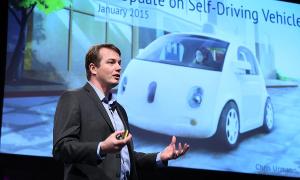
Google's Chris Urmson

Google’s Chris Urmson driving down the wrong path.

The scientists and technicians who are developing autonomous vehicles sincerely believe in the potential benefits of their work, I’m sure. They explain how it will bring mobility to the elderly or the disabled, save countless lives by avoiding car crashes, improve fuel efficiency, and require less space for parking lots.

Who could be against that, right?

Except that driving a car is, most of the time, a solitary act. Single-occupant vehicles on any given workday make up more than half of cars on the road. With estimates ranging as high as 76 percent, it is clear that we still prefer to drive alone.

And other emerging transportation technologies, such as the ride-sharing models that are being pushed by for-profit companies Uber and Lyft, perhaps are not as sustainable as they want us to believe.

In this world filled with countless ways to communicate and travel, we are still consuming resources and are more lonely than ever.

So instead of creating yet more ways of being alone, society instead should be putting additional effort into social means of transportation–bicycles, buses, trains and other forms of transit. It is only by looking each other in the eye day in and day out that we maintain our ability to be civil and retain our essential humanity. That, and it uses less roadway.

The driverless cars that some believe will help humankind may instead be individual coffins.