We’ve Stopped Fighting, My Transgender Son and I

We’ve stopped fighting, my teen-aged transgender son and I.

Sure, we still go at each other over the stupid little things in life, like who gets the bathroom first, or not cleaning up in the kitchen. But it feels like the transgender thing is a done deal. It is no longer the silent animosity that poisons our personal atmospheres. He needs my support, doubly so since things will never be simple for him.

It was time to end the war.

I don’t know what it was, exactly, that tipped the balance. Since my child came out four years ago, I’ve been reading and listening and learning what I could about transgender. But a few things recently seemed to strip away for me the distractions and get right to the heart of it.

And it was as if a switch had been flipped, like I had crested the ridge of a mountain and could now see clearly the view from that height. This is not to say that the rest of the journey will be perfect. Only that this milestone is behind me now. Behind us.

He may not have seen it quite yet. Or maybe he senses a subtle shift in my approach, my tone. I know that he thinks I should’ve accepted all this years ago.

But I didn’t accept it at first. I was heartbroken, and grieved instead for my beautiful daughter who now does not exist. My now son shares her memories, but he also carries with him those years of anxiety, self-doubt, and self-hatred. And the uncertainty about whether I supported him and loved him.

We are lucky to have avoided the suicide that plagues so many families of trans kids. I hate to consider how close we may have come.

What do all parents try to teach their children? To believe in themselves and to not waste effort trying to be someone they are not. I couldn’t convey that message to my own child if I continued to oppose who he sees himself as being. For him to believe, I have to believe too. Without that, I look like a hypocrite.

Today we have an appointment with a surgeon who will remove my child’s breast tissue. This was something I was very conflicted about, but now, by taking this step, I am moving beyond just passive acceptance. I am putting my support and commitment into action.

The Ghosts of Loneliness

The month after the September 11th terrorist attacks, my wife and I decided to visit the harvest festival at Cox Farms in Virginia. She’d heard about it from our neighbors so we took a Saturday to see what it was all about.

It was a windy fall day with clear skies, and the festival area was already busy when we arrived. From the parking lot, we walked through the entry gates into an open, gently sloping area bordered by corn fields. Pumpkins, straw bales and gathered cornstalks decorated everything.

Our two-year-old daughter, bundled in layers, ran to the first activity area. It was a small stage with percussion instruments for the kids to play. Some music was coming through a sound system and my daughter picked two drum sticks and banged along on a log. My wife and I sat on some hay bales and watched the somewhat chaotic “music.”

My wife and daughter at Cox Farms in 2001.

My wife and daughter at Cox Farms in 2001.

I carried our younger child, not quite one year, in the carrier backpack. He was bundled too and hunkered down against the wind. He peered out at the activity around him but seemed content to stay in his nest.

Our daughter next wanted to try the long slide. Built into the side of a slope, I thought it would be daunting to a small child but she was game. At the bottom we waited and as she slid to a stop in the soft straw, she looked as if it were a bit much.

“Would you like to go again?” I asked.

“No,” she said. So we moved on to the next thing.

My wife and I had come to Cox Farms that day looking for something. It had been a rough year for us. Our son had been born through an emergency caesarian section when my wife had suffered a ruptured aneurysm while pregnant. The subsequent brain surgery, while saving her life, caused trauma that required months of rehab and supervised care. And all while we tried to raise two small children.

The aneurysm was an event that divided our lives into “before” and “after,” a clear marker that separated what we wished for our future from what was now actually achievable. The brain trauma also created a separation between “us” and “them”—those who understood what brain injury was all about and those who could not.

These twin difficulties worked in tandem to create a feeling of isolation for us. And the September 11th attacks only added to our desire to find connection with others and with a normal flow of life.

But we didn’t find it that day, nor for several years to come. The loss and the resulting loneliness were with us constantly, a formless presence that acted out when least appropriate, seeping into our daily routines and interactions. It seemed to live in our bones.

And now, these many years later, feeling that we’ve almost regained our footing, that visit to Cox Farms on a blustery October day seems like a story from another life, an alternative past. I’m saddened to think that our children may have sensed our lack of direction, that it may have shaped their views of the world. But it couldn’t be helped, not then and not now.

We were there for maybe an hour when my wife and I decided that we were ready to go. We walked back to the car and ate lunch in the back of our station wagon, hiding from the wind.

I Awoke to See the Surgeon Leaning Over Me

I awoke to see the surgeon leaning over me.

“It didn’t happen,” he said. “We had to cancel.” Then he disappeared.

I was in a fog of anesthesia so I had no choice but to accept what he was telling me. My memory of where I was slowly filtered in. A nurse handed me a bottle of sore throat spray and wheeled me into another room.

My wife was there, also struggling to wake up from the drugs. We’d scheduled to have my kidney transplanted into her, and now we were learning that it wasn’t happening. At least not as we had expected.

Doctors came into the room, while the nurses finished fussing with our IVs and blankets. My parents were summoned from the waiting room.

“I’m really sorry about this,” the lead surgeon said. “We didn’t have a sufficient supply of blood from the blood bank and I didn’t feel we could go forward with the operation.”

I tried to understand the situation, and I got more than my wife did, who dozed through most of it. Thankfully, my parents were there and lucid. I could compare notes with them later.
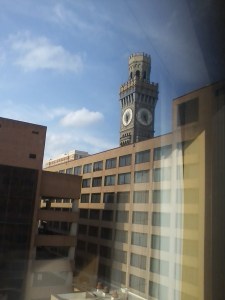
View of Bromo Seltzer Tower from my hotel.

View of Bromo Seltzer Tower from my hotel.

“We can reschedule for tomorrow, but I won’t be able to do it,” the surgeon went on saying. My parents grumbled about this, preferring–as we all did–to have things go as planned. We weighed the merits of coming back next week with the original team, or going with a new team the next day. Finally, we settled on a plan, thinking that we were already in Baltimore, all ready to do this, we might as well get it done now.

We were discharged for 24 hours. Thankfully, we had rooms only a block away. My wife and I roused ourselves sufficiently to walk back to the hotel, although I don’t really remember the walk. My parents told us to call if we needed anything, said they’d pick up the tab for the extra night. My wife and I went back to our room to sleep off the meds.

I texted a few key people–my sister-in-law who was watching our kids, friends who could spread the word–to let them know of the delay and then climbed into bed. The day moved about us as we rested. On the sidewalks below, people walked to and from work. Guests checked in and out of their rooms. The day moved to afternoon as we slumbered, with our hospital bracelets still on our wrists and gauze patching the IV holes.

We drank water, but food was of little interest. Our last full meal had been the night before, with my parents and mother-in-law in the hotel restaurant. It was good but I didn’t enjoy it much, feeling as it did like a last supper. Now, the only thing that sounded good was a granola bar; my wife had a bag of chips. Our systems must have been in low gear from the sedatives. It saved us the trouble of ordering a meal.

The day seemed in low gear too, and I decided to step outside and get some air. My wife continued to snooze as I left the room and walked out of the hotel.

It was on the warm side of normal for an August day in Baltimore. The city was preparing for the Grand Prix car race that was scheduled for Labor Day weekend. A racecar sat on display in the hotel drop-off area.

View from the hospital.

View from the hospital.

“This is your car, right?” I joked with the bellman on duty.

“Yeah, I wish!” he said.

I walked slowly on the sunny sidewalk. People passed me going both directions. There were a mix of tourists and folks going about their weekday routines. I wondered if anyone noticed my hospital bracelet. They certainly didn’t know that a few hours before I’d been deep in anesthetic sleep waiting for my kidney to be removed, only to learn that it wasn’t.

I had a strange feeling like I’d come to meet destiny but destiny was a no-show. What was I supposed to do now?

Of course, I knew that the whole thing would begin again tomorrow, but until then, there was open space.

I walked a few blocks toward Camden Yards, passing the Grand Prix barriers that were being placed along the race route. More hotels, and then the stadium was in front of me. The Orioles were not playing that day, but during summer, Baltimore is never more than a few hours away from the front end or back end of another baseball game.

Photo: Natalie Litz on Flickr

Photo: Natalie Litz on Flickr

I decided I’d gone far enough. It was time to head back to the hotel, to prepare for what still lay ahead.


This happened about a year ago, when we were in Baltimore, Maryland, to have the transplant operation, some details about which appear here.