Books That Will Go Unwritten

I think I could write a book.

It probably wouldn’t get accepted by a publisher, and even if it did probably no one would read it.

But that doesn’t change the fact that I am fairly certain that I could write a book. As in, I have the knowledge and the skills and the discipline to complete the project.

But I have not actually written a book and it seems unlikely that I ever will. There are several reasons for that.

One is my career and my ability to make a living. Early on, my career was satisfying enough that it was all I really needed. I didn’t engage much in hobbies or side projects. But after I was laid off in 2009, my professional work lost its appeal and it was then that I began to think about putting my energy elsewhere (like into this blog for instance).

A related issue is my inability to find a way to write the kind of book I want to write while not going broke or starving to death. To do justice to the ideas that I have would require significant investments of time and money. I just don’t see how I could keep my job and write a decent book. Nor do I see myself financing the effort from my savings and expecting to have the cost reimbursed from the publishers and from book sales.

Many published writers in the past few decades have not had to make that kind of choice. A discussion of women photojournalists–while talking about photographers and not writers–nonetheless sheds some light on the business of publishing: “The business has been taken over by a younger generation, many of which have alternate sources of funding, such as trust funds…. [E]ditors have sought out these self-funding talents. They had little choice. The new photographers didn’t mind, they needed the validation the publications offered and in the case of trust-funders, they didn’t need the money.”

For me it would mean quitting my current job and taking a leap of faith on a project with a very small chance of success. I’m not that much of a risk-taker.

Another is that I’m only recently figuring out, late in life, what kinds of topics I  am so interested in that I’d be willing to devote the time and energy into making it a full length book. For many years I was very focused on only a few ideas that frankly had done already by other writers, and I wasn’t  expanding into anything new. I could probably do it now but few writers find success late in life and the odds are against me.

There are actually three people who I know or have known through the normal course of life who have written and published books. One is Charles Bock, with whom I went to college. Another is Ellen Prentiss Campbell, a former neighbor and someone with whom I spent a few years in a writers’ group, reading some of her early work. The third is Andrea Jarrell, another neighbor and friend. They’ve been able to get their writing out there. I’d love to find time to pick their brains about it.

Back when Great Literature and Great Journalism were being written, the market for such things was almost assured. People had few options for leisure activity but to watch TV, see a movie, listen to radio, or read a book or magazine. The publishing houses thrived on high quality material and were always needing more of it. Bookstores were commonplace.

Today the tables have turned. Lots of people write or claim to want to write, while we have fewer and fewer places where this writing will be seen. As noted above, old models of success no longer apply. And if you have a decent bookstore within 10 square miles of you consider yourself lucky.

Which has me wondering: how many books are out there living as an idea inside someone’s head that will never see the light of day because the basic pathways of writing for publication have collapsed?

Sad to think, but it could be hundreds of thousands.
Remembering What We’ve Accomplished

On Friday, President Obama had this to say when visiting Hiroshima, Japan:

Science allows us to communicate across the seas and fly above the clouds, to cure disease and understand the cosmos, but those same discoveries can be turned into ever more efficient killing machines. The wars of the modern age teach us this truth. Hiroshima teaches this truth. Technological progress without an equivalent progress in human institutions can doom us. The scientific revolution that led to the splitting of an atom requires a moral revolution as well.

His thoughts are my thoughts too, this Memorial Day. Technology does have a way of finding its own worst use.

Indeed, I’ve been thinking a lot about where we’ve been and where we are, and where we are headed, as a nation and as a society.

Maybe it’s too much thinking. But we are all living with some measure of discomfort.

It can’t be too much to ask that we could be putting our efforts toward making things just a bit better.

Writing is a Crap Shoot

I want to let you in on something that I’ve learned the hard way: writing is a crap-shoot.

Case in point: Elizabeth Gilbert is the best-selling author of Eat, Pray, Love. I have not read anything she’s written, but I’m sure she’s a fine writer. Fine enough to impress the editors at Esquire magazine, where one of her unsolicited manuscripts was pulled from the slush pile and published–a dream that most writers can only hope to achieve. That one event catapulted her into a career as a writer.

editor

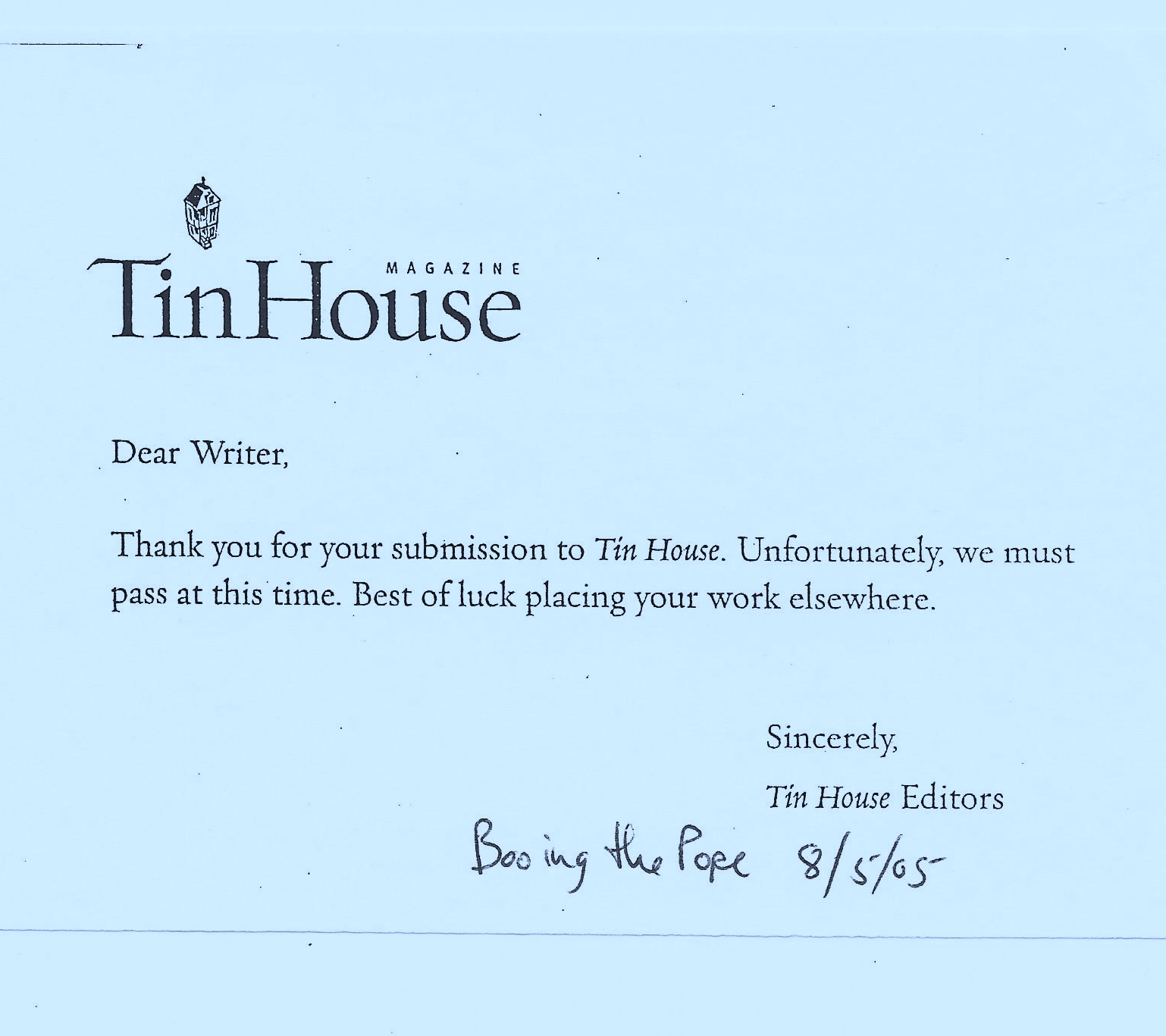
Actual rejection slip from an editor (I have many).

It does not mean that she is a remarkably better writer than all the tens of thousands who silently toil with no success. Let’s all admit that she got lucky.

And about editors–they are human too. They have feelings, they have biases, and they make mistakes. They can be arrogant, misguided, and sometimes they cheat, steal, and lie. But they are the guardians of the gate, and they will exercise their power to either make someone’s career or make sure that a writer is never heard from again.

Recently, I submitted a short essay to the Washington Post Magazine. For a few years, they have been running a regular feature where the essayist describes a small, seemingly unimportant object that has significant meaning for them. After six months (editors are soooo busy), I finally received a response from an editor. He declined my essay, giving the reason that, while it was a “powerful” story about my grandfather, “there’s not a particular narrative about the object in question–which enters late in the piece.” (I subsequently self-published the essay here.)

Quietly, I accepted his explanation, believing that my essay just didn’t meet the magazine’s standards. I don’t know what constraints exist in the magazine’s editorial processes, and figured that if I studied other published essays, I’d understand what he meant.

Yet, in a recent issue, an essay was published that included everything that this editor said was wrong with mine.

When editors contradict themselves so blatantly, it’s hard for me to take any of them seriously.

If anyone tells you that there is a writing community–a network of support where writers find strength–then they are lying. Writers and editors eat their own, and secretly (or not so secretly) rejoice in the failure of other writers.

A few years ago, I realized that I wanted needed writing to be a significant part of my life. The need is there, the drive and desire. Maybe it is just that I don’t have the talent. Or maybe that I’ve started too late, that I have too many other competing interests in my life, that I don’t have the time and the space necessary for proper reflection.

I continue to roll the dice, hoping that I may get that magic combination that will take me to the next level. But it’s possible that I will never find out.

Take a Survey: Attitudes about work and life

People have various attitudes about work and life. Some are enthusiastic about their careers while others are much less so. Some are optimistic about life while others find it a struggle.0206150838

Individuals, of course, are the product of a complex set of unique variables. But larger groups, affected by similar social and economic forces, tend to share similar views (called the “cohort effect”). These generations may collectively have attitudes about work and life that are noticeably different from each other.

Below is a link to a quick survey (three questions) that I hope will shed some light on this.

Take My Survey!

Let me know what you think in the comments section of this post. I will share the results at a future date.

Twenty-five Years of Nothing

celeb90

On the eve of my 25-year college reunion, something struck me in a recent article in the Washington Post, something that made me take notice:

The first decade of the 21st century produced two recessions and two “jobless recoveries,” and when it was over, the vast majority of Americans found themselves no better off than they were a quarter-century ago.

This is the career landscape into which I and my classmates graduated. Hopes of finding meaningful work have all but evaporated over time. We are now just trying to get by.

I’m not struggling, by any means. I and my wife have healthy incomes. But we have two children nearing college age. We live in a modest house with a modest mortgage. We have two modest cars. We go into debt to take a modest vacation once in a while. I’ve been laid off once, so far.

In contrast, by the time he was my age, my father was the president and part owner of a company in San Francisco that employed hundreds of workers. There is no way I will ever reach that mark now.grads

Nor will anyone of my generation. As I have said elsewhere, people who graduated from college between 1989 and 1992 have, for the most part, vanished from the public sphere. It does not mean that we are not smart enough, or talented enough, or ambitious enough. Rather, it has everything to do with the economy.

And, for those of us who are doing reasonably well monetarily, we are paying in other ways: lack of career advancement. We will shuffle through our mid-level jobs, never rising to our potential. There are consequences to that.

We are part of America too, so our story is America’s story. The Post article wraps up with this:

[America] has waited decades for middle-class jobs to come back, through a loop cycle of political bickering, to no avail.

I can vouch for that.