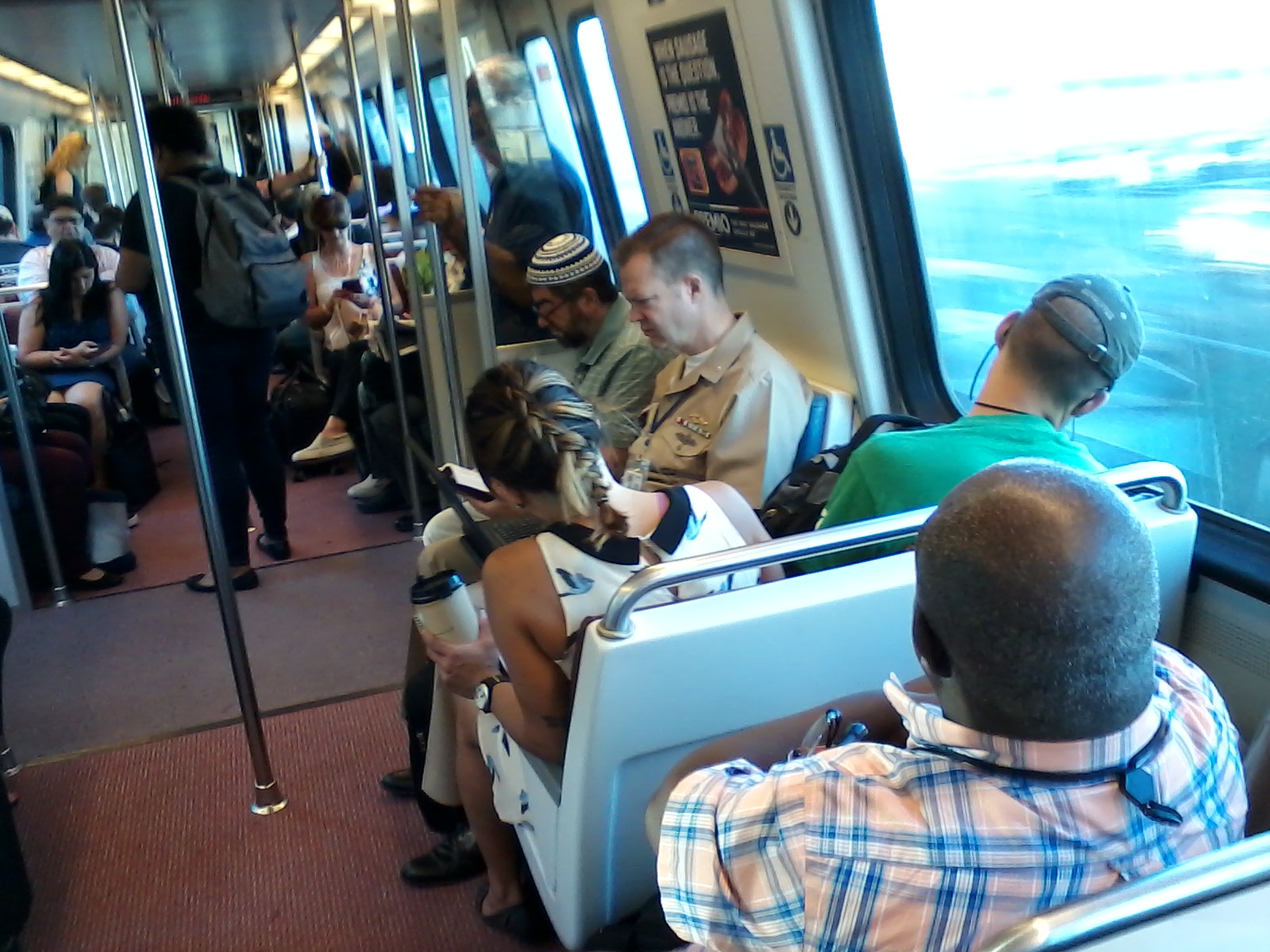
Public Transportation, for the People

My seat on the Metro train has an empty Bacardi bottle and a lime wedge.

The guy in the seat behind me is dancing along with the music in his headphones like nobody is watching.

The woman in the seat in front of me is talking on her phone. The contact on her phone says My Boo.

Sometimes, the person sitting across from me is reading a book in Chinese, and the person sitting next to me is reading a book in Russian.

Sometimes, street dancers will board the train and perform to loud music as the train moves between two stations, asking for money before they exit to try again on the next train. This is technically not legal but it sure is entertaining.

Life on public transportation is rarely dull.

On the Washington, D.C. Metro, one will see a whole palette of humanity, from drunkards to lawyers to tourists and families. There is Black and White, Asian and Latinx. There is young and old, healthy and infirm, and plenty of Queer people. Sometimes it’s so crowded you can barely move. Other times I’m one of only a few people.

It’s always good to be aware of one’s surroundings, but it’s equally good to notice who’s on board with you. Sometimes I’m surprised when my first impression of someone is proven to be wrong, when they turn out to be kinder or more gentle than they appear.

Sometimes tensions do flare and voices are raised. It’s not always a simple matter to squeeze so much variety into an enclosed train car or bus. But I have yet to see, after decades on the trains, any true violence.

Not that there’s no violence in the Metro system because sometimes there is, late at night or in less populated stations. But it seems usually more to do with personal animosity and unrelated to the “public” part of public transportation.

Riding public transportation requires an unwritten social contract: I leave you alone to get where you need to go and you leave me alone to get where I need to go. Without it, the effectiveness of public transportation breaks down.

People sometimes violate this social contract by doing such things as begging for money, getting into arguments or shoving matches, or trying to talk to someone who does not want to be talked to, especially if it’s about politics or religion.

But they remain in the minority. Most people I ride with don’t try to turn the bus or train into a market or an exclusive place where some people are allowed to ride and others are chased away. Which is good because I imagine there is a tipping point where there would be fewer and fewer riders because they don’t feel comfortable or safe. As long as most people get onboard because the bus or train gets them where they need to go, public transportation will continue to serve its purpose.

I realize that public transportation has a reputation, and I think it is mostly undeserved. It seems to be based on media portrayals of the New York City subway system, which in movies is always a crime-ridden place filled with bums, garbage and graffiti. I have not ridden the NYC subway, but I have ridden public transportation in Boston, Philadelphia, San Francisco, London, Munich, Paris, Auckland, and of course Washington, D.C. My experience has been that, when public transportation is properly run and cared for, it is something that ordinary people find appealing and useful. It is not something that caters only to the dregs of society.

There are people who fear public transportation even under the best conditions. As a result, they travel in their own private vehicles, isolating themselves from the public as much as possible. But that solves nothing and only contributes to many problems.

In the old fairy tale of Beauty and the Beast, the Beast lives in isolation and scares everyone away because of his arrogance, hatred, and selfishness. It is only when he allows himself to be in the presence of others that the curse is lifted.


What Would ‘Earth Food’ Be?

In most science fiction, when a planetary culture is described from some place that is not Earth, there is usually a unified planetary cuisine.

There is “Klingon food” for example, without mention of regional variations.

But on Earth we have literally hundreds of different styles of food, each related to the location where it is from.

So if friendly aliens arrived and wanted to eat “Earth food,” what would we give them?

In my view, it would be a dish made of meat and rice, with a beer to drink.

There are cross-cultural versions of meat with rice that span the globe. There is:

  • Chinese fried rice
  • Plov from Uzbekistan
  • Indian biryani
  • Arabian kabsa
  • Spanish paella
  • Arroz con pollo in Latin America
  • Arroz caldo from the Philippines

Biryani; photo courtesy of Wikimedia

Additionally, rice is the primary staple food for more than half the world’s population, which makes it a prime candidate for being “Earth food.”

As for beer, it has been a beverage for humans for approximately 5,000 years and is produced and consumed in nearly every nation today. Plus it goes well with a lot of food, including meat with rice.

I make a point of eating “Earth food” as often as possible. In fact I had biryani just the other day.

It’s not just that I enjoy the flavor, because I really do. More than that, I feel that I’m engaging with global culture, communing with millions of other humans who find the same food as delicious as I do.

This is especially important to me at this time in history. In my view, there is far too much irrational “us” against “them.” Far too much circling of the wagons. Far too much exclusion and not enough inclusion. Not enough finding common ground over a shared meal.

And if unfriendly aliens show up, and we keep on behaving this way, we will be ripe for takeover.

Unless we are able to win them over with our delicious “Earth food”.

The Dream Works Only if the Team Works

In the past couple of years, several of my colleagues have simply vanished from the workplace.

No announcements made. No fond farewell. Just gone — some of them temporarily, some of them permanently.

I have to resort to alternative means of finding out what’s going on. Are they still in our email directory? Are they still on LinkedIn? Because asking direct questions of management or coworkers is discouraged, arouses suspicion, and often results in getting no meaningful information.

Two people’s workspaces were left as-is for months, as if they were going to return. They never did. (Finally someone was assigned to box up their personal effects and ship them home.)

Here’s the thing: we are directed by the company to think of ourselves as part of a team. Managers are even called “team leads” rather than “managers.”

But this is no way to run a team. Because teamwork requires a reasonable, bi-directional flow of information.

Imagine being a member of a sports team. One day, you show up for practice and ask “Where’s John?”

Everybody shrugs.

You ask your coach. “I can’t tell you,” he says.

Game day rolls around. “Where’s John?” Nobody knows, or nobody is talking. And this continues for most of the season.

It’s creepy and it’s unnecessary.

And it undermines trust.

Trust, of course, is essential to teamwork. To continue the sports metaphor, if you pass the ball to a teammate, you trust that they will make the effort to receive it with the overall goal of winning the game. You trust that your teammates are watching out for you to avoid injuries and pull off the win. You trust your coach to not be giving you bad advice or dangerous substances (although trust in coaches has been diminished by some very serious abuses on recent years).

In the book Tribe: On Homecoming and Belonging, the writer Sebastian Junger explains that the essence of trust and connection is the belief that the individual is willing to sacrifice for the benefit of the group and the group is willing to sacrifice for the individual. It is a reciprocal understanding.

Here, that ain’t happening.

Which leaves me to wonder what is behind all this secrecy. Laws and regulations? Company policy? Distrust of employees? Wanting to keep employees unsettled and always guessing?

Because of it were just a matter of simple human decency, there would be more information, not less.

Truth (But Not Truth Social)

In the spirit of Independence Day, I hold these truths to be self evident.

(In no particular order.)

Everyone’s well being rests on three pillars: a gainful way to make a living; access to health care; and a community of support.

There are good things decent people do when no one is looking.

If this brings me joy, and it’s not hurting you, why does it matter to you?

The world makes more sense if you realize that most people have a reason for being the way they are.

We are more alike than different. We just need to have a shared understanding of what it is we are all talking about.

Love the prodigal, and be patient. See the person fully worthy of moral concern, extending love beyond the prejudices of your upbringing.

We are all on a journey toward acceptance, and some get there sooner than others.

Historically there are people who have a point of view that has been marginalized or silenced.

Science does not replace religion. But science does replace cultural traditions that masquerade as religion.

There are too many arguments that suffer from logical fallacies, based on emotion and ideology, the setting up and knocking down of strawman arguments, and the selective cherry picking and misuse of facts.

We must not support stating beliefs as “truths” that cannot be challenged.

I am divesting from militarism, from war, and investing in community, healing, and true liberation.

Liberalism creates freedom by lifting barriers and creating opportunity.

Tyranny is the arbitrary, unjust, and unrestrained exercise of power, usually executive power by few or one individual.

The State cannot demand that a pregnant person sacrifice their life, their fertility, or their health in service of “unborn life” particularly where a pregnancy will not or is unlikely to result in the birth of a living child with sustained life.

The biggest impediments to business are social inequality, civil unrest, corruption, and environmental degradation.

When high government officials have businesses, you have a conflict of interest. They are not looking at the country’s interest with these projects. They look at their own interest first.

In our times we see an increasing trend for people in the public eye to display ghastly levels of narcissism. These foul-mouthed, low-intelligence, often wealthy sociopaths, devoted to self-aggrandizement and the debasement of anything truly admirable, demand not only our unreserved celebration of their psychosis, but compliance with their ever-changing immoral opinions.

Prejudice, bigotry, and fear are setting the agenda.

The lesser man will win because he is playing to people’s ignorance. He offers empty dreams, but he is giving every voter a bag of rice, and they all want to believe him.

Criminals lie.

Beware of anyone who declares they’re the only one who can solve the crisis and seizes power indefinitely.

Being convinced of your own greatness is one of the surest signs of being crazy.

Success That Writers Crave

A few years ago, I posted a couple times in reaction to an article in the Washington Post. Not to beat a dead horse, but I have a bit more to say.

The article was written by Cynthia McCabe, who was e-mailed by a man, a complete stranger, announcing his intention to commit suicide. The reasons this man gave were that he, as a writer, had “said everything I wanted to say and consider my work finished.”

In my posts, I take issue with McCabe’s inability to relate to the man’s situation. Specifically, I found it strangely insensitive that a fellow writer could not sympathize with that man’s desire to have his writing read, and in that way find some measure of community that understood him.

Instead, McCabe’s article calls the man narcissistic and selfish, perpetrating an emotional mugging.

Narcissistic, just for wanting some success in his writing career. Success that all writers crave at some level, right?

In case further proof were needed, the latest magazine and course catalog from my local writers’ center includes a piece by a writer named Anu Altankhuyag, who has this to say:

I knew I wanted to continue writing as more than a hobby. I wanted to one day be able to walk through a bookstore and see my name on the shelf. Every writer does.

Including, one would assume, Cynthia McCabe. But seeing that desire in a fellow writer was too much to ask.