Was It Something I Said?

We broke up by email.

“Dear band friends,” it said. “I emailed Mike yesterday to let him know that I was planning on leaving the band and that I thought we should disband. We talked it over today and we are in agreement — while we may individually (and collectively) continue to play music in various configurations, the band is no more.  –Brad”

bassman

Me – the bass player – going for it at one of our better gigs.

I was okay with it at first. There had been some signs that foretold our demise. Our drummer had quit and we were struggling to find our sound without her. We needed to either a) locate a new drummer or b) figure out a new configuration to play our songs with what we had. So, it wasn’t much of a surprise that it just wasn’t going to work out.

But then, about six months later, I found out that, with a new band name, Mike was playing again with our singer. A few months after that, Brad had joined them and they played an outdoor gig nearby.

That meant that, besides the drummer who quit, the band was back together. Except without me.

I won’t say that it didn’t sting. Because it did. And it still does.

At the outset, the break up seemed unremarkable. I’d been with the band for four years, and Mike and Brad had been playing together for about six. We’d performed a respectable number of paying gigs and recorded a CD. But these kinds of things have a life cycle, and time was beginning to take its toll. The drummer quitting was the final straw, and while we tried to limp along for a couple of months, it wasn’t working and we knew it.

At least, that’s what I thought. But now Brad, Mike, and the singer are playing together again, so there clearly is no tension or grudge held there. The drummer quit. Of all of us, I’m the only member who

  • was not consulted on the break up,
  • did not leave voluntarily, and
  • was not asked to rejoin.

I think they’re trying to tell me something.

But what? I gave all I had to give to the band. My bass playing was only getting better. I provided valuable suggestions on riffs and arrangements that were readily adopted. I supplied back-up vocals and percussion. I showed up to all the gigs. What did I do that merits being exiled? Was it something I said?

Sure, if I wanted to be blunt, I could ask. But I’ve only had a few conversations with Brad over the past year, and none with Mike. It’s not like I’ve had the opportunity to easily bring up the topic. And I don’t think it would go over well if I showed up unannounced, demanding an explanation. That would just make me look crazy.

Besides, actions speak louder than words. The message is loud and clear.

The new band will be performing in the next couple weeks. They have a different guy playing bass. They didn’t even extend me the courtesy of a personal note.

It’s Time For a Revision: An Addendum

In any given situation, behavior can be at odds with one’s feelings about the situation. In such cases, people become discontent and seek ways to make their behavior and feelings consistent with each other. The condition–known in psychology as “cognitive dissonance”–is solved by either changing one’s behavior or changing one’s attitude towards it. Frequently, the chosen response is to adjust one’s attitude rather than trying to change one’s circumstances.

People have cognitive dissonance in connection with a great many things because, sadly, things are not always as we wish them to be.  We rationalize and make excuses, always hoping that if we keep re-framing, we can set things right. But many times, the situation is what is wrong, so that is what must change.
the Door

Recently, I came to realize that I’ve had cognitive dissonance  in regard to my career, and decided that it was time to do something about it.

Yet I have continued to wonder why it has taken me this long to seek out alternatives, and I think that maybe I’ve found an answer. A classic psychological study demonstrated that the more invested one feels in a situation, the less likely one is to abandon it and the more likely one is to try to change one’s attitude to fit. Such efforts to relieve the cognitive dissonance are not always successful. “It’s worthwhile, and a bit alarming, to ask how many…projects we fail to abandon – bad jobs, bad marriages, bad wars – because we think we’ve invested too much to turn back,” notes Oliver Burkeman, who writes about social psychology for The Guardian.

I’ve spent more than 15 years pursuing a career that I thought would bring the satisfaction of making a difference in the world. It hasn’t, and no amount of attitude adjustment is going to make it so. I had thought I’d invested too much to turn back, but my lay-off forced me to confront the absurdity of sticking with it. I see that clearly now.

I can close the door on this stage of my life. I’m ready to open a new one.

It’s Time For a Revision


A Manifesto

I’m tired and I want out.

Until recently, I was pretty sure I was in my choice of career, acquiring the knowledge and skills that would allow me to be a purposeful part of society. But perhaps the traditional career is not my cup of tea after all. Instead, perhaps I need to reexamine what set me on this path in the first place, and redirect my efforts into work that is more personally rewarding.

When I lost my job in 2009, I basically panicked. I have a wife, two kids, and a mortgage. I had to do something. Unfortunately, this obscured my ability to see any alternative opportunity. Like a drowning man, I lost hold of any rational view of the best course of action. I ended up being re-hired by the same company, doing work related to my former position.

Revision camp
As the panic has subsided, I am able to look at my assumptions. One is that I wanted a traditional career, the conventional man-as-breadwinner model.  It seemed a reasonable assumption, being the best way to make my mark in life and provide for myself and my family. However, I’ve realized that when my job was eliminated, the idea of my career had been eliminated too.

This has not been an easy realization for me. I wrote an essay that was published elsewhere about my conflicted feelings concerning my career, or lack thereof. (I was given a pseudonym by the publisher as protection from potential career damage.) I said there that for many people, and men especially, the career goes to define the adult self. Without the recognition that a career brings—amongst peers, colleagues, and maybe also the public—life lacks direction.

Now I’m seeing that I committed career suicide a long time ago–I just didn’t know it.

Honestly, though, I’ve never had a clear vision of my course in life. I’ve flip-flopped many times, with few consistent threads to hold it together. But I had a dream, an ephemeral idea of who I saw myself as. Essentially, it involved being an effective part of finding a solution to what I saw as the critical issue of my generation—the environment. And it involved doing so in a creative fashion, most likely writing.

But my dream had some flaws. Specifically, my pursuit of a career has been misguided in regard to corporate life generally and specifically work on environmental issues. Neither has been as satisfying or successful as I had hoped. I thought that, given enough time, the personal rewards would come, but it just hasn’t happened.

Time to set a new course.

A writer friend of mine once pointed out that the word “revision” actually is “re-vision”, as in “to see again.” Recently, I’ve come to see that my life, post lay-off, will require a revision.

But long-standing points of view do not change overnight. And I see, with the help of some time and distance, that my insistence on sticking to the corporate comforts and the environmental path was blinding me to other possibilities.

This means that I need to stop clinging to what I think I ought to be doing. Says writer Amy Gutman, “The more wedded we are to a specific outcome—the more we narrow our sights—the harder it may be to craft a fulfilling life with the materials at hand.”

Changing entrenched habits requires new methods. To borrow from the “tactical urbanism” lexicon, I need to take a deliberate, but phased, approach to change, making short-term commitments and keeping my expectations realistic. In other words, I need to make a choice, set small goals, stick to it, and take baby steps.

Furthermore, I need to see the problem in its component parts. Only then can I eliminate what is unnecessary and cast off the extraneous. What remains is what I need to live.

Thoreau wrote “I am convinced, both by faith and experience, that to maintain one’s self on this earth is not a hardship but a pastime, if we will live simply and wisely.”

A vision is forming, and I think I see a way. I’m letting go of the dream…to find a new one.

Note: See also the addendum to this post.

The Enigma of Hair

For nearly 15 years, I hated my hair.

I know what you’re thinking–it’s a long time to be in conflict over something about which one can do little. A few years back, I reached a sort of truce with my hair and began to accept it for what it was. But it is an uneasy truce, one that threatens to erupt into conflict again at any moment.

So you can imagine my surprise when a woman I’d never met before stopped me recently to tell me I have “gorgeous hair.” I was flattered. Furthermore, it made me reassess my feelings about my hair.

Me at 4 years old.

Me at 4 years old.

When I was born, I had straight, blond hair. Somewhere around 8 or 9 years old, however, it began to darken and curl. Having lived with one kind of hair up to that point, I was unprepared for this change.

Curly hair does not run in my family. Both of my parents have essentially straight hair. Of my two sisters, one had straight-as-straight-can-be hair, and the other has what I would call wavy hair. My younger brother has wavy hair too. Mine is undeniably curly.

My mother tried to blame the change on me, that I was not taking care of my hair properly and so causing it to curl. In hindsight, I see how ridiculous this is, but at the time, I listened to my mother. So I washed it excessively, combed it excessively, and tried different hair cuts, all in an attempt to bring back the flaxen hair I had. It was no use.

Me at 11 years old (with orthodontics).

Me at 11 years old (with orthodontics).

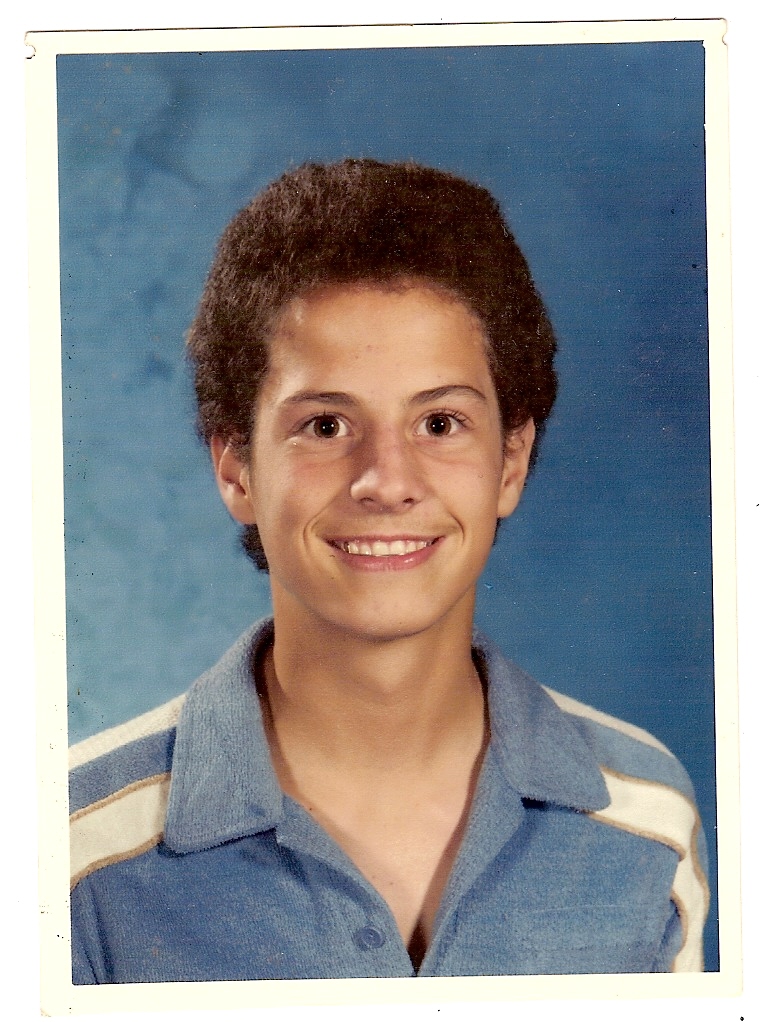
I was at a loss for how to care for my new hair, and in fact was doing more damage than if I’d just accepted it and let it be. This being the late 70’s, what I wanted was hair like David Cassidy–long, rich, flowing hair. I tried to grow mine longer, but it went cockeyed, poofed, and frizzed. I looked more like Gabe Kaplan, and I wasn’t amused.

Hair is a strange thing, if you think about it. Every other mammal on the planet is either completely covered in hair or is completely naked. People, on the other hand, have this strange patch on the tops of our heads. It doesn’t seem to serve any functional purpose, so we create meaning for it. Native American men grow their hair long as a symbol of their strength and cultural identity. Sikh men grow long hair as a symbol of piety. Buddhist monks shave theirs off, also to show piety.

Me at 15 years old, with frizz in full swing.

Me at 15 years old, with frizz in full swing.

It’s hard for an individual to be accepting of what one’s been given when culturally we don’t seem to know what to do with our hair.

To this day, I normally don’t think of my hair as an asset.  So to have a complete stranger tell me my hair is gorgeous came as a bit of a shock.

“Really?” I said.

“It’s like Richard Gere hair,” she said, smiling.

Wow. Who knew?

All of Life is a Performance

All of life is a performance.

When you get up in the morning, you enter the stage and you don’t exit the stage until you go to bed at night. All day long, you are in front of the audience, both your admirers and critics. And just to keep things interesting, it is always improvisation. There is no director, no stage manager, no script. We each must seek our motivations and speak in character.mic3

As with all performance, you will have some “on” days and you will have some days when you are really off, days when you’ll want to hide backstage and not re-emerge until the next show. You will sustain injury and heartbreak. You will experience an entire change of cast. But the show must go on.

If you act out of character, or refuse to appear, you may be boo’d or deserted by your fans. Critics will wonder aloud what happened to your mojo.

When the performance is over, when the show finally closes, your obituary is your review. The friends and the critics will finally weigh in on what they thought of you. Sadly, you will not get to read these reviews. In fact, while the performance is running, you may never know for sure what anybody thinks. But you must perform anyway.

Because all of life is a performance.

[With a tip of the hat to Erving Goffman. I’ve not read The Presentation of Self in Everyday Life, and can only say that this piece was born of my own experience. But I did read Asylums in college and was deeply impressed.]