Not As Hoped

August 3, 2021 — my birthday — my wife and I were enjoying our first overnight trip since the Covid-19 pandemic began in early 2020. We didn’t know then that it would be the last we’d have together living with the independence we take so much for granted.

We decided to keep it simple, making a road trip from our Maryland home to Pennsylvania and spending time at various points of interest in the southeastern part of the state.

We had a lovely lunch in Havre de Grace, Maryland, in the outdoor seating of a restaurant overlooking the Susquehanna River.

My wife at Tyler Arboretum

We stayed in a hotel in Chadd’s Ford. From there we visited the Tyler Arboretum and the town of Media, where we did some shopping and bought bubble tea.

We had a great dinner for my birthday, outdoors at a nearby restaurant. The summer Olympic Games were occurring in Tokyo, postponed from the year before, and we watched a few events on the television that night.

Our children were off living their lives, moving ahead after the long wait caused by Covid-19. Both called that day.

That summer our oldest had moved out to begin graduate school at Pennsylvania State University. He called to discuss how he and his girlfriend were settling in at their new apartment.

Our youngest was working at a summer camp as a counselor. He called to share how things were going, along with some frustrations regarding the camp staff and how situations were being handled.

Despite the fact that our kids were elsewhere — or maybe because of it — my wife and I felt that we’d mostly left behind us the concerns and restrictions from the past year and a half. It was an enjoyable bit of freedom.

And of hope. We began to see the light at the end of the dark tunnel created by the Covid-19 pandemic. We were feeling that we’d survived, that life would go on, that we could enjoy some of the dividends of having made it this far — through parenting, through a global contagion, through the more difficult years of our lives.

But all that would be halted just five months later. When my wife experienced a ruptured aneurysm in January of 2022, life would not be as we’d hoped.

We’ve spent the last four years adjusting to what is too easily called the “new normal.” Thoughts of a quick recovery have proven to be unrealistic. My wife lost her job and the ability to do many of the things she enjoyed. She applied for (and ultimately received approval for) federal disability payments.

Instead of living out our later years with travel and some well-earned ease, we are now in the positions of being caregiver taking care of one who’s lost their independence.

Perhaps the timing of it all is what’s most frustrating. We put in the work, we endured the hardships, but now are unable to reap many of the benefits.

It doesn’t feel fair. But I also realize that fairness is not a guarantee for anyone.

What’s left is a constant feeling of discontent, softened now and again by some of life’s simpler pleasures. But I can’t help the urge to look once in a while at what’s not available, and think about whether it might ever be available again.
The Trouble With Being American

I have no cultural identity other than “American.” I do not consider myself to be Irish-American or African-American or Hispanic-American or any other cultural identity that I can fall back on. So you can understand my displeasure at the current state of America.

The United States is my country. I was born here and have lived here all of my life. Going back to the early 1700’s, my ancestors have been born here, lived here, and are buried here.

This is the only criteria for American citizenship–be born on American soil (see the U.S. Constitution, 14th Amendment). There are no other criteria, tests, or qualifications.
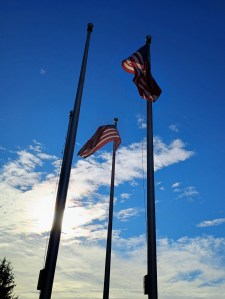
Some people try to make the claim that “real” Americans are those who typically exhibit outward displays of patriotism, have a simplistic view of our nation’s origins, and hold narrow views of what an American should look like. But there is nothing to support that claim. It is just personal opinion (that can be safely ignored).

Singing the National Anthem more loudly does not make you more American. Waving the flag more vigorously does not make you more American. Having more ancestors here does not make you more American. Serving in the military does not make you more American. Being Christian does not make you more American. These things simply don’t.

Unfortunately, these same people also claim to know what America really is (as opposed to what?) and refuse to acknowledge that there is, or even might be, a more expansive, messy, diverse, and complicated understanding of our country.

And the sad thing for me is, that version of the “real” America–the one currently being heavily promoted by Donald Trump and his MAGA co-conspirators–is not my America. It is not the America that I see, or ever want to see in my lifetime. Instead, it is some strange conflagration of illusions, misinformation, wishful thinking, and self-righteousness with large doses of self-delusion, racism, and xenophobia mixed in. (MAGA Americans like to say that those critical of their political positions must hate America. In my view, the America in the “Make America Great Again” is a fictional, made-up place that they somehow think we can return to, making such criticism absurd.)

So where does that leave me?

I am an American in an America that I don’t recognize. When the stars and stripes is displayed, how am I supposed to feel? How can I say I’m proud to be an American when the America that is currently on display is a cruel, mentally unstable place that goes against my integrity and inner sense of what an American is supposed to be?

Sadly, I feel that the America I grew up in, that I learned about in school and on the street, and that I believed in, is rapidly disappearing. Once it is gone, and replaced with something unrecognizable, what then?

Public Transportation, for the People

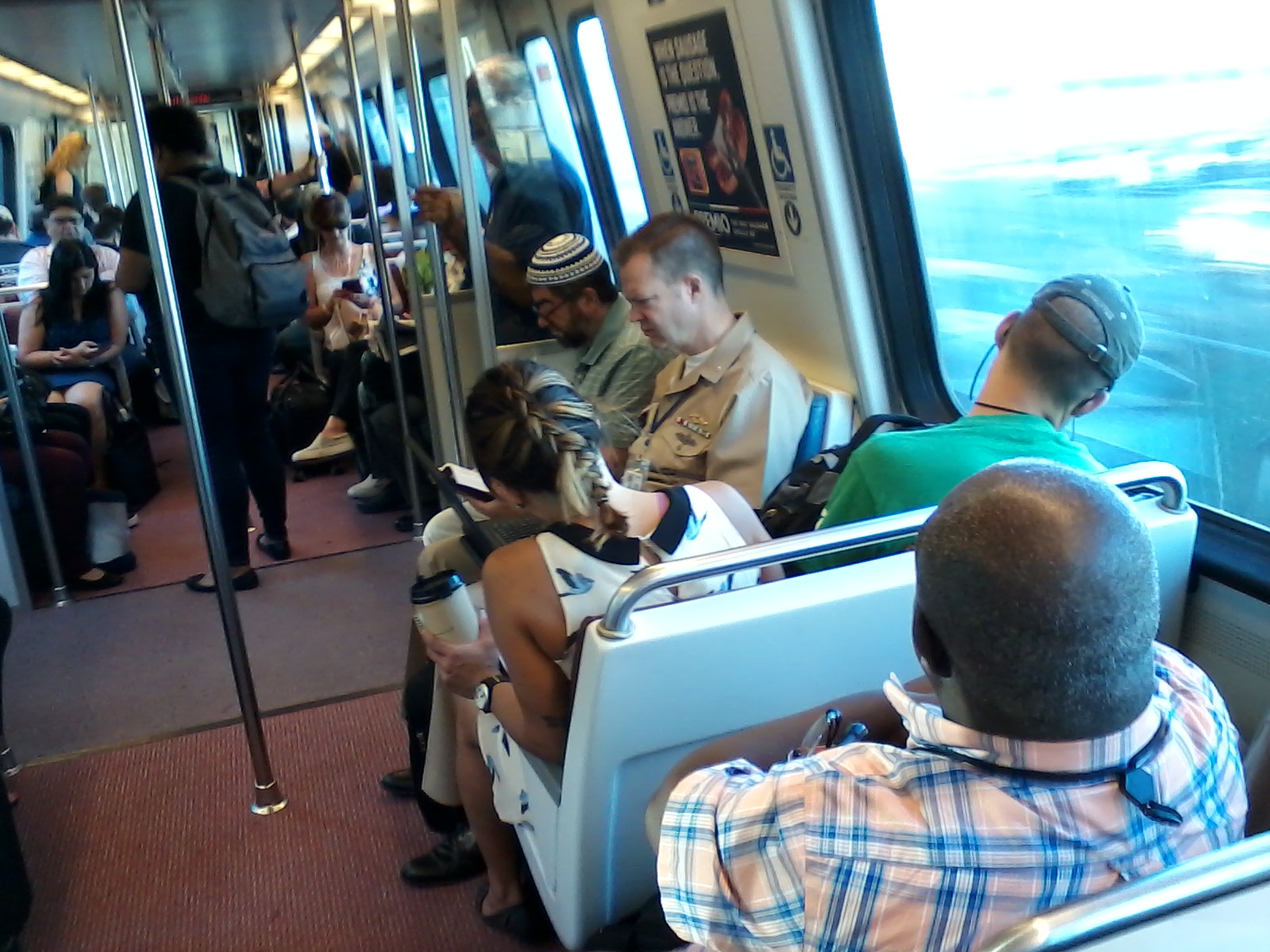
My seat on the Metro train has an empty Bacardi bottle and a lime wedge.

The guy in the seat behind me is dancing along with the music in his headphones like nobody is watching.

The woman in the seat in front of me is talking on her phone. The contact on her phone says My Boo.

Sometimes, the person sitting across from me is reading a book in Chinese, and the person sitting next to me is reading a book in Russian.

Sometimes, street dancers will board the train and perform to loud music as the train moves between two stations, asking for money before they exit to try again on the next train. This is technically not legal but it sure is entertaining.

Life on public transportation is rarely dull.

On the Washington, D.C. Metro, one will see a whole palette of humanity, from drunkards to lawyers to tourists and families. There is Black and White, Asian and Latinx. There is young and old, healthy and infirm, and plenty of Queer people. Sometimes it’s so crowded you can barely move. Other times I’m one of only a few people.

It’s always good to be aware of one’s surroundings, but it’s equally good to notice who’s on board with you. Sometimes I’m surprised when my first impression of someone is proven to be wrong, when they turn out to be kinder or more gentle than they appear.

Sometimes tensions do flare and voices are raised. It’s not always a simple matter to squeeze so much variety into an enclosed train car or bus. But I have yet to see, after decades on the trains, any true violence.

Not that there’s no violence in the Metro system because sometimes there is, late at night or in less populated stations. But it seems usually more to do with personal animosity and unrelated to the “public” part of public transportation.

Riding public transportation requires an unwritten social contract: I leave you alone to get where you need to go and you leave me alone to get where I need to go. Without it, the effectiveness of public transportation breaks down.

People sometimes violate this social contract by doing such things as begging for money, getting into arguments or shoving matches, or trying to talk to someone who does not want to be talked to, especially if it’s about politics or religion.

But they remain in the minority. Most people I ride with don’t try to turn the bus or train into a market or an exclusive place where some people are allowed to ride and others are chased away. Which is good because I imagine there is a tipping point where there would be fewer and fewer riders because they don’t feel comfortable or safe. As long as most people get onboard because the bus or train gets them where they need to go, public transportation will continue to serve its purpose.

I realize that public transportation has a reputation, and I think it is mostly undeserved. It seems to be based on media portrayals of the New York City subway system, which in movies is always a crime-ridden place filled with bums, garbage and graffiti. I have not ridden the NYC subway, but I have ridden public transportation in Boston, Philadelphia, San Francisco, London, Munich, Paris, Auckland, and of course Washington, D.C. My experience has been that, when public transportation is properly run and cared for, it is something that ordinary people find appealing and useful. It is not something that caters only to the dregs of society.

There are people who fear public transportation even under the best conditions. As a result, they travel in their own private vehicles, isolating themselves from the public as much as possible. But that solves nothing and only contributes to many problems.

In the old fairy tale of Beauty and the Beast, the Beast lives in isolation and scares everyone away because of his arrogance, hatred, and selfishness. It is only when he allows himself to be in the presence of others that the curse is lifted.

Memo to Joe Breda

“Matthew – I hope you are well. I’m writing for two reasons:”

So began an email from the head of my division at work, my boss’s boss’s boss’s boss. A guy named Joe Breda.*

He continues: “First, while I know you have made a partial leave request with HR I do not have any information about the circumstances of your leave. It is not necessary for me to know any of the details, but if there is anything I can do to assist please let me know.

“Second, I want to make sure you are aware how the company’s RTO (return to office) policy applies to your situation. Obviously, you are not expected to be in the office on days you have been granted leave. However, you should be in the office – up to three days per week – for days that you are not taking leave. If this presents a hardship, I’m advised that you to consider applying for full leave. Please let me know if you have any questions.
JB”

This email arrived on the eve of my wife being discharged after three and a half months in the hospital.

Me at Johns Hopkins Hospital in February 2022.

In January of 2022, my wife suffered a ruptured cranial aneurysm. After emergency surgery to save her life, she remained in the Johns Hopkins Hospital in Baltimore — first in intensive care, then several weeks as a regular inpatient — until late April. She needed months of physical therapy to recover, and she is still disabled today.

This was an incredibly difficult time for me and my family. We all faced hardship, stress, and worry over this entire period of time.

So to receive this heartless, tone deaf email from upper management did nothing to ease the strain.

In fact it made it worse.

Worse because I applied for and received authorization for 12 weeks of protected leave under FMLA. Joe Breda not only seemed to not know this. But also, his insistence that I adhere to the RTO requirements contradicted what I was previously told by HR, namely that those requirements did not apply to anyone currently exercising their FMLA rights.

Worse because the the uncertainty surrounding the day and manner of my wife’s discharge made it necessary for me to be flexible with my schedule, able to travel to the hospital or discharge facility on short notice. Being required to be physically in the office made that very difficult.

Worse because I was running out of leave. So Joe Breda’s glib, uninformed comment that I “may want to consider applying for full leave” is empty and meaningless.

This email from Joe Breda has eaten at me for close to three years. In all the time since this email, Joe never once inquired about my wife’s health or asked how I was doing.

His offer of assistance — especially since he claimed to not know what was going on — was complete self-serving bullshit.

He kicked me when I was down, using the power of his position, and never apologized or even acknowledged my situation.

So I now realize why this eats at me so much.

It was an abuse of power disguised as a “clarification of current policy.”

It was forcing me to concede when I was vulnerable, something that thugs do.

It was bullying.

Joe Breda has left the company and no longer is in a position of authority over me.

So I now want to take the time to say what I have been wanting to say for three years.

Fuck you, Joe Breda.


*Yes, this is his real name. A Google search will bring up some information about him, including the company where we both worked. But I won’t say more than that.

What Would ‘Earth Food’ Be?

In most science fiction, when a planetary culture is described from some place that is not Earth, there is usually a unified planetary cuisine.

There is “Klingon food” for example, without mention of regional variations.

But on Earth we have literally hundreds of different styles of food, each related to the location where it is from.

So if friendly aliens arrived and wanted to eat “Earth food,” what would we give them?

In my view, it would be a dish made of meat and rice, with a beer to drink.

There are cross-cultural versions of meat with rice that span the globe. There is:

  • Chinese fried rice
  • Plov from Uzbekistan
  • Indian biryani
  • Arabian kabsa
  • Spanish paella
  • Arroz con pollo in Latin America
  • Arroz caldo from the Philippines

Biryani; photo courtesy of Wikimedia

Additionally, rice is the primary staple food for more than half the world’s population, which makes it a prime candidate for being “Earth food.”

As for beer, it has been a beverage for humans for approximately 5,000 years and is produced and consumed in nearly every nation today. Plus it goes well with a lot of food, including meat with rice.

I make a point of eating “Earth food” as often as possible. In fact I had biryani just the other day.

It’s not just that I enjoy the flavor, because I really do. More than that, I feel that I’m engaging with global culture, communing with millions of other humans who find the same food as delicious as I do.

This is especially important to me at this time in history. In my view, there is far too much irrational “us” against “them.” Far too much circling of the wagons. Far too much exclusion and not enough inclusion. Not enough finding common ground over a shared meal.

And if unfriendly aliens show up, and we keep on behaving this way, we will be ripe for takeover.

Unless we are able to win them over with our delicious “Earth food”.